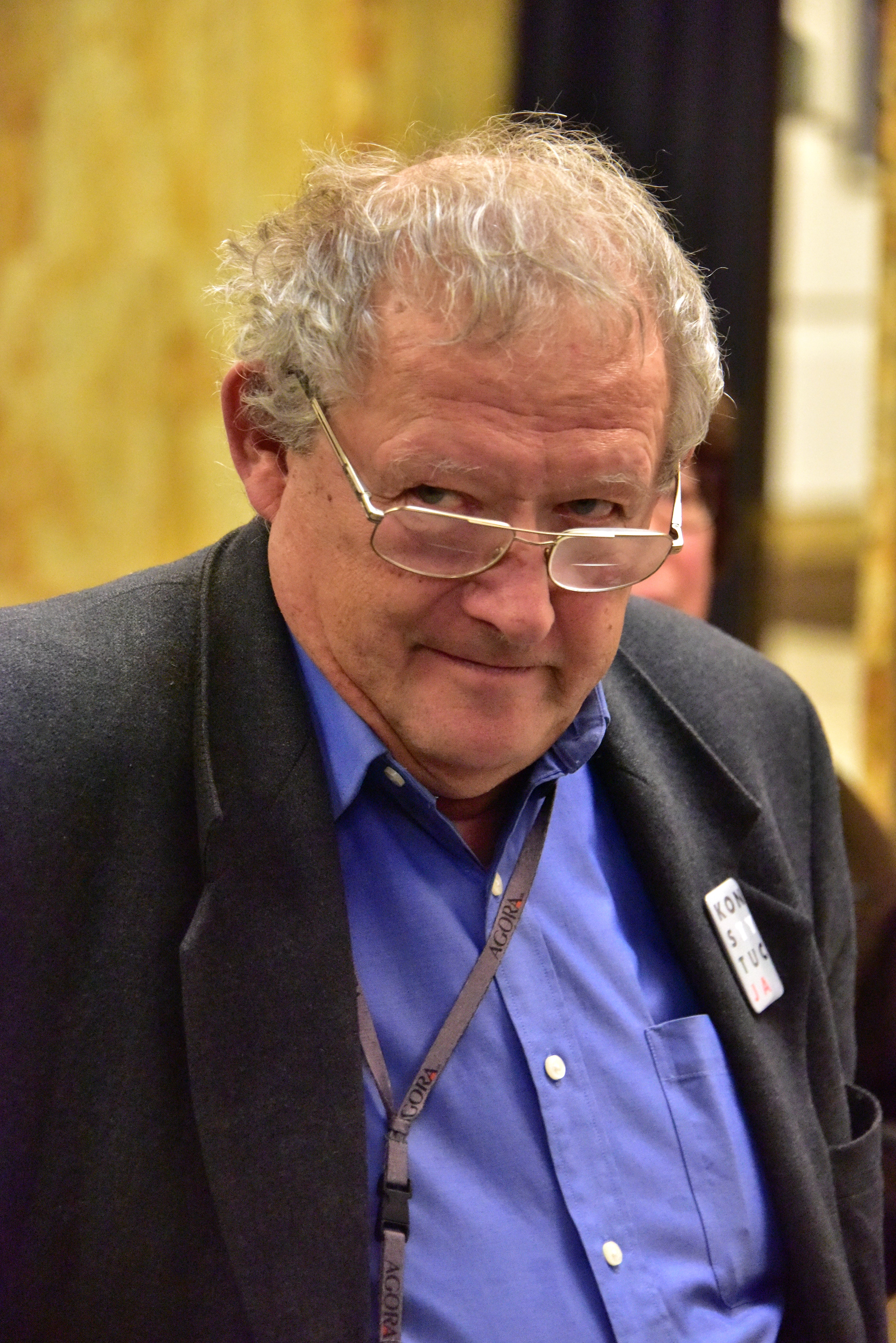
pull up a chair

where wisdom gathers, poetry unfolds and divine light is sparked…

Category: antidotes to madness

oh, the places we’ve come . . .

winter, i’ve always sensed, is the curling-in time, the season of unseen stirring, and in an octave of dawns, dusks, and nightfalls, winter will be upon us. 

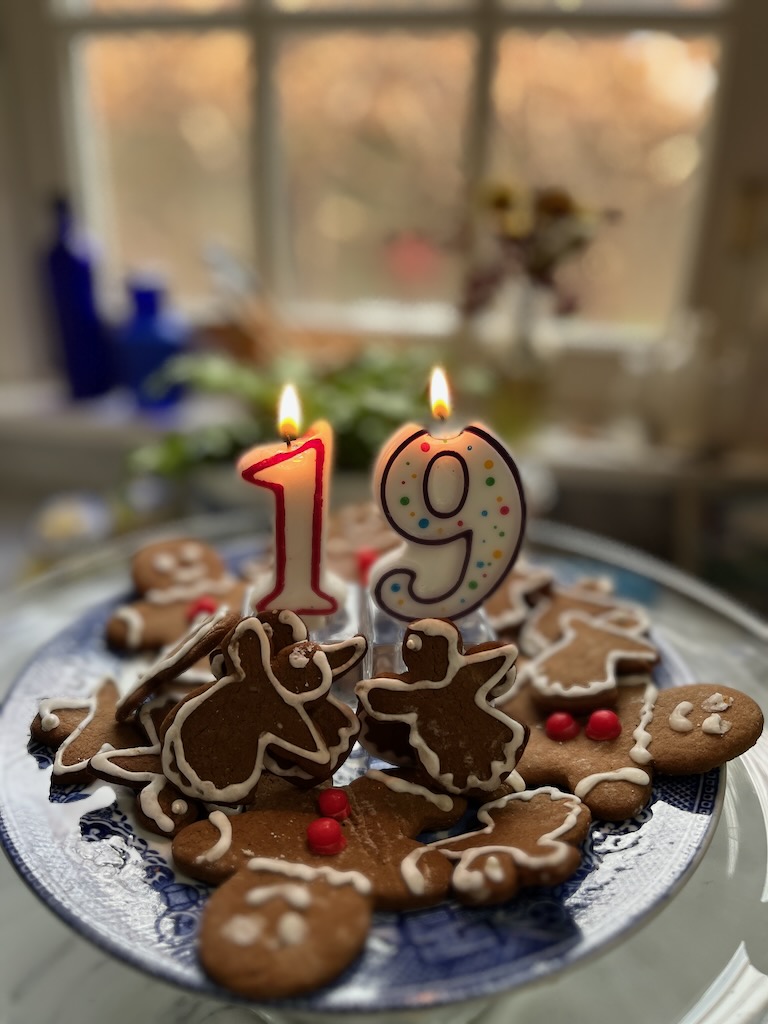
but even now, it’s a season for quieting, for simmering thoughts as well as saucepots of cinnamon stick, star anise, and clove. my simmering for the last nineteen years picks up the pace as the page turns on another year of pulling up chairs to this imaginary old maple table, one where the indentations of long-ago math homework are pressed into the grain, where so many coffees and juices have been poured and sipped and spilled and sopped up with sponges. over the course of these nearly two decades, it seems i’ve developed a knack for simmering while tapping away at the rows of alphabet keys—some 1,255 simmers and counting, all under the name “pull up a chair,” now tapped, posted, and filed away.

only a handful of the very first chairs—bless them, those stalwart humans—still pull up a chair, at least every once in a while. but along the way, so many chairs have been added, and multiplied. and our polestar has never shifted: to carve out a sacred space where questions are asked, and stories are told, where hearts are bared, and above all where gentle, gentle kindness is the metronome by which we set all our rhythms. once in a while, over all the bumps and bruises encountered along the way, we’ve been known to bow our heads and pour out our hearts in holy, holy please God, pray for us.

on the twelfth of december, 2006, our firstborn had just been bar mitzvahed, and our then so-called “little one” was but a kindergartener, not yet reading or writing but melting my heart by the minute and filling our notebooks with his stories and antics and an encyclopedia of unforgettable “teddyisms.” (some kept alive to this day; for the sheer pure joy of it). the firstborn, now law professor, insisted at the dawn of the self-published blogging age that i, his little old mother, could figure out how to “blog,” a verb that’s always sounded to me like a crude guttural effusion, a burp perhaps. and back in the day, he gave me his hand-me-down laptop to do it. to prove i could blog, that is. (as has so often been the case, he even then was wiser than me…)

back then, the question that had captured my attention was the simplest of notions: i believed, after a few years of keenly observing, tagging along with, and writing long newspaper stories of families in the thick of life transitions as a reporter for the chicago tribune, that life’s biggest questions aren’t reserved for colloquia and global summits, nor do they wait for podiums and percussive applause. they are the stuff of the everyday. and if we watch closely, pay keen attention, we can lift those universal, deeply-human questions and struggles from the quotidian stream, hold them to the light for closer consideration, and reap their wisdoms and epiphanies in real time. now, before the moments pass us by and we come to the saddest realization of all: that it’s too late, and our chance at most wakeful living has slipped into the distance. 

all these years later, life certainly has galloped along here at the table. this ol’ chair has seen the growings up of two boys, buried parents beloved, moved another from her home of sixty years. taken a tour of cambridge, mass., and a second helping of college. trekked across the pond, set our sights on war zones, and been rolled into surgical suites and recovery rooms. we’ve feared for our country, for humanity, for civility, and plain old decency. and we’ve refused to surrender to the crude and cruel ways wielded by those who seize power. we’ve kept our minds opened, and tried—oh, we’ve tried—to emphasize the imperative of objective, double-sourced truth, and the slaying of hearsay and heresy. we’ve laid out worries here, and plenty of joys; we’ve marveled and wondered and been gobsmacked aplenty. i’ve pondered cancer and the physics of time, and the holy shimmering presence i know as God. 

lately i seem to have taken to gathering up wisdoms far greater than mine will ever be. i am, as a beloved friend of the chair once put it, something of a magpie. a magpie mostly attuned to seeking the sacred amid the plainstuff of living. the idea of the commonplace book is one i heartily embrace: bring on the poets and sages and prophets, and let me invite you into their brilliant notebooks and minds and unfurl for you their passages and poetics that take away our collective breath and find a way of percolating for hours to come. 

this ol’ chair has given me a place to keep on tapping away at the keys. i realized long ago that i untangle the knots of my life by stringing out sentences. and trying on thoughts. thank you for indulging me, those of you who choose to read along. thank you for pondering the questions at the end of each post, in the quiet of your own soul, or by leaving a note at the table. 

you are, collectively and individually, humans who restore and buck up my faith in the inherent majesty and wonder of the shimmering undying spirit that populates this earth with more than a modicum of heaven’s best offerings.

bless you, bless you, a thousand times thousand, bless you.

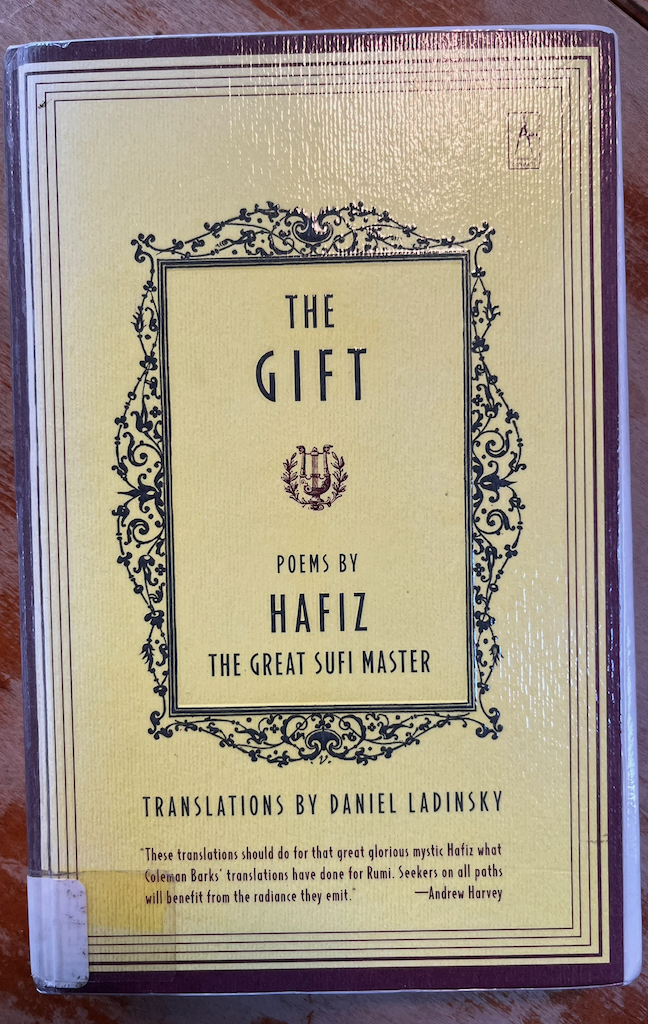
this week i am bringing a little birthday bouquet of beauties that struck me across the week, all of them tied together by the beautiful idea that the birthing of holiness is a sacramental act of which we must partake. it’s one that entails unlocking our hearts, making room in the manger within, and allowing the Holy and Sacred to form within, and to birth it with our words and our love in the act. it’s quite the trinity here: a benedictine monk who practices and teaches meditation in the french countryside at a monastery known as bonnevaux; st. john of the cross, the great mystic, as translated by the poet daniel ladinsky; and the late, great luci shaw, a beloved british-american poet and essayist who died at 96 on december first. 


first up, the idea of birthing God within us from the benedictine monk, laurence freeman, whom i’ve been learning from for years…

In the 14th century, Meister Eckhart enjoyed waking people up in his sermons by expounding some uncomfortably new perspectives about their standardised faith. He must have stirred a few dozy parishioners when he asked: “What good is it to me if this eternal birth of the divine Son takes place unceasingly, but does not take place within myself? And, that it should take place within myself, is really what matters.” 

Actually, the great Augustine had asked the same question a thousand years before and added that if we are the children of God, we must become God’s mother as well. If, he said, this birth of the eternal word as Christ in the soul is to happen, our heart – the deepest centre of our being – must become the sacred manger. If we are filled with egocentric distraction there is ‘no room at the inn’ and so the heart must become that empty and open space where the birth takes place and through which he  is welcomed into our world.

In today’s gospel, John the Baptist is usually and badly translated as saying ‘repent, for the reign of God is close at hand’. Basileia, the Greek word we think of as ‘kingdom’, is feminine and so could equally well translate it as ‘queendom’. It doesn’t mean a juridical area but the space in which the presence and grace of God is acknowledged and welcomed. The gospel word, badly translated as ‘repent’, is ‘metanoia’: a change of mind and heart. It is not about feeling sorry for past mistakes. It means spinning round 180 degrees and entirely changing your perspective on and approach to reality.

Living in the desert, wearing a garment of camel hair and eating locusts and wild honey, John seems to us a bit extremist. People who reduce waste and get back to essentials are often called crazy. But because of his spiritual sanity he drew the crowds who asked him ‘what shall we do?’ because, like us, they lived in confused, divided and dangerous times. He told them simply to live honestly and justly but that this lifestyle would prepare them for the imminent – and immanent – coming of the great transformer of all things. 

Meditation is the great simplifier. It reduces the way we waste both time and life’s opportunities. In daily life it is the catalyst for ongoing metanoia. The medicine that loosens the grip of illusion. Usually, we start enthusiastically but before we get to the full 180 degrees we slow down and say, ‘this is quite good, let’s stop here’. Fortunately, if the birth process has already started, it will not allow us to arrest or deny it. We have to see it through until it breaks through into our world and we are happy and lucky if we do.

—Laurence Freeman


and from the sixteenth-century mystic St. John of the Cross there comes this interpretation/translation of what daniel ladinsky calls one of his “love poems”…

IF YOU WANT

If
you want
the Virgin will come walking down the road
pregnant with the holy,
and say,
“I need shelter for the night, please take me inside your heart,
my time is so close.”

Then, under the roof of your soul, you will witness the sublime
intimacy, the divine, the Christ
taking birth
forever,

as she grasps your hand for help, for each of us
is the midwife of God, each of us.

Yet there, under the dome of your being does creation
come into existence eternally, through your womb, dear pilgrim–
the sacred womb in your soul,

as God grasps our arms for help; for each of us is
His beloved servant
never far.

If you want, the Virgin will come walking
down the street pregnant
with Light and sing …

—St. John of the Cross, “If You Want” in Daniel Ladinsky, Love Poems from God: Twelve Sacred Voices from the East and West (New York: Penguin Group, 2002), 306-307.


and, in closing, here’s a classic from blessed, blessed luci, whose great contribution to the canon of Christian poetry would be her capacity for drawing big truths about God and human experience from viscerally pulsing fine-grained images and objects. she is the perfect voice to close out this nineteenth year of the chair….

Kenosis
By Luci Shaw

In sleep his infant mouth works in and out.
He is so new, his silk skin has not yet
been roughed by plane and wooden beam
nor, so far, has he had to deal with human doubt.
He is in a dream of nipple found,
of blue-white milk, of curving skin
and, pulsing in his ear, the inner throb
of a warm heart’s repeated sound.
His only memories float from fluid space.
So new he has not pounded nails, hung a door,
broken bread, felt rebuff, bent to the lash,
wept for the sad heart of the human race.

amen.

may this blessed week bring softening to the walls of your heart, and a widening within those chambers so that Holiness, however you name it, might be birthed there….love, b.

the not-so-simple tasks of being alive

life, sometimes, makes like it’s an arcade of carnival challenges, and to make it to the other side is, in fact, something of a triumph we barely take time to note.

we shouldn’t, though, take it for granted. we are mightier than we think. and there will come times when we truly need to believe how mighty we can be. we’re not here on this earth to dawdle around.

as this week draws to a close, i can testify that these things happened: a new used car was found, bought, driven home, and will soon be ferried to another state; a kid wrestled through the decision of which of three job offers he’d choose, and started the one; husband down for the count with a cough that sounds like it’s hollowing his lungs; cavity filled in the way back of my mouth; latest peek at my lungs behind me (now awaiting results, a fraught interval that always leads to some trembles); and the latest round of edits on Book No. 6 at last sent off to editor (i had to wait till her calendar cleared).

not included in the list, but very much there, are the facts that i spent the week dodging the heck out of whatever virus was mucking up the works, for fear my scan or my cavity filling would get bumped; also, never mind the “check tire pressure” light that went on halfway home from the car lot, and the hurdles to get that untangled. in addition, i arose each dawn, never crashed my own car, swam a few miles, cooked a few mediocre dinners and one or two fair ones, and grocery shopped what seems like ninety-five times.

such is the business of living. each week throws at us a spaghetti bowl of hurdles, some humdrum, some of dimension that leads us to gulping.

it’s the quotidian stuff that comprises our day to day. and to make it through and to the other side is a feat that draws on cords and gears we barely acknowledge. to miss the chance to take note, to not ponder just how resilient we are, just how swiftly we can untangle ourselves from houdini’s chains is to short shrift our capacities.

we live our lives amid stories of what seem insurmountable feats: folks rolling into surgeries that untangle their insides, or shave off a lump on their spine; house fires that leave lives in ashes and soggy remains; kids finding out their cancer is double-D badd. (and those are stories plucked only from the last 48 hours, each one devastating and true.)

the news of the bad guys around us might distract and infuriate and leave us in tears. but the hard work of being human is never far from home. it’s the pit in our belly we awake with, and the headache that drums us to sleep. it’s what we might face before breakfast, and what comes with an unsuspecting wallop midway through the day. it comes in the phone call we never expected, and the one that makes us fall to our knees.

i’m not trying out for a part as the voice of doom here. i’m simply saying what we too often forget: no matter the circumstances, nor the twists in the story, we are all made of strong stuff—stronger than we remember to note.

to get to the other side of the traumas and troubles that hurtle our way is worthy of note, if not ovation. it might do us well to take count of the muscle it takes, and the grit, and the intense imagination, to merely get to the other side.

and here we are, on the far side of all those things that a week ago seemed insoluble.

that alone might stand as proof that even the frailest among us are tough as tough can be. and we can take on just about anything. we are breathed into life with every capacity our lives will demand. and we are living proof of how much we can survive.

you needn’t share this with anyone other than yourself, but perhaps you might find strength in looking back across the arc of your life and seeing what a marvel you are, and all the impossible hills you have climbed. what marvels you the most?


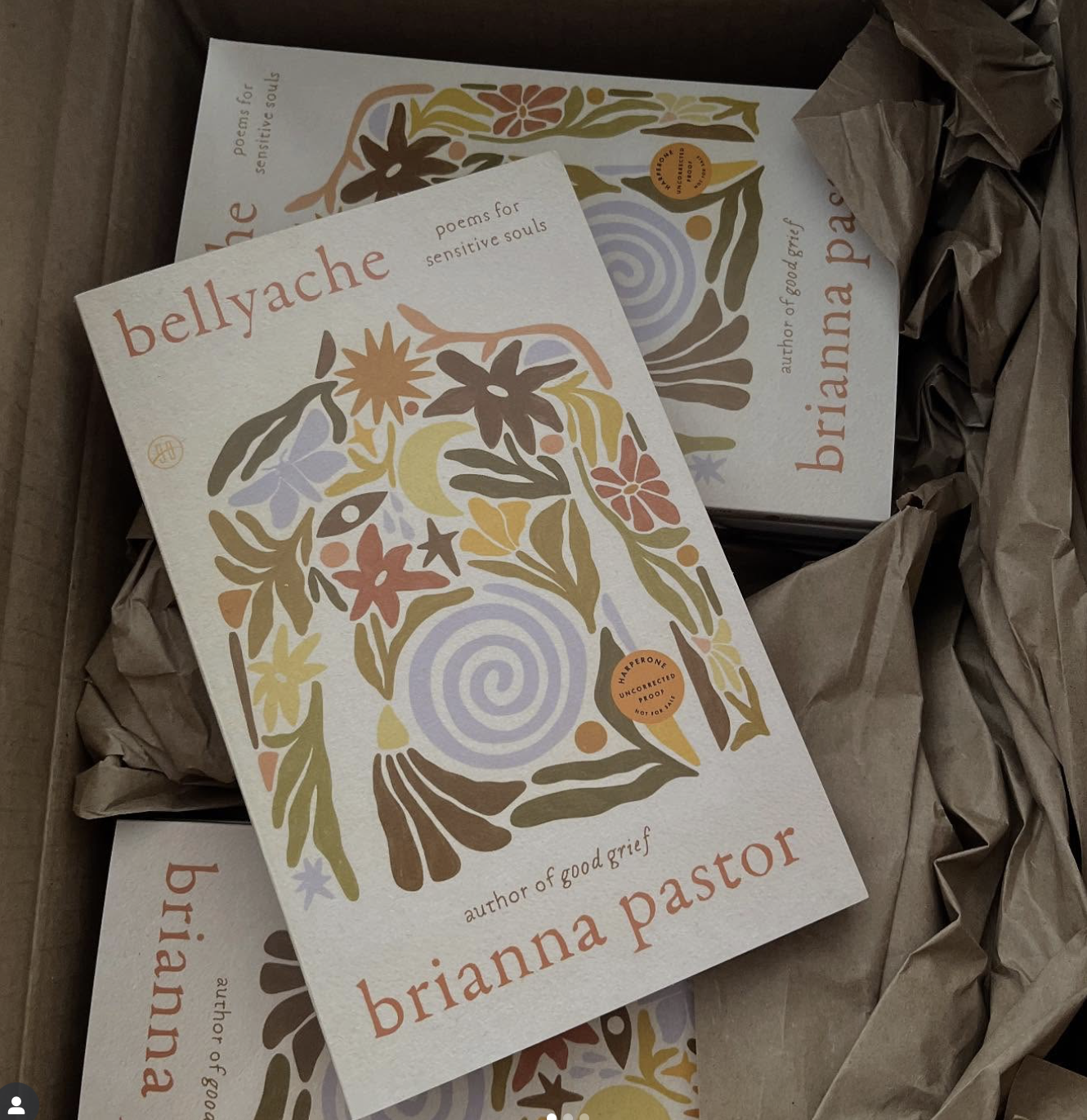
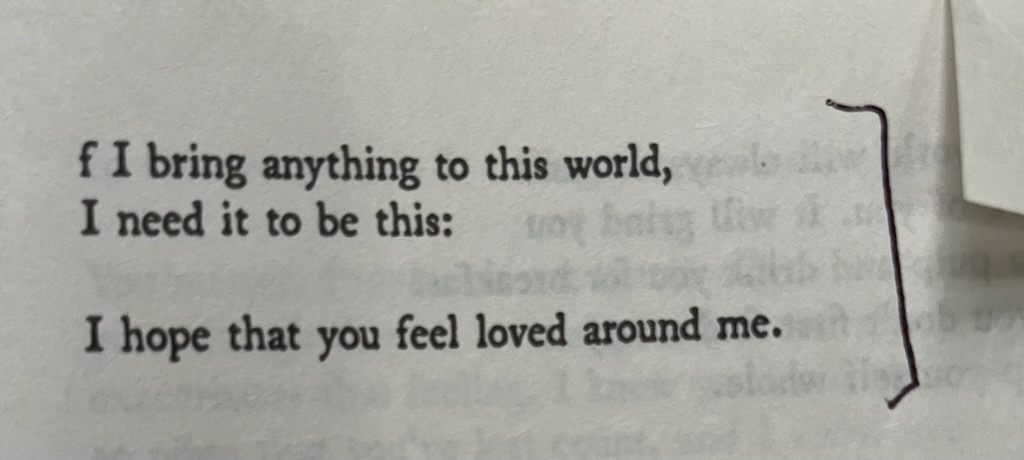
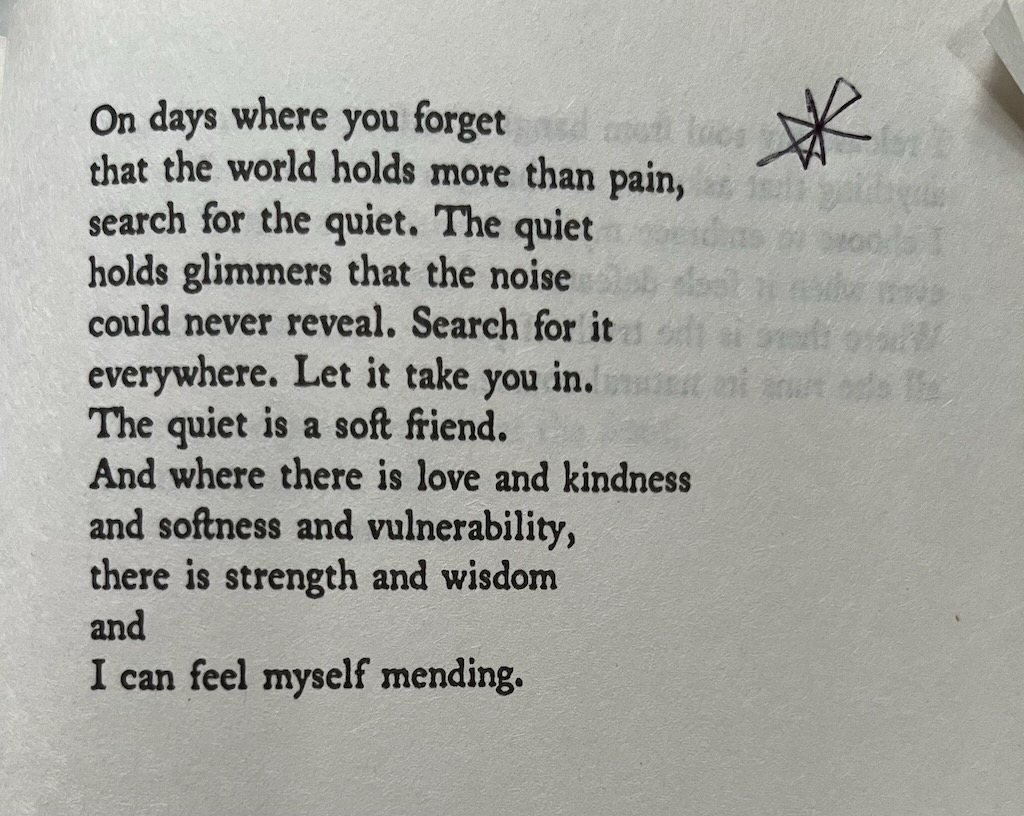
as antidote to all that, i bring you a bit of wonder in the form of the latest book that crossed my transom. it’s titled bellyache: poems for sensitive souls (harper one, 2026), and they had me at the subtitle. it’s by brianna pastor, a poet described in her bio as “a queer writer, empath, advocate, and author of the poetry collection good grief.” the book isn’t due out till february, but i got a review copy, and i’ll share a few marvels here. pastor’s poetry is rooted in childhood trauma and what it means to heal, with sensitivity and love as the non-negotiable parts of the deal. she writes, according to the author note, “about the raw, the uncomfortable, the overlooked, and makes clear that at the root of all things, is love.” it’s not every day that you open a book and find yourself in the midst of a poet whose heart feels so immensely attuned to the pain and the preciousness of tender, tender feeling.

here’s one of my favorites….

and here are two others (the spare simplicity is everything in these love-drenched poems):

and this:

Excerpted from pages10-12 Bellyache by Brianna Pastor, reprinted with permission from HarperOne, an imprint of HarperCollins Publishers. Copyright 2026.

the ol’ ticker still ticks. and then some.

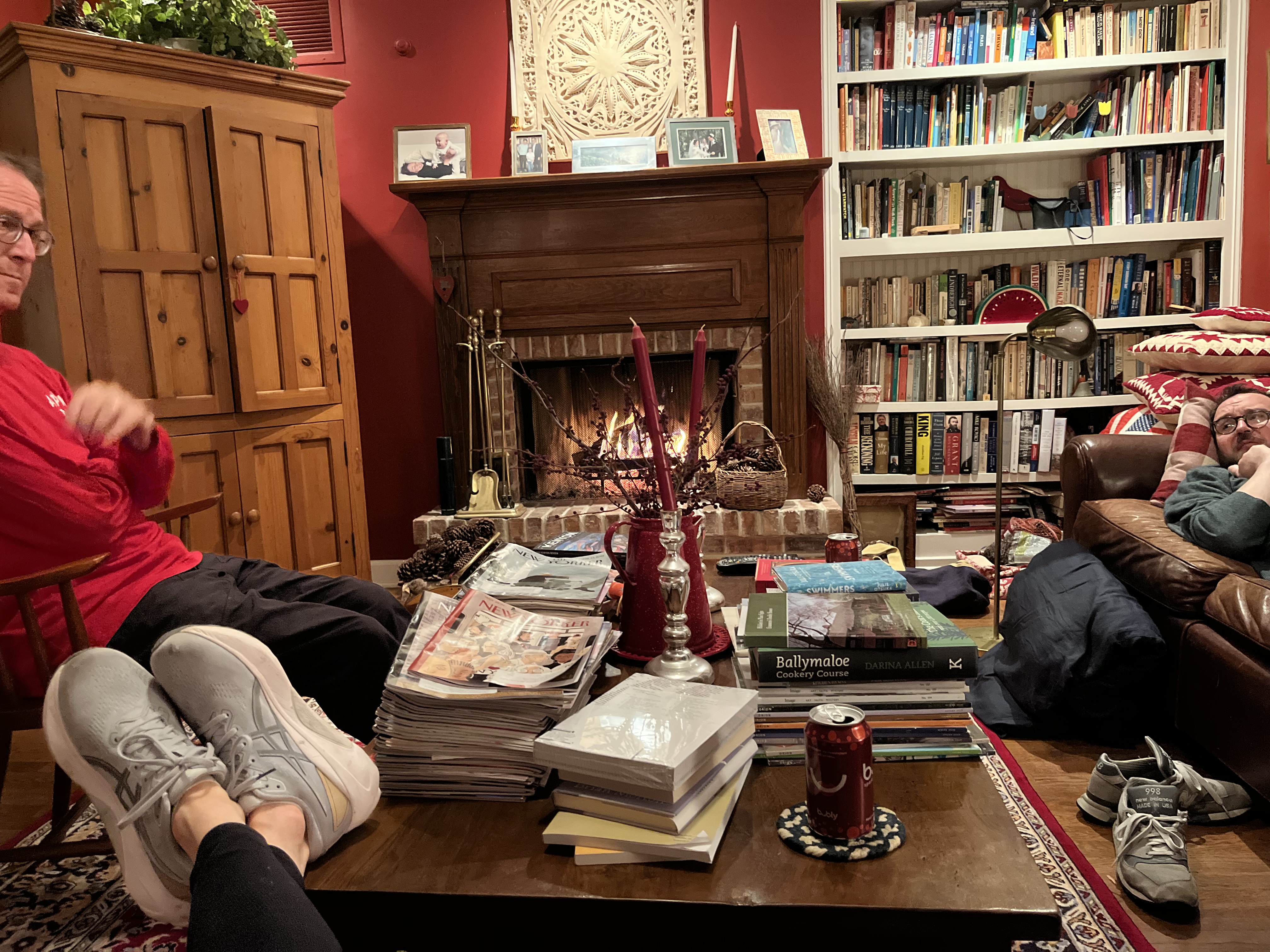
a rare peek inside this ol’ house, where three of us nestled by the fire, catching a moment that no one saw coming…

because of the way my heart leapt midafternoon yesterday as i bumbled into the house, hands all muddy from tossing out the ferns that had frozen in the snow snap, i can claim with absolute certainty that i’m nowhere near dead yet. 

what might i mean by such a rash—you might say “obvious”—pronouncement? 

well, quite simply, my oft-tired ol’ ticker fired off a triple flip the likes of which simone biles would be proud soon as i glanced down at my phone, that indispensable appendage i always forget to keep indispensably by my side, and noticed a smattering of words that seemed to be spelling out something about “the trip to Chicago” followed by “keep the drive daylight” followed by “i will just hit the road,“ all walloped with “on the off chance that you guys aren’t busy tonight.” 

and thus i discovered the manchild who’s been heavy on my heart all week, as i worried about the car that was stuck in the tow lot, and the miracle that he’d not been slammed into metal or glass when his car fishtailed on a slick, dark country road, i discovered there’d be three not two at our dinner table last night. and how perfect that i’d just made a triple-size batch of one of my autumnal mostly vegetable stews. 

never mind that he’s 32, and a law professor these days. never mind that i’ve been at this mama gig for rather a while now (well, 32 years plus the duration of mammalian gestation), it’ll never get old. it’s pretty much an indelible truth that until my last breath on this planet the number one zone in my heart will forever be the can’t-get-enough-of-my-boys zone. 

and so, in less time than it takes to spell indefatigably up to the task, i had fresh flannel sheets on the bed, a basket of farmer’s market apples on the bedside table along with a mason jar of my fresh-made granola, and if i’d had time to string up holiday lights in the room where he grew up, i’d have done that too. along with a chorus of night-crooning angels.

why the back-flipping joy? 

well, living as i am in a personal epoch of carpe diem, in which nearly every dawn i flutter open my eyes and unfurl a big fat gratitude prayer for making it to the sheer marvel of watching sunlight stream in, while simultaneously existing in this moment in history when good news is as infrequent as a meadow of daisies in november, the sheer joy of surprise, especially in the category guess-who’s-coming-to-dinner, is of the highest order. 

and sometimes it’s just plain rejuvenating to remember your heart still knows the steps to the happy dance, and can leap into it on a moment’s notice. 

my zeal for making each moment count is not a dynamic that’s waning. it only gets more and more intense as the chapters of living press in from all sides. 

i seem to have been catapulted full time into that real-life equivalent of frank lloyd wright’s architectural jujitsu compress-and-release, in which the master architect squeezed in the walls of an anteroom so that once you stepped into the chamber beyond you felt the whoosh of expansiveness as the walls and the ceiling let soar. so too with life and its tough spots. in time, they finally relent and release. and you breathe deeper than you remember breathing in days. 

our lives are undulations of breath, on both a grand and an intimate scale. the pattern set soon as the umbilical cord is cut—the lungs, the diaphragm, the ribs rise and fall, empty and fill accordingly. and so it is with our lives on a larger scale, as life seems to toss us into the vise, only to at last let us out. let us breathe. 

i am breathing today. i am breathing as my house fills with people i love to celebrate the birthday of a woman we love, the matriarch of us all. my mama, who’s shown us grace, resilience, and who these days unendingly charms. we’re not marking the date of her birth, she tells us, but we are marking our love. and we are doing it the best we know: we are gathering in joy, and in love, from corners hither and yon. 

and in this old house, when the three of us sat down to stew, we got an extra dollop of breath out of the deal. it was—and is—delicious. 


a bit of social action here at the chair, for anyone who might be so inclined. here in chicago, and even here in the leafy burbs we’ve been shattered by the roving bands of federal agents decked out in the camo gear, faces covered in masks, as they’ve rough-armed and thrown to the ground dozens and dozens and dozens of those whose skin might be brown. contrary to federal messaging, these are good folk earning meager livings the hard way: cutting grass, raking leaves, tending to kids in strollers or buggies, pounding shingles to roofs. and for the sin of trying to live unnoticed lives in a country meant to be safe harbor from thugs and militias, they’ve been plucked from the streets, or their cars, or their classrooms, and sent to a hellhole, leaving behind families to fend for themselves. a little band of us here where i live have armed ourselves with whistles and courage, to stand up to the thugs. and to help in any meager way we can. one among our little band offered this possibility to help stock the grocery shelves at a free market in chicago’s mostly hispanic little village neighborhood, where the fear is rampant and the streets have been swept of their usual buzz. it felt mighty good to send off a grocery cart of simple sustenance. and, indeed, i felt the breath fill my lungs.

here’s what my neighbor wrote….

For those that are looking for an option to offer concrete support to Little Village families impacted by ICE…one of my [neighbor’s] dearest friends (Keri Krupp) is a school social worker at Little Village’s Zapata Academy, which serves 500 kids from pre-k to 8th grade and is in need of support for their free “store” Mercado Zapatista. The Mercado is completely reliant on donations and has become a source of support for many of Zapata’s families — while typically focused on winter apparel and toiletries, it is now also distributing food to families that have been hit by both the loss of income due to ICE and the disruption to SNAP benefits. Her stories are heartbreaking. You can quickly donate through by selecting items from this Amazon wishlist or by sending an Amazon gift card to her work email (kbkrupp@cps.edu).

https://www.amazon.com/hz/wishlist/ls/291BEA7WRUHZ9?ref_=wl_share

At a time when it can be hard to know where to best focus donations, [my neighbor] can personally vouch for Keri’s commitment to the Little Village community and prudent stewardship of Mercado Zapatista, which she began in 2024. Any donations, big or small, will make an immediate difference to Little Village children and their families!  

and thank you for considering.

bless you all. what filled your lungs this week?

remedy against despair

sometimes, it’s just not so complicated. 

how to survive in the modernday melee, i mean. 

how not to get sucked into the cesspool, or the tarpit of utter despair. 

there are flocks of us, bumbling around, looking down at our weathered, timeworn selves, our selves that are wrinkled or missing some parts, wondering what in tarnation little old me can do about this. all of this chaos, all of this cruelty, all of this jaw-dropping gilding and seizing of power, all of this thuggery, what in the heck can i do?

it’s pretty much the question that runs on auto-pilot through the spheres of my brain. 

what oh what oh what?

i turn to the poets, i turn to the pacifists. this week i found myself in the pages of history. more and more i am drawn to the plain old truths of our not-yet-extinguished civilization. 

as a species we’ve been cruel from the start, that’s a streak that runs in us. we’ve had so much darkness it makes me want to run for the hills. no wonder the desert elders of the third and fourth centuries did just that, ducked out in far-flung caves and barely ever came out. they just prayed and prayed, imagined God as their next-door neighbor and turned their humble selves into living, breathing prayer altars. 

but, just as emphatically, there’ve always been those who turned the other cheek, who refused to partake in whatever the scourge of the age. who did not give up on the vision of radiance, of equal justice for all. there have always been those who heeded the words of the jew from bethlehem: blessed are the poor in spirit, the meek, the merciful, those who hunger for righteousness, blessed are the peacemakers. jesus didn’t even make it to ten. he cut off the list at eight. later on, he threw in “love as you would be loved,” which is actually a teaching he would have learned in the temple, leviticus 19:18, “love your neighbor as yourself.” (i hate to break it to christians, but we’ve no corner on that commandment, it’s as old as time, and core of nearly all world religions.)

it’s the revolutionaries, the radicals, the refuseniks who would not succumb, they’re the ones who might hold the clues: how to be a force against daily injustice when all you’ve got is your will and your hope and your deadset compass pointed at kindness, at mercy, at justice for all. 

their point, the refuseniks, ever has been thus: we cannot decide that we’re not equipped. we cannot throw in the towel. the heroes of history usually don’t come with superman capes. it’s people like us, with a limp or a lisp, figuratively or literally, who might look in the mirror and decide, “i’m all i’ve got, so i’d best get to work.” 

which brings us back to the cruelty and chaos du jour.

this week, beating back the latest bout of teeming futility and powerlessness, against the backdrop of scenes i’d not imagined emerging from the american landscape—federalized gangs knocking heads against pavement, crushing ribcages under the weight of full-body clutch holds, beaning clergy in the head with pepper balls, and most recently dragging a preschool teacher from her classroom in front of her gaggle of toddlers—i found myself once again on the prowl for what in the world little old me might do to push back against any of this, to counter the cloak of rampant despair. 

and i found it—curiously, plainspokenly—in the introduction to a book of letters from prison, specifically the gdansk prison during poland’s communist takeover by the totalitarian regime that clamped down cruelly on every facet of daily life in the last decades of the 20th century. 

adam michnik

adam michnik, an irrepressible political activist, is the writer of the letters, a lifelong dissident first arrested at 18 for partaking in the writing and dissemination of “an open letter to the party,” critical of the communist regime. he would become one of the leaders of the solidarity movement that in 1989 ended communist rule in poland, and went on to become editor-in-chief of Gazeta Wyborcza, credited with elevating the newspaper to become “a sort of conscience of the New Poland.” he rightfully lays claim to a life spent provoking debate on democracy and human rights. 

during that lifetime, punctuated by intervals of activism followed by imprisonment, again and again, michnik often found himself in jail cells where he forged his activism with pen and paper, his letters and essays smuggled out of prison, and widely distributed on the far side of the prison walls. 

what i find especially notable about his essays, as i rail against blatant mis- and dis-information in our clickbait age, is that his essays were then and still now are considered models of balance and fairness. what drove him was a singular concern for “deepening his own and others’ understanding, and therefore he [could] not afford the luxury of distortion for partisan reasons.” (emphasis mine). oh, that we should emulate his restraint, seize his clear-eyed purpose. 

while ours certainly isn’t a national moment that rises to the level of “organized evil” of poland’s totalitarian regime, it seems fair to say we’re witnessing “authoritarian adjacent” dictates and dramas, particularly in the demonization of the helpless, and the thuggery thrust viciously upon them. 

and so, turning to even darker moments in history, we find our cues.  

in the introduction of michnik’s letters from prison and other essays, the new yorker’s longtime foreign policy analyst, jonathan schell, captured michnik’s revolutionary counter-revolutionary approach. 

he leads into it by first laying out the norm in mapping revolution, and illustrating how the poles turned it on its head, ultimately triumphantly: “the classic formula for revolution is first to seize power and then to use that power to do the good things you believe in. in the polish revolution, the order was reversed. it began to do the good things immediately, and only then turned its attention to the state. in a sort of political and moral version of the hedonist’s credo, ‘carpe diem,’ the opposition proceeded directly, and without postponement toward its goals. its simple but radical guiding principle . . .”

what comes next seems to me the wisest, most doable action we might take:

“Start doing the things you think should be done, and . . . start being what you think society should become. Do you believe in freedom of speech? Then speak freely. Do you love the truth? Then tell it. Do you believe in an open society? Then act in the open. Do you believe in a decent and humane society? Then behave decently and humanely.”

do not succumb to the ways of the demonizers, the clickbaiters, the shills for distortion, deceit, and demagoguery.

put simply: love as you would be loved.

or, in the words of james baldwin: “the place in which i’ll fit will not exist until i make it.”

so, go make it.

how would you describe the world in which you pray to live?

when war games are played on your streets

ICE agents on the campus where my mama now lives

there is nothing make-believe about it. the leafy lanes and brick streets of the little village where i live have been invaded this week. not by distant armies, but by thugs of our country’s own making. men—yes, always men—dressed in combat suits, their faces covered in balaclavas, wearing boots made for stomping and crushing, roaming the streets in vans with darkened windows. traveling in patrols of two vans or three, they cruise slowly, surveilling, and when they come to a stop, when they burst out of the vans, i’m told you can smell the testosterone in the air. they are armed for conflict. they are on the hunt and ready to snatch.

they’ve cruised down our alleys, parked near our grade schools, stopped across from the library, and set chase across the manicured lawns where my mama and some 300 of her fellow nonagenarian, octogenarian, septuagenarian compatriots live out their days in what’s meant to be peaceful harmony. how many they’ve “caught” is unknown (these are not folk who disclose, whose m.o. is secrecy and surprise), but tallying anecdotal reports, the number is somewhere between five and seven, and, mind you, that’s merely the count from these quiet little streets where violent crime is nearly unheard of, and the only gangs you might see are the preteens and their too-many motorized scooters clogging the lanes.

whom might you ask is the target of all this slo-mo patrolling?

it’s the gentle brown-skinned folk who change our children’s diapers, who warm their lunches, and tuck them in for naps, who rock them in their arms, singing lullabies in spanish, and who rinse off the scrapes and the cuts on their knees, and smother them with kisses. or they’re the gentle-souled men who cut back our hydrangeas at the end of the summer, or trim our lawns to manicured perfection. or the ones tacking shingles to roofs, to keep the rains out. they might be the women who shlep into homes lugging vacuums and pails spilling with bottles of cleaning supplies. the women who scrub the toilets, and change the sheets, and fold the laundry in crisp four-corner stacks, so meticulously they rival the stacks in the boutiques at the mall.

thug is not a word i use loosely, and for a peace-making girl it hurts to write it. but i cannot think of another word to put to souls who sign up for a job of cops-and-robbers gone rogue. when i was little i watched my brothers move little green plastic soldiers around the basement floor. they made guttural sounds and knocked over the men with their green plastic rifles and hand grenades. i’d wander away with one of my dolls clutched under my arms. when it wasn’t “war” on the basement floor, they took to the yards and the street where we lived. they’d hide in bushes, leap out, and “capture.” the same guttural sounds, only this time with humans as soldiers. the boys on the stingray bicycles versus the boys on the run.

we are a nation obsessed with our war games. from what i read, basements and rec rooms these days are filled with big loud screens and folks with their headsets and clickers, controllers and keyboards, killing and maiming with automatic rat-a-tat-tats and bombs exploding in cauliflower clouds. i imagine the guttural sounds now come from the screens, in digitized amplitudes. obliteration, i’m told, is the aim.

and we are now a nation that’s bringing its war games to our own backyards. especially if you happen to live in a city deemed blue, with a president who’s never been keen on the city that didn’t embrace his big shiny skyscraper with his name in football-field-sized letters slapped on the side.

i know full well that this is albino-pale compared to gaza or kyiv, but a “federalized military presence” complete with long guns and tear gas is not why we pledge allegiance to the flag. it’s a war of terror. parents afraid to take children with fevers to the ER, children watching their parents handcuffed and hauled away at school drop-off or pick-up. taquerias that now lock their doors. street vendors who’ve locked up their pushcarts and turned off the lights in their kitchens. a people on lockdown is inhumane, unconscionable, and unsustainable.

all because their skin is brown? these are not the criminals, rapists, drug dealers, human traffickers once upon a time purported to be the sole target of this racist campaign. there’s no reading of rights, no miranda anywhere in the vicinity. if you’re brown, and you’re out on the streets, you’re a target. and being a target often means being thrown to the ground, hands tied behind your back. doesn’t matter if toddlers are watching in horror, screaming for their mama, or their nanny. doesn’t matter if you have a u.s. passport back home in the top drawer of your bureau.

but that’s not even the worst of it. the worst is that the folks they snatch are then “disappeared,” a word that means precisely what it says. where you land is a wild-eyed guess, and the people who love you will need to pony up cash to track where you are, and to get you the heck out of the hellscape of a jail, where toilets are few and lights buzz 24/7. too bad if you need pills for your heart, or inhalers so you can breathe.

but here’s a faint glimmer of light: the ones of us whose skin happens not to be brown, we are not having it. and we are leaping out of our complacencies, and in the company of others finding something akin to solidarity, to resilience, to compassion that compounds through the magnification of the many.

chicago, hog butcher to the world, is a fighting-back town. you don’t send your thugs to our streets and expect that we’re going to hide behind the couches. we are whistling our lungs out at the first sighting of a slow-rolling, dark-windowed van. towns that aren’t usually in the news pushing back against men in camo suits, towns with names like naperville, mt. prospect, wilmette, they’re in the resistance.

1939 berlin isn’t too distant for too many of us. i sat next to a woman at an organizing meeting the other day whose hands were quaking as she said she can’t stop thinking of her grandfather and wondering at what point he realized he needed to send his wife and children out of the country, to that faraway place named america, where the tired, the poor, the huddled masses yearning to breathe free were welcomed, were harbored, were the name of the game.

where did that america go?

that question has been haunting me for months now. but what’s happening here on the streets of chicago is giving me hope. we are many, and we are not about to surrender to thugs. we are bursting out of our cloistered existences, and doing what we can to be our brothers’ keeper.

when crews are harbored in your garage for hours, hiding, awaiting the nightfall retreat of the thugs, when you are ferrying out water and oranges, when you’re dashing down the alley to tell the construction crew that ICE is nearby and you see the sheer paralyzing terror on the face of one of the workers, you do not forget. you see the humanity that is all of us. you feel the horror, sense the gentle kindness, get sick at the thought of these men who got out of bed expecting nothing but another day’s hard work now wondering if they’ll ever get home.

you cannot for the life of you figure out why no one in charge can stop this. but then you look over your shoulder and see that there are those around us who are not waiting for help from beyond. the people who live down your very own block, and just across the way, they are showing their muscle, their hearts, their humanity. and for the first time in a long time, you think maybe there’s hope. maybe, just maybe, the good guys can win.

and that’s a war game i’ll play. though i play by pacifist rules.


here, my beautiful friends, is something i truly hope you will read. it’s a little bit long, but i don’t think you will find it in your scrolling around the internet, and it is just what we need in this moment.

it’s a view from the front row of the horrors russia is visiting on ukraine, and the profile in courage that is ukrainians and their unwillingness to surrender to evil. this comes from the Peace Prize acceptance speech of german author Karl Schlögel, and is “a powerful summons to relinquish naivety and wishful thinking, to think hard and to act bravely.” the Peace Prize of the German Book Trade is a major literary award “for authors who have contributed to peace through their writing.” recent recipients include historian Anne Applebaum (2024) for her work on autocracy, author Salman Rushdie (2023) for his defense of free expression, and historian Karl Schlögel (2025) for his work on Eastern Europe and warnings about Russian expansionism. these are Schlögel’s words, and i found them soul-stirring to the highest order. if ukrainians can push back against evil, so too can those of us here on our leafy little streets, and our concrete corridors….

Learning from Ukraine. Lessons of Resistance.

No one is more interested in peace than the Ukrainians. They know that an aggressor with limitless determination cannot be stopped with words. They are realists who can afford no illusions. Their refusal to be victims drives them to fight back. They are prepared for anything. They fight for their children, for their families, for their state – they are prepared even to die for their country. What amounts to television footage for others is firsthand experience for them. Ukraine’s defence at the front would be nothing without the army of volunteers behind it. They have survived the winters and braved the nightly terror of drones and missiles for weeks, even months on end. The IT experts of yesterday are the drone pilots of today. The festive dress women don for the theatre or a concert betrays an attitude that holds firm even in a state of emergency – the club is where young people draw strength to continue the resistance. They are heroes in a post-heroic world, without making a fuss about it. They keep their transport system running, and with it their country remains whole. The howl of sirens is background noise for their everyday lives, not just a fire drill. They have learnt how drone strikes differ from ballistic missile attacks. They are helping us prepare for the time after this historical turning point. They are teaching us that national defence has nothing to do with militarism. Soldiers, and above all women soldiers, are respected because everyone knows that they are performing their duty and doing that for which they are prepared. The citizens of Ukraine are teaching us that what is happening is not the ›Ukraine conflict‹, but war. They are helping us understand whom we are dealing with: a regime that hates Europe and that seeks to destroy Ukraine as an independent state. They are showing us that accommodating the aggressor only increases its appetite for more, and that appeasement does not lead to peace – it paves the way to war. Because they are on the front line, they know more than we in our still-safe confines of the hinterland. Because they are at the mercy of a superior enemy, they must be faster and more intelligent than their foe. Ukrainians, who are generally suspected of nationalism, are showing us that patriotism has not become obsolete in the 21st century. They are ahead of us in terms of military technology, as they were forced to fight at a time when we could still allow ourselves to ponder questions of eternal peace. They took it on themselves to develop weapons that were withheld from them out of hesitation or fear. They are the mirror into which we peer, reminding us what Europe once stood for and why it is still worth defending. They are calling out to us: do not be afraid – not because they are not afraid, but because they have overcome their fear. Ukraine’s writers do their utmost to express what those farther away lack the words for. They have taken the Ukrainian language out into the world and performed a literary miracle. Their poets speak with deadly seriousness, while some have even paid for it with their lives. Their president is a man who expects the truth from his compatriots, no matter how bitter he knows it may be. They are well versed in the behavioural tenets of resistance and are teaching the Europeans what to expect if they continue to fail to prepare for the worst-case scenario. They have learnt from experience that when threat levels are high, decisions are made overnight, while in quieter times they are put off until the day after tomorrow, if even then. Stoic aplomb is a luxury they can only afford once the war is over. To endure, to persevere, despite unspeakable exhaustion – this is the revolution of dignity in permanence. They are the ones to whom we owe our peace, while they pay a price both incalculable and unfathomable. 
—Karl Schlögel

how will you stand up for justice, give voice to the voiceless, be home to the tired, the poor, the huddled masses yearning to breathe free?

*thank you to the dear friend who sent the photo above. best close-up i’ve seen.

brokenness abounds.

the siege of rebar and rubble seems endless. there are shards on our streets, and in our hearts.

the images stun me every time. images find their way in where words sometimes take roundabouts. of all the thousands and thousands of words that have passed before my eyes this summer past, that have sometimes settled into the nooks and crannies of my brain where i can’t shake them out, the images are otherwise: immediate, gut punch. they demand no absorbing. they are all but instant. as fast at it takes for the pupil, retina, and occipital lobe to zap into action. 13 milliseconds; a measure i can’t even measure. another name for instant.

no wonder we feel assaulted. the assault is everywhere.

this week i felt gutted. i am almost ashamed to hold up images of war against images of destruction that i cannot shake. the destruction that gutted me most this week was wrought by the sin of hubris, of addiction to power and greed. what’s rebuilt will not be a hospital for the deathly ill, the dying, the shattered. it will be for the clinking of crystal, and the lifting of forks that are gilded.

in a world of brokenness, we go dizzy sometimes thinking that all there is is evil. we don’t know how to stop it. which is why i spend my hours poring over the pages of sages and everyday saints, not the ones beatified and sanctified, the ones ushered into the hallowed halls of a hierarchy that’s laid out miles and miles of rules and red tape. the saints i search for are the ones whose names you would never ever know, the ones who populate the checkout lines at the grocery, who drive the buses and never fail to wait for the kid loping to the bus late and frantic, or the lady with the pail of cleaning supplies and the limp that won’t let her hurry.

henri nouwen

henri nouwen was a dutch-born priest, psychologist, and theologian who left the vaunted podiums of yale and harvard divinity schools to devote his life to those who might be seen as broken, broken of mind by worldly measure but not of spirit. he became pastor of l’arche daybreak, an interfaith, non-denominational, shared community where both the intellectually challenged and the not intellectually challenged live as one. it consists of eight homes, an old barn, and 13 acres in the rolling hills of ontario, about an hour north of toronto. its core belief is that beneath every brokenness there is light. radiant light.

henri nouwen is no longer; he died of a heart attack at 64 in 1996. but his books, some 39 translated into 35 languages, live on. his radiance, his wisdom, is without end.

nearly every morning, i read henri. he glides into my inbox deep in the night, awaits my morning. he sets me straight for the day. this week, one morning, he reminded this:

Everyone is a different refraction of the same love of God, the same light of the world, coming to us. We need a contemplative discipline for seeing this light. We can’t see God in the world, only God can see God in the world. That is why contemplative life is so essential for the active ministry. If I have discovered God as the center of my being, then the God in me recognizes God in the world…. The spiritual life requires a constant and vigilant deepening and enlivening of the presence of God in our hearts.

if we can look into the brokenness, beyond the brokenness, if our guiding principle is a belief that the Sacred is inextinguishable, cannot be broken, then we might, just maybe, find fortitude in setting our sights on seeing the God in our midst.

i know the nature of God is twisted and sometimes torn, depending on our stories, our pasts, those who taught us or not. i know that some refuse to utter God’s name, and some to deny God’s presence. but i use the name, the knowing, as that for which there are no words. the inexpressible, the depths that defy expression. i know God as the tender force that draws even strangers together. i know God as the hay bale into which i fall when i am afraid. i know God when i look into the eyes of pain without end, and a glimmer is caught, and love is made real, and by only the grace of God we pull each other out of the darkness, the impossible darkness. i know God as the depth and the light of me.

so when henri nouwen reminds me that if i keep God in my center, if i sense the palpable presence as often as i turn my attention that way, then i am equipped for what so often feels impossible: i can search for and find the sparks of the Divine in most any tableau i encounter. in the joyous laughter of the jamaican nurses who love my mama, who make her giggle like a schoolgirl. in the friend down the lane who is crushed and crushed again and again by the cruelties of someone she birthed, someone she will love fiercely forever—no matter the cost. in my absolute favorite grocery store checker, the one with the pink or purple hair, the multiple piercings, and more ink on her skin than it took to write Webster’s first dictionary, the one who holds my hand tight as the tears pour down her cheeks as she tells me the tale of her beloved who’s died, as she tells me how hard it is to still be alive.

these days i’ve shifted my orientation, my seeing. i’ve slipped out of the worldly paradigm, a paradigm that crushes me daily. i’ve moved into the realm of the sacred, the holy. the only way forward, as the rubble and rebar compounds, is to do as nouwen teaches: seek the sacred, be it the faintest of sparks or a bonfire. seize it, hold onto it as long as you can. even amid the rubble there will be the faintest stirring from under the dust, under the twisted steel rods. when the broad view, the overview, dares to pummel us, for all we can see is the evil, the hubris, the cruelest of cruelties, maybe the wisdom is in shifting our sights to whatever is holy and unfurls right before us: the faintest of kindness, of improbable light, of love that refuses to whimper or die.

the world beyond our reach is going to break us every time, but the world we can touch, the world we can sense with all our own God-given senses, that just might be what saves us. and the way we too can take part in the saving.

may it be so.

what broke you this week? and more urgently: what stirred you to see the Sacred?

the images above are of gaza, kyiv, washington, d.c. can you tell which is which?

we are all filled with tears. if only we notice.

i am, as i so often am, late to the game. late to the nick cave game. i’ve known of his profound capacity to pierce the armament of the contemporary human wardrobe: the shield that keeps us at a distance from our own vulnerability. i’d heard rumor that he was a writer’s writer. but i’d never really dived in. 

until now. 

when a beloved, beloved friend sent me a letter he’d written that rang so, so close to truth — to my truth, anyway — i signed right up for more, more, more. 

nick cave, in case he’s floated outside your circle of knowing, is, in a nutshell, a once-upon-a-time choir boy from australia, who went on to a wild ride through the early punk rock scene, and with his shock of black black hair and an emaciated profile, might aptly be described as a goth pioneer (note to mom: that means someone who takes on a wardrobe that’s something of a cross between a corpse and your most ghoulish uncle, and wallows in the literature and the language and the aesthetic of similar darkness, verging on the macabre). in time, he moved into the quieter, more contemplative lane of soulful song. his trademark, a baritone so deep it feels pulled from igneous rock, is fittingly in sync with the haunting, soulful lyrics he’s come to write. 

nick cave

i’d known that tragedy struck dear nick, when his then 15-year-old son, arthur, fell from a cliff near brighton, england, and seven years later another son, jethro, died at 31, a death he doesn’t talk about, abiding by the wishes of jethro’s mother. i’d read bits of his writings about grief.

It seems to me, that if we love, we grieve. That’s the deal. That’s the pact. Grief and love are forever intertwined. Grief is the terrible reminder of the depths of our love and, like love, grief is non-negotiable. There is a vastness to grief that overwhelms our minuscule selves. We are tiny, trembling clusters of atoms subsumed within grief’s awesome presence. It occupies the core of our being and extends through our fingers to the limits of the universe. Within that whirling gyre all manner of madnesses exist; ghosts and spirits and dream visitations, and everything else that we, in our anguish, will into existence. These are precious gifts that are as valid and as real as we need them to be. They are the spirit guides that lead us out of the darkness.

but never have i read any of the longer works i will now go find (faith, hope and carnage, an extended interview with the journalist seán o’hagan.) what’s intrigued me most, in poking around and gathering bits in the ways of magpie (a bird known for scavenging trinkets hither and yon), is his take on religion. it’s always the soulful entrée where i find my curiosities leading me. this paragraph alone shouts, read, read, read more to me….

Cave is an avid reader of the Bible. In his recorded lectures on music and songwriting, Cave said that any true love song is a song for God, and ascribed the mellowing of his music to a shift in focus from the Old Testament to the New. He has spoken too of what attracts him to belief in God: “One of the things that excites me about belief in God is the notion that it is unbelievable, irrational and sometimes absurd.”When asked if he had interest in religions outside of Christianity, Cave quipped that he had a passing, sceptical interest but was a “hammer-and-nails kind of guy.” Despite this, Cave has also said he is critical of organised religion. When interviewed by Jarvis Cocker of Pulp on 12 September 2010, for his BBC Radio 6 show Jarvis Cocker’s Sunday Service, Cave said that “I believe in God in spite of religion, not because of it.” 

*(emphasis, mine; in the case of “hammer-and-nails” it just struck my funny bone.)

the red hand files is the name of his blog, where he writes perhaps his most spontaneous writing (the hidden beauty of blogging [among the uglier words in the lexicon]). started years ago, it was a place for nick cave fans to send him questions, questions he’d sift through and choose to answer—or not. it seems to have morphed into a place of profound nakedness, another name for truth in unprotected, unshielded, undressed form. 

here, the letter that drew me in, or most of that letter anyway: 

As the ground shifts and slides beneath us, and the world hardens around its particular views, I become increasingly uncertain and less self-assured. I am neither on the left nor on the right, finding both sides, as they mainly present themselves, indefensible and unrecognisable. I am essentially a liberal-leaning, spiritual conservative with a small ‘c’, which, to me, isn’t a political stance, rather it is a matter of temperament. I have a devotional nature, and I see the world as broken but beautiful, believing that it is our urgent and moral duty to repair it where we can and not to cause further harm, or worse, wilfully usher in its destruction. I think we consist of more than mere atoms crashing into each other, and that we are, instead, beings of vast potential, placed on this earth for a reason – to magnify, as best we can, that which is beautiful and true.  I believe we have an obligation to assist those who are genuinely marginalised, oppressed, or sorrowful in a way that is helpful and constructive and not to exploit their suffering for our own professional advancement or personal survival. I have an acute and well-earned understanding of the nature of loss and know in my bones how easy it is for something to break, and how difficult it is to put it back together. Therefore, I am cautious with the world and try to treat all its inhabitants with care. 

I am comfortable with doubt and am constitutionally resistant to moral certainty, herd mentality and dogma. I am disturbed on a fundamental level by the self-serving, toddler politics of some of my counterparts – I do not believe that silence is violence, complicity, or a lack of courage, but rather that silence is often the preferred option when one does not know what they are talking about, or is doubtful, or conflicted – which, for me, is most of the time. I am mainly at ease with not knowing and find this a spiritually and creatively dynamic position. I believe that there are times when it is almost a sacred duty to shut the fuck up.

I’m not particularly concerned about where people stand – I’ve met some of the finest individuals from across the political spectrum. In fact, I take pride and immense pleasure in having friends with divergent views. My life is significantly more interesting and colourful with them in it. 

Perhaps this all amounts to very little, but I suppose, in the end, I value deeds over words. I see my own role as a musician, songwriter, and letter writer as actively serving the soul of the world, and I’ve come to understand that this is the position that I must adopt in order to attempt to cultivate genuine change. In fact, I am now beginning to understand where I do stand, Alistair – I stand with the world, in its goodness and beauty. In these hysterical, monochromatic, embattled times, I call to its soul, the way musicians can, to its grieving and broken nature, to its misplaced meaning, to its fragile and flickering spirit. I sing to it, praise it, encourage it, and strive to improve it – in adoration, reconciliation, and leaping faith. 

Love, Nick

but that’s not all….

maybe what we need in this age is to move beyond words. to use our eyes more than our ears. to look and look closely at the common bonds of our humanity, and herein is precisely the study we might need, to see the human visage wrought  by sorrow, or grief: on the brink of tears, fighting tears, to watch the flinching of muscle, the biting of lips, the contortion of muscle, pulled by nerves tied to whatever is the emotional core of us. to see how the human face on the brink of tears is sooooo deeply universally understood, felt, responded to. maybe in that place of wordlessness we can remember that we are all one, of one species, and that within us all is the emotion called grief, called sorrow. and we’d do well to remember that we are all always on the verge of brokenness. and, too, we might be the arms that reach out to dry the tear, to hold the quivering shoulders, to brace the wobbling spine against whatever strength we might muster. maybe we need to remember how tender we all are, somewhere, somewhere deep inside…..


only one poem this week, and it wasn’t actually written as a poem, but laid out that way here it works mightily. it’s excerpted from abolitionist Sojourner Truth’s “Ain’t I a Woman” address, in the version published in 1863. The speech was originally delivered in the 1851 Women’s Rights Convention in Akron, Ohio. we might do well to ask, in the face of so much inhumanity, if swapping out the word “human” for “woman” stirs its own seeds of compassion….i am bereft; hollowed, haunted by the stories of immigrants pulled from their churches, their cars, their homes, flung to the ground, stomped on, kicked, living in fear…..

sojourner truth (unknown birth date; died 1883)

but this, as written, is more than mighty as is…..

Ain’t I A Woman?

That man over there
says that women
need to be helped into carriages,
and lifted over ditches,
and to have the best place everywhere. 
Nobody ever helps me into carriages,
or over mud-puddles,
or gives me any best place!
And ain’t I a woman? 

Look at me! Look at my arm!
I have ploughed and planted,
and gathered into barns,
and no man could head me!
And ain’t I a woman?

I could work as much
and eat as much as a man —
when I could get it —
and bear the lash as well!
And ain’t I a woman? 

I have borne thirteen children,
and seen most all sold off to slavery,
and when I cried out
with my mother’s grief,
none but Jesus heard me!
And ain’t I a woman?
. . .
Then that little man in black there,
he says women can’t have
as much rights as men,
’cause Christ wasn’t a woman! 
Where did your Christ come from?
From God and a woman!
Man had nothing to do with Him.

If the first woman God ever made
was strong enough to turn
the world upside down all alone,
these women together
ought to be able to turn it back,
and get it right side up again!
And now they is asking to do it,
the men better let them!

+ Sojourner Truth

because you are all so wise in so many ways, what thoughts might you add to a conversation on love and grief, and the intermingling therein?

i’m off to my 50th high school reunion this weekend, a date that gives me pause, as it was one of the tenderest times in my life 50 years ago, a time that marked me through all these years. it was a steep uphill climb for a long time there. and thank holy God i lived long enough to get here. my prayer is that those who show up find compassion and grace, and that those who choose to stay home look around and see lives that have grown beyond the bounds of whatever have been the obstacles.

and i pray, oh i pray, for this world. no kings rally tomorrow….i heard a story this week about the not-far-away catholic church where ICE agents filled the parking lot during spanish-language mass, targeting the prayerful inside. so the priest becalmed those in the pews, locked the church doors, promised protection to his flock, and a brigade of rapid-response volunteers drove parishioners safely to their homes. cars had to be left behind. prayers were laced with terror. this is not the america my uncle died for, bayoneted in the night in a tent on iwo jima….

as my beloved friend fanny put it, “they come after us because we’re brown.”

**thank you, laura, for sending me nick….

on faraway sands, the poets of war spoke to me

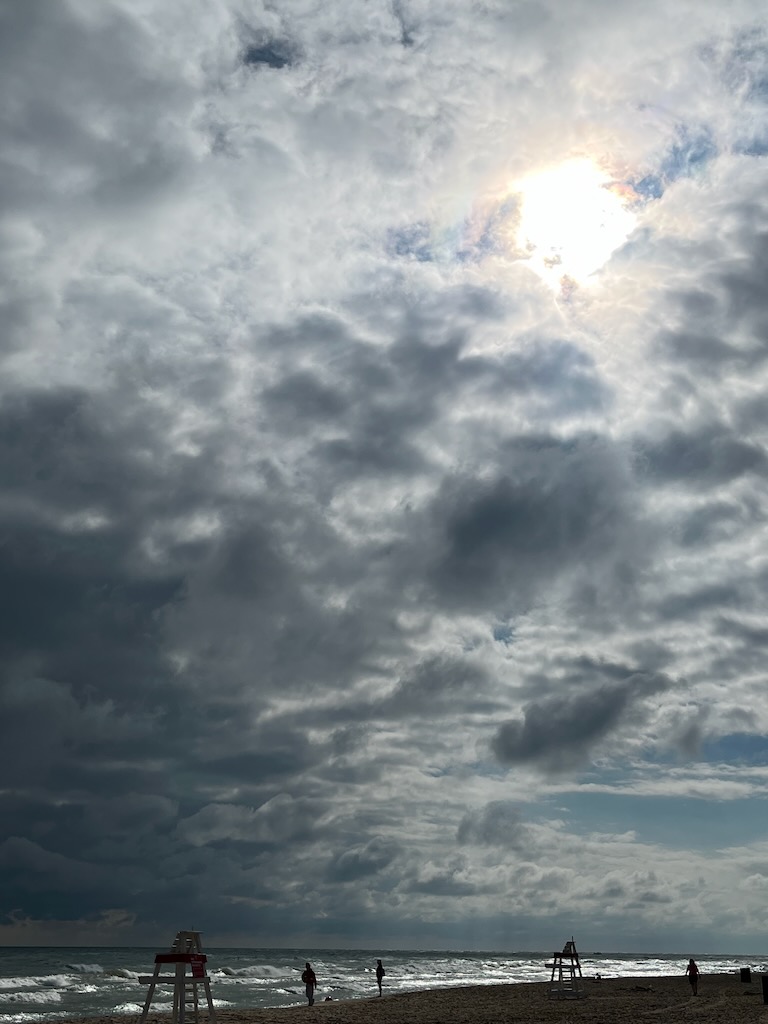
i was alone for the day, a whole sumptuous day of solitude and silence. so i, like half the rest of the world it seemed, was pulled to the water’s edge. i carried but a book and a bottle of water. i knew the week ahead would be rough, though i hadn’t a clue yet quite how rough. (two beloved souls, my exact age, died suddenly, one falling to her death*, another simply dying in his sleep.)

the book i carried is one i’d yearned to crack into, and as i sat there allowing its truths to wash over me, as the waves of the lake just across the sand washed over the shoreline again and again, i felt every drop of its anguish and truth. it was a book of poems written by thirty poets in gaza, and four from the west bank.

once upon a time, for ten good years, i gathered up each month for the chicago tribune a collection of three books that had most stirred my soul. they might be children’s books, or poetries, or memoirs and stories of the holiest people. the gatherings were vast, and some of those publishers still send me books, knowing full well my readers now are not the millions from the tribune and beyond, but rather the cherished friends of the chair.

this book i bring today is one worth clutching in your hands, pressing hard against your heart. it might be even more poignant against the improbable news that a cease fire in gaza has begun and some twenty living israeli hostages will soon be released.

its title, you must live: new poetry from palestine (copper canyon press, 2025), only begins to tell the story, only hints at the horrors and tendernesses within. but you can hear the pleas, the cries rising up from the rubble. it’s a bilingual anthology of poetries from gaza and the west bank, translated from the arabic and edited by Tayseer Abu Odeh and Sherah Bloor, with guest editor Jorie Graham, and it’s written not by poets who’ve somehow escaped, left behind the ravages of war, but rather it’s written by those still there. in poring over its pages—slowly and with prayerful intent—you hear the murmurs perhaps unheard by anyone else, you hear the lone voice rising from dust, you hear the whimper of a child left alone in the world, in the shattered brokenness of a world that no longer stands.

“especially now,” the editors write, “it is crucial to attend to those whose voices are under threat of elimination.”

ocean vuong called it “a light beam of a collection in our dark hours.” ilya kaminsky, the great poet most famous for his deaf republic, has written that it’s a book “filled with poems of utter urgency, poems that give us wisdom, in the face of devastation, in spite of devastation.”

i was as moved by the story behind the poems, as by some of the poems themselves. for starters, editing in a war zone is no feat for the timid. the editors write that at first they didn’t realize that every time someone’s phone connected to a satellite (to reply to an editing question) they became a target. to get a clear signal, the editors write, meant a life-or-death decision: standing atop rubble is where the signal is sharpest, and yet of course that means the poet is risking her or his life to reply.

consider that.

the editors write too that every time a reply did come through, be it a response about punctuation or diction, the editors sighed with relief. “they were still with us.” imagine being willing to die over a comma rather than a semicolon. consider that the next time you make a simple correction in a sentence you’re typing.

the collection begins with a poem that’s become fairly widely known, “if i must die,” by the late Refaat Alareer. the editors write: “this poem stands in for all those poets we failed to reach in time. their poems—chalked onto collapsed walls, or on the blackboards of schools-turned-shelters-turned-bombsites, traced in sand, or shared in private messages—will never reach us.”

the silence is stunning. the silence demands our reverence.

the editors call the poems a “poetry of witness,” speaking from a war zone deadly for journalists, a war zone where so many stories would otherwise go untold. the poets paint the portrait. and it is seizing with humanity. humanity crushed. humanity pummeled. human refusing to extinguish its tender, fragile beauties. we must know what we, humanity all, have wrought.

here are a few samples, barely enough to give you a sense of the pathos within, the pathos that rises from this old globe like a poisonous cloud desperate for one breath of air….

here is the poet Waleed al-Aqqad’s elegy for a young friend, set at the boy’s funeral, and tenderly describing the mutilations of his war-torn body:

We said goodbye
to you in your small death like the death
of sparrows.
We rearranged you.
We placed your severed hand across your chest,
covered your wounds with flowers,
cried as you wanted.

or this, from Ala’a al-Qatrawi’s poem to her children, two daughters and two sons, all under the age of six, all killed in an air strike on their home. she addresses her babies in heaven, offers her own body parts to her daughter, Orchida, as if she could piece her body back into her embrace:

And give my lungs to her.
Without them, maybe she suffocated.
Maybe she couldn’t call my name.
The rubble would have been too heavy for her.

it is wrenching to read. all of it. page after page, i read slowly, as if a dirge. i sat on a bench on the sand thousands and thousands of miles away. that seemed cruel, unfair, that i should be hearing the sounds of a day at a beach, when the sounds of war pressed on. and the words of new poets would again go unheard.

to those who understand the power of words, to those who dared to gather poems out from the rubble, bless you, and bless you, and may peace, everlasting peace, at last come to the holy land.

maria corina machado, recipient of the 2025 nobel peace prize

this hard week ends with a few sparks of hope: first, word of the cease fire and the imminent promised release of 20 living israeli hostages, and the bodies of 26 confirmed dead. and, in the immediate wake of that, the nobel peace prize was awarded this morning to venezuela’s “iron lady,” maria corina machado. the committees’ citation reads: “She is receiving the Nobel Peace Prize for her tireless work promoting democratic rights for the people of Venezuela and for her struggle to achieve a just and peaceful transition from dictatorship to democracy.”

where did you find hope in these hard times?

*joannie barth was a most beloved reader of the chair. she lived in evergreen, colorado. was the right-hand everything to the best-selling author philip yancey. she and i had gone to college together, but mostly got to know each other’s souls through this ol’ chair. she would send notes radiant with love, with a faith that couldn’t be shaken. she shared her own heart’s ache, an ache i now hold for her. i was with her less than a year ago, and as she always had, she lit up a room. her smile rose from a deep deep place. a week ago, she was rock climbing. and the belts gave out. she died instantly. not at all surprisingly, i feel her closer than ever. she was, and is, an angel.

joannie

hallowing the hollows

“the garden of eden with the fall of man” (ca. 1615):
Peter Paul Rubens
Jan Brueghel the Elder

i emerge here from a day of prayer, a day of poring over the sins of my soul, and the sins of us all collectively. it is a day that’s not easy to leave behind. certainly not this year.

Yom Kippur, the day of atonement, opened with the rabbi once again sharing shattering news. a horror in manchester, england, he told us, without details, had left more than one dead.

morning light streamed in.

i felt us all move in closer, a natural deeply human instinct to harbor each other. it’s those natural instincts that tend to get drowned out on ordinary days, days when it’s noisy, days when we’re so distracted we don’t pay attention to the sound of our breath, the warmth of our skin, the deeply human instinct to run toward, not away, from someone who’s hurting.

we live in a world so distant now from the original vision. from an edenic world where boughs were bent from the heaviness of their fruits, where the silence allowed for the chorus of chirring and chirping to rise from the underbrush, from the branches. in the beginning, in the genesis, after the cascade of wonders—light, darkness, seas and sky, dry land and waters, seed-bearing plants and fruits with seeds buried inside, two great lights in heaven’s vault, the demarcation of day and night, teeming waters and birds filling the air, wild beasts and slithering, down-on-the-ground ones—the one who’d imagined it all, the one we name God, God looked down and saw still a void. how would the garden be tilled? how would it be kept?

and so God made beings in God’s own image, so genesis tells us. and for a short flash of time, man and woman lived in peaceful accord. but temptation arose. and it all shattered and changed. eden was no longer. the man and the woman were banned.

and all these millennia later, we are a people plagued by temptation. temptation of power, of greed, of malice and evil, of hurtful whisper, and weapons of war.

we have fallen so far from the garden of peace and tranquility.

and so, on Yom Kippur, we atone. all world religions, as far as i know, hold confession at the core, are built on the knowing that we will go wrong, exercise evil, traffic in hate.

and so, through the day, over and over and over again, we confess. we confess in short form and long form. we confess and confess, each go at it grating closer and closer to the core.

against the backdrop of the world in which we are living, these are a few of the confessions we prayed:

“The ways we have wronged you by hardening our hearts; and the harm we have caused in Your world through careless speech.”

“The ways we have wronged You by giving in to our hostile impulses; and the harm we have caused in Your world through inflexibility and stubbornness.”

or this, one of the pleas to the Almighty and Merciful, Avinu Malkeinu:

Avinu Malkeinu, halt the reign of those who cause pain and terror.”

so ardently we confess and we pray.

to enter the sanctuary, be it the one of a synagogue or the one under the heavens in my own backyard, is to submit to a paradigm other than the distortions of a world ruled by greed, and power, and envy, and lust.

in these past godawful years, when i can almost hear the walls of decency and democracy crumbling, i retreat more and more into the sanctuary. the voice to whom i answer is that of the Merciful, Benevolent God, a God who is gentle, and tender, a God who seeps into the deepest parts of me, the parts where i surrender, where i know my place is so, so small, and yet, whatever light i can bring to this world, whatever infinitesimal flickering flame, it matters. because we are not the only flame. we inch closer together when word comes, once again, of horror and chaos and evil upon evil. we are many, many flames. or we can be. if we so choose.

it is a mighty thing to stand and sit through a day when over and over we confess our sins, our evils, our hurt-making acts. we are a nation that could do with a day of atoning.

and i am blessed that i, a lifelong believer in God’s tender mercy, was asked to atone for the sins of my own and the sins of us all.

i enter quietly back into this shattered, and shattering world.

i will not extinguish my faint little flame.

what will be your flame this holy day?


i leave you with words of john lewis, the late great hero of civil rights and warrior for justice:

Every human personality is something sacred, something special. We don’t have a right, as another person or as a nation, to destroy that spark of divinity, that spark of humanity, that is made and created in the image of God. 
—John Lewis 


and should you care to be moved by one of the gentlest, fiercest spirits ever to walk among us, this beautiful interview, recorded just last week, of jane goodall, the great primatologist and anthropologist who died at 91 on wednesday. bless her, she was deep in her last book tour when her blessed heart beat its last.

i remember how, when there was a jane goodall special on national geographic, my mother would huddle us around the TV, for she was someone worthy, and i always found her a brilliant source of hope, kindness, an uncanny attunement with nature and nature’s creatures. i have prayed all my life to live to be a wise grace-filled woman like her…..wrinkles worn with dignity, hair whitened by the sun, wrapped in her shawl, at once wise and funny, of the moment and yet timeless. . . .

turn to sweetness

Gen One Honeycake

the new year calls for sweetness. the Jewish new year, i mean. it’s encoded, in fact, in the Talmud, the nearly-as-old-as-time, all-you-need-to-know guide to living Jewishly, a sacred compendia of rabbinic discourse, debate, and back-and-forth covering ancient teachings, law, and theology, and it gets down to the nitty gritty of what to eat when, and certainly on Rosh Hashanah, one of the highest of the high holy days. it’s spelled out, right there in tractate Keritot 6a (truth be told, i am not quite sure what a tractate is, but i’m surmising it’s something like a bullet point), where a certain sage named Abaye in the second century suggests that eating certain foods might bring on good things in the new year (this might explain the thinking behind the famous sheet cake scene with tina fey from saturday night live*). these sacred foods for the new year are called simanim, and while the Talmud explicitly names fenugreek, dates, leeks, and beets, it merely points broadly to sweetness. honey wended its way into the Rosh Hashanah traditions way back in the seventh century. which means the jews have kept the bees in business for a long, long time. and the dipping of apples in honey is a tradition that waited till the 16th century, which means we’ve been dipping now for 500 years.

and i realize i am steering well off course here, but i find myself in a rabbinic hole of infinite delight and must let you know that jews, known as lovers of wordplay, have prayers to accompany each of those prescribed foods (derived from the shared linguistics in the hebrew root), and the way it worked was that the particular prayer was prayed, followed by the eating of said foods, and this whole shebang was known as the simanim seder. here are a few of the foods and the prayers they inspired:

personally, i think we should all be loading up on dates and beets. but now i am really off in the ditch, and shall return myself to more linear thinking. . .

we were musing about honey, or at least i was. and since this is ultimately going to be a story about honey cake, i’m in the midst of explaining how we got there. how i wound up shoving a bundt pan of sumptuous honey-doused batter into my unreliable but deeply lovable ancient commercial-grade oven.

i tend to be someone who gloms onto traditions. and, given that these days, i spend a lot of time musing about time and the passing of years, i was suddenly struck—even though i am the farthest thing from a baker—with the question of whether there was some heirloom recipe for the holiday that i might have been missing. so i struck out to the best family baker, my brilliant and beloved sister-in-law brooke of the upper east side, and before the text with the query could possibly have registered in her wee little phone, she shot back the recipe she’s been baking for years. she noted that it was a super hit, and she noted that it was a family heirloom not in the traditional since, as her mother/my mother-in-law staked her claim to feminism by not knowing her way about the kitchen, and thus might not have baked in her life, dear brooke had made it a family tradition, one that secured its position the very first year she baked it when all that was left was a plate full of crumbs.

that’s all the convincing i needed, so i (practically as inept a baker as my late, great, mother-in-law) leapt aboard. i wheeled my grocery cart wildly through the store, plucking spices off shelves, fresh-squeezed OJ from the cooler, stocking up on fresh bags of flour, baking soda, baking powder (for the ones currently on my shelves had likely turned to clay, the subjects of years of idle waiting), and i set myself to baking. words being more my thing, i immediately gave it a name, this honey cake of famed repute. since dear brooke had clued me in its familial origins with this trademark hilarious note —”Considering that Mom’s recipe for the New Year was attending someone else’s party, this is our (1 generation = me) tradition.”—i immediately dubbed it Gen One Honeycake, and so it’ll stick. i also informed my boys they’d best follow along, for it was now incumbent upon them and their children’s children to crank the ovens every Rosh Hashanah, and pull out the whiskey and OJ.

excuse me, you say? where does the whiskey come in, and why are we talking cocktails so early in the morning? well, this famed honey cake, so dense it shall bulk your biceps as you ferry it to the table, is loaded: whiskey (or rye), OJ, a cup of coffee, a cup of honey, and a shuk‘s worth of spices. (a shuk is the israeli name for an open-air spice market)

aunt brooke continued, holding my hand (long-distance) the very whole way:

“It’s Marcy Goodman’s honey cake and it’s a fan favorite. Use the whiskey and use the sliced almonds in the recipe. And if you have whole wheat flour, sub in 1/2 c wheat flour for 1/2 c white flour. Make it in a tube pan. It’s a big dense cake.”

much to my amazement i found it pure delight to stand at the counter dumping in this and that, and stirring as directed. as the smell rose from the bowl, i began to understand the soothing powers of baking. and now wonder if it’s seductive enough—and sufficiently sedative—to carry me through the next 1212 days (inauguration 2029).

oops!

because my oven is, as i’ve mentioned, a recalcitrant behemoth, i’ve no idea whether it rose to the necessary 350-degrees Fahrenheit, and suspect it was probably my fault that the cake, despite its extra five minutes in the oven, decided to collapse round the middle (a flub fixed first by dumping extra almond slivers into the hole, and then duly disguised by brooke’s suggestion of stuffing the hole with rosemary sprigs, which i happened to have growing out back).

by the time i carried it to the table, where eager forks awaited, i felt my chest puffing out just a bit, swelled with pride at picking up the family slack. we now have ourselves a tradition. and my boys, by edict of their mother, shall carry it on, far into the next and the next and the next generation. may it always be so.

with no further ado, for i’ve tarried long enough here, i offer you the famed aunt brooke gen one honey cake, courtesy of one marcy goldman, reigning queen of the honey cake whoever she is. the version here was posted on deb perelman’s smitten kitchen site, and comes along with notes at the end, worth reading for their spicy humor.

Gen One Honeycake, from famed family baker BJKR, courtesy deb perelman’s Smitten Kitchen, courtesy marcy goldman (a cake with lineage!)

SERVINGS: 16
TIME: 20 MINUTES TO ASSEMBLE; 1 HOUR TO BAKE
SOURCE: MARCY GOLDMAN’S TREASURE OF JEWISH HOLIDAY BAKING
See Notes about recipe changes at the end of the recipe.

3 1/4 cups plus 2 tablespoons (445 grams) all-purpose flour (see Note)
1 3/4 teaspoons baking powder (see Note)
1 teaspoon baking soda
1 teaspoon kosher salt (see Note)
4 teaspoons ground cinnamon
1/2 teaspoon ground cloves
1/2 teaspoon ground allspice
1 cup (200 grams) vegetable or another neutral oil
1 cup (320 grams) honey
1 1/2 cups (300 grams) granulated sugar
1/2 cup (110 grams) light or dark brown sugar
3 large eggs
teaspoon vanilla extract
1 cup (235 grams) warm coffee or strong tea (I use decaf)
1/2 cup (120 grams) fresh orange juice, apple cider, or apple juice
1/4 cup (60 grams) rye or whiskey, or additional juice
1/2 cup (50 grams) slivered or sliced almonds (optional)

Pan size options: This cake fits in two (shown here) or three loaf pans; two 8-inch square or two 9-inch round cake pans; one 9- or10-inch tube or bundt cake pan; or one 9 by 13 inch sheet cake.
Prepare pans: Generously grease pan(s) with non-stick cooking spray. Additionally, I like to line the bottom and sides of loaf pans with parchment paper for easier removal. For tube or angel food pans, line the bottom with parchment paper, cut to fit.
Heat oven: To 350°F.
Make the batter: In a large bowl, whisk together the flour, baking powder, baking soda, salt, cinnamon, cloves and allspice. Make a well in the center, and add oil, honey, granulated sugar, brown sugars, eggs, vanilla, coffee, juice, and rye. [If you measure your oil before the honey, it will be easier to get all of the honey out.]
Using a strong wire whisk or in an electric mixer on slow speed, stir together well to make a well-blended batter, making sure that no pockets of ingredients are stuck to the bottom.
Spoon batter into prepared pan(s). Sprinkle top of cake(s) evenly with almonds, if using. Place cake pan(s) on two baking sheets, stacked together (which helps the cakes bake evenly and makes it easier to rotate them on the oven rack).
Bake the cake(s): Until a tester inserted into a few parts of the cake comes out batter-free, about 40 to 45 minutes for a round, square, or rectangle cake pan; about 45 to 55 minutes for 3 loaf pans; 55 to 65 minutes for 2 loaf pans (as shown), and 60 to 75 minutes for tube pans.
Cool cake: On a rack for 15 minutes before removing it from the pan. However, I usually leave the loaves in the pan until needed, as they’re unlikely to get stuck.
Do ahead: This cake is fantastic on day one but phenomenal on days two through four. I keep the cake at room temperature covered tightly with foil or plastic wrap. If I want to bake the cakes more than 4 days out, I’ll keep them in the fridge after the first 2 days. If you’d like to bake them more than a week in advance, I recommend that you freeze them, tightly wrapped, until needed. Defrost at room temperature for a few hours before serving.

Notes:
Size: These days, I bake this cake in two filled-out loaves, as shown, instead of 3 more squat ones. My loaf pans hold 6 liquid cups; they’re 8×4 inches on the bottom and 9×5 inches on the top; if yours are smaller, it might be best to bake some batter off as muffins, or simply use the 3-loaf option.
Flour: After mis-measuring the flour many years ago and baking the cake with 2 tablespoons less flour and finding it even more plush and moist, I’ve never gone back. The recipe now reflects the lower amount.
Baking powder: The original recipe calls for 1 tablespoon of baking powder, but I found that this large amount caused the cake to sink. From 2011 through 2023, I recommended using 1 teaspoon instead. But, after extensive testing this year, I’ve found that a higher amount — 1 3/4 teaspoons — keeps this cake perfectly domed every time, and even more reliably than the 1-teaspoon level.
Salt: The original recipe calls for 1/2 teaspoon but I prefer 1 teaspoon.
Liquids: This is address the question that comes up in at least 30% of the 1115 comments to date: “What can I use instead of whiskey?” and/or “What can I use instead of coffee?” The original trifecta of liquids in this cake [coffee, orange juice, and whiskey] is unusual and wonderful together, and I still think the perfect flavor for this cake. But if you want to omit the whiskey, simply use more orange juice or coffee. If you want to omit the coffee, simply use tea. If you don’t want to use tea, use more juice. If you don’t want to use orange juice, my second choice liquid here would be apple cider (the fresh, not the fermented, kind), followed by apple juice.
Apples and honey: It’s a whole thing!
Sweetness: The recipe looks like it would taste assaulting sweet but you must trust me when I say it doesn’t. But, if you reduce the sugar, any one of them, you will have a cake that’s more dry. You can still dial it back, but do understand what the adjustment can do to the recipe.
Flavor: Finally, this is every bit as much of a spice cake as it is a honey cake. Honey isn’t the most dominant flavor, but it’s one of many here that are harmonious and wonderful together. It smells of fall in a way that a simmer pot of $60 candle could never. I hope you get obsessed with it too.

that’s it, sweet friends. certain we could all use a little sweetness at this turn in the year, where did you find sweetness this week?

*as promised, the tina fey sheet cake scene. (nod to faithful chair reader sharon of twin cities!)