“it’s like we’re the great kaleidoscope, all little pieces, but every time you turn it, it’s different. so you and i are made up of exactly the same stuff, but every one of us is unique. there’s only one in all the world. and the same with every petal of a pansy….i’m the star thistle, and the grass, and the dirt. i am you; you are me.”
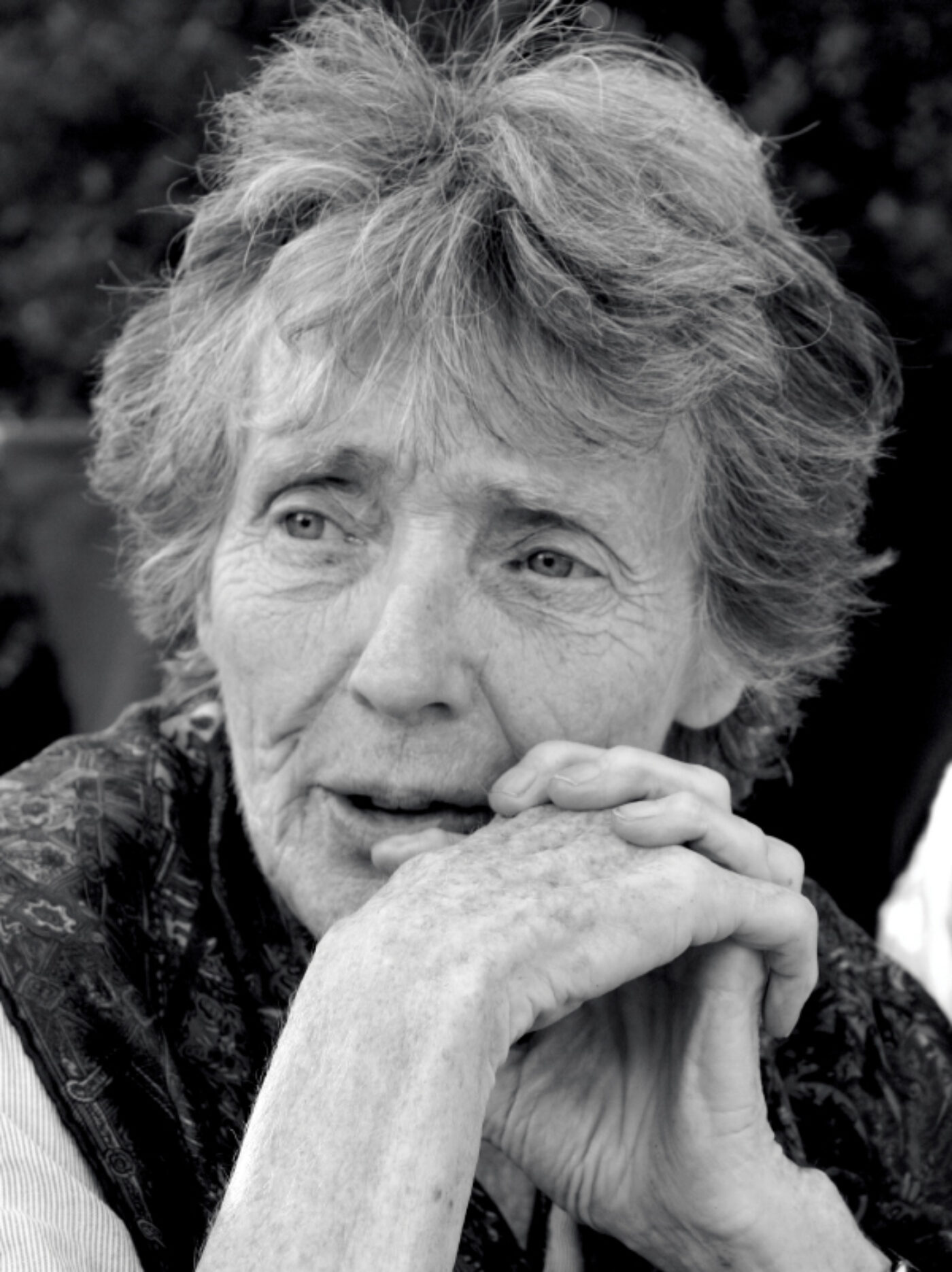
i tumbled into this most breathtaking old soul, majestic soul, and i shall let her do the talking today. i quickly grew so enchanted by her voice, her deep and gravely voice, a voice that must have traveled rocky roads, that i began to take notes, and i am leaving those notes here: part transcript, part poem. i’m not catching every word but the words i’m catching are those i do not want to lose. it’s as if a great elder has come today to impart something. to share a light, the light she came to know was her one thing to share. to leave with the world.
may we all be so.
may we all by illuminated by this nearly 96-year-old, who is a veritable masterpiece of all that matters.
and here are notes, in prayer form, in poetry…
that i can still breathe easy i don’t want to have just visited this world i want to be a child of wonder and astonishment
i’m having my second childhood now, my happy childhood i was always the outsider, i was always pointed at, i always felt terribly self-conscious so i have fun now
i’m just learning about play because i didn’t know what play was when i was a child i think play means exploring, experimenting, being curious, looking, seeing, being in the body not being afraid
it’s about the miracle and mystery of being alive
“we shall not cease from exploration and the end of all our exploring will be to arrive where we started and to know the place for the first time”
that’s t.s. eliot.
i had cancer once and . . . and afterwards i had surgery and i felt like i had to give myself a reaon that i was spared. that i got my life back and then, over many years, i saw that i had something to give, my light
something ineffable that i don’t know that light of harmlessness and harmony and singing and being joyful and rejoicing and being grateful
we’re here to experience the wonder of being in a body. . . to know that we are each other that we’re the same we’re made of all the same stuff . . . we’re little bits of stars, we’re dust
it’s like we’re the great kaleidoscope all little pieces but every time you turn it, it’s different so you and i are made up of exactly the same stuff, but every one of us is unique. there’s only one in all the world. and the same with every petal of a pansy….
i’m the star thistle, and the grass, and the dirt. i am you; you are me.
. . . my prayer is to go gently and as much aware of myself leaving with gratitude and joy and the satisfaction, “i’m done, i’m outa here. and it’s ok” it’s all such a mystery
thanks, i wanna say thank you not try to figure anything out, or understand it
but just be in awe
what’s the secret? it’s go slow for me . . .
[breaks into song. . .]
this beautiful film was made by two south african filmmakers who go by first names only as far as i can tell, justine and michael. their mission: to explore our shared humanity. their enterprise is known as reflections of life, formerly green renaissance. i do believe there is a trove worth plumbing…..i do not know the name of this blessedly beautiful nonagenarian so i shall name her simply Wisdom.
as we enter into supremely holy time, in both the jewish and the christian spheres, (are we not always in supremely holy time?), our friend here prompts the question how will you choose to live in awe?
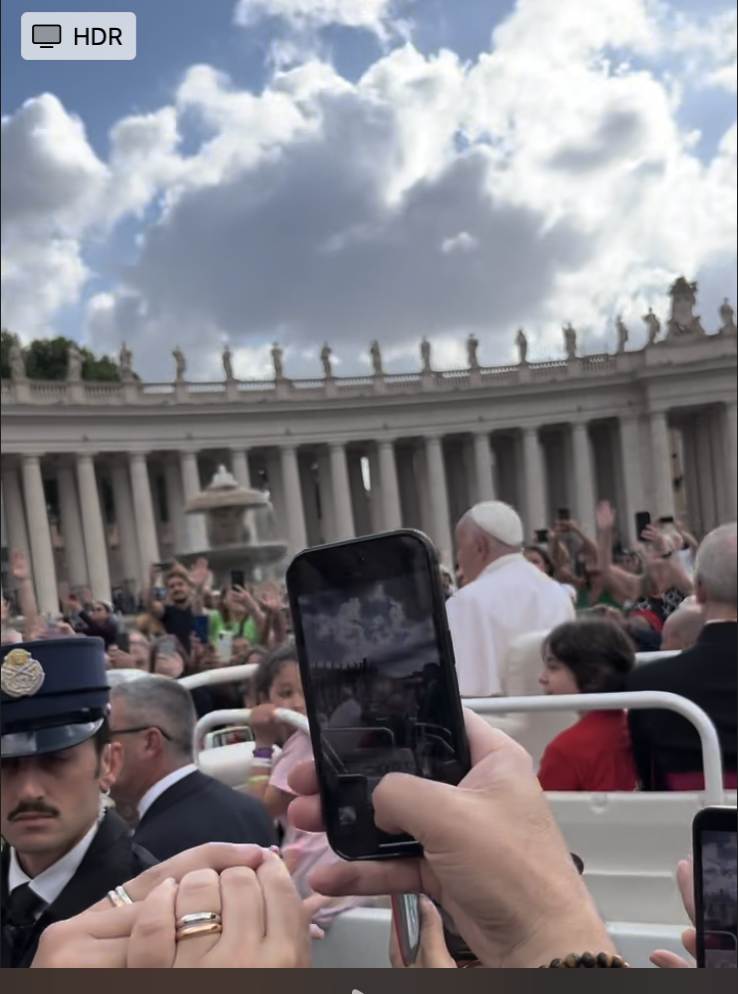
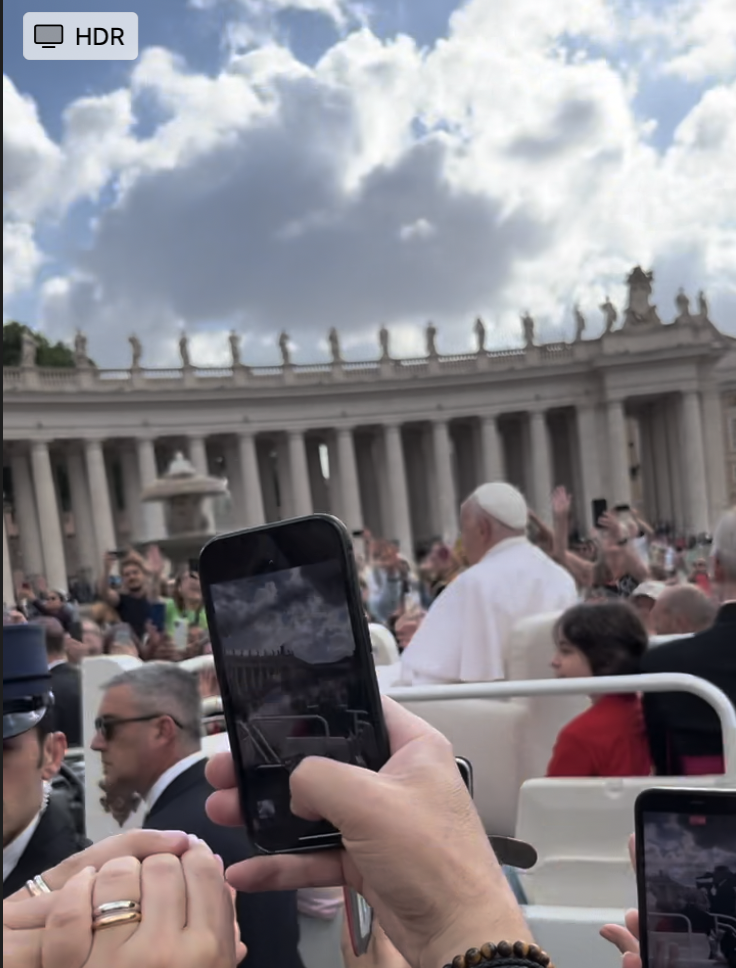
closest i got to Il Papa, when i found myself accidentally at the barricades that clear the way for the Pope-mobile
sages are in short supply, it seems. certainly now, and certainly on the global scale. i scan where i can, ever on the lookout. and wasn’t my eye caught when i read the words “artisanal path” to “handmade peace.”
tell me more, my little heart shouted.
though it sounded a bit like a recipe for earthy bread or hand-thrown plates, the sort that rise from the potter’s wheel, i sensed the subject here was far more urgent, and in dire need of replenishing. not what you’d find on any pantry shelf.
hand-crafted peace, peace constructed with care and attention. peace that we at home can build, without scissors or glue or a potter’s spinning wheel.
i clicked on a duly-provided link, and wasn’t one iota surprised to find that Il Papa, our most beloved Francis, was the one who not only dared to raise his voice above the blather, but considered it a requisite of his job’s description.
he is, after all, shepherd to a farflung flock. but more than that, he’s a prophet, which, according to the definition i found in richard rohr’s brand-new the tears of things: prophetic wisdom for an age of outrage, means a radical change agent, teacher of a moral alternative, and deconstructor of every prevailing order. rohr reminds us of the prophets of ancient times, the ones described by isaiah and ezekiel, whose job it was to hold the powers that be “maddeningly honest.”
bring on the prophets, please.
in these times, francis, our dear pope who from his hospital bed in rome reached out to the suffering of gaza, is the rare voice to which all the world will sometimes listen. thank holy God, he speaks the language of love without condition, clause, or pause. there are those among us, in this age of outrage, who might do well to listen. especially when they claim to take instruction from the very same God who whispers to Il Papa.
the new york times calls him “an increasingly lonely moral voice on the world stage.”
all the more reason to listen. and listen hard.
“peace is crafted; it is the work of our hands,” francis began at a prayer vigil in the central african republic back in 2015, “it is built up by the way we live our lives.” he was speaking to an audience of children, teens, and young adults in bangui, the capital of the central african republic, when that country was in the midst of a sectarian war between Christians and Muslims, and thousands had been killed, and more than a million displaced from homes, their properties looted or destroyed.
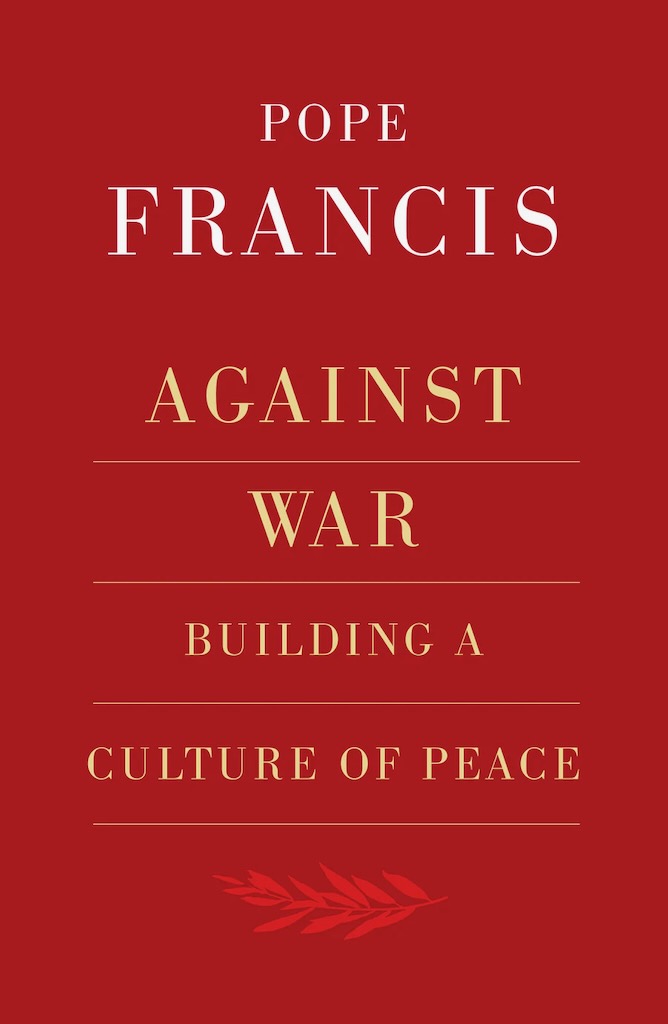
this artisanal path, “built up by the way we live our lives,” is spelled out, it turns out, in francis’s Against War: Building a Culture of Peace, a book i’ve ordered from my local bookstore, as it’s one with permanent claim to a slot on my bookshelf.
it’s not that i think i can build a culture of worldwide peace, though once upon a time i dreamed of such things. the point here, from the wee bit i’ve read, is that peace is a sphere we build bit by bit, as we travel through space and time, and it’s built by even the most unassuming of gestures, attitudes, and actions.
what the pope is saying, and what the world ought listen to, is that the tiniest empathies and kindnesses matter: giving cuts in the grocery line, waving someone into your expressway lane; taking time to take the call, dropping the tupperware of soup on your neighbor’s stoop. biting your tongue when you’re tempted to snap, and, yes oh yes, turning the other cheek, a trait i’m told no longer belongs in a world of dog eat dog.
what a game changer: here’s the head of a church that counts 1.39 billion baptized among its ranks, and he too concurs that we needn’t be rocket scientists in the art of magnanimous charitable persuasion to make a dent in the realm of ever-spreading goodness.
for one thing, it’s fairly contagious. if you’re out-of-the-blue kind to me, if you take my breath away with some wonder act of yours, chances are i’m inclined to be a copy cat and try the same. if for no other reason than the pure joy of watching someone be surprised you’ve not just slammed the door in their sorry, sorry face.
here’s where Il Papa begins his artisanal path to handmade peace, with this fulsome criticism of the futility of war:
“war is not the solution, war is madness, war is a monster, war is a cancer that feeds off itself, engulfing everything!”
that’s all i needed to keep on reading. and what i found, and what you’ll find should you decide to play along, is a compendium of his most outstanding commentaries on war and peace during the first nine years of his pontificate.
here are a few of the nuggets you just might choose to tuck in your peace-gathering pockets.
because one can’t best the pope when it comes to eloquence and voice, i am quoting from the book, here on in, and plucking five that leap out the most….
1.) seeing the world as one human family living in one common home.
The stars in the sky shine down on every single person — from the beginning of time to today — and learning “to look at the stars” will be “the most effective vaccine for a future of peace,” he said in Ur, Iraq, in 2021.
“Anyone with the courage to look at the stars, anyone who believes in God, has no enemies to fight. He or she has only one enemy to face, an enemy that stands at the door of the heart and knocks to enter. That enemy is hatred,” the pope said.
“There will be no peace as long as we see others as them and not us,” he said. Humanity lives under one heaven, under the gaze of one God who desires his children to be “hospitable and welcoming” to each other on earth.
2.) reconciling with one’s enemies and embracing unity in diversity.
The pope told young people in the Central African Republic that the first step toward being a peacemaker was “never hate anyone. If someone wrongs you, seek to forgive.”
“We only win if we take the road of love,” he said, and, with love, “you will win the hardest battle in life” and find peace.
But “we need to pray in order to be resilient, to love and not to hate, to be peacemakers,” and “you must be courageous,” he added. “Courageous in love, in forgiveness, in building peace.”
3.) the difficult art of dialogue and listening, which can sometimes be as hard as building a bridge over an abyss.
Pride and arrogance must be eradicated from one’s own heart, he told young people at a congress of the educational project, “Scholas Occurrentes,” in 2016. “Our world needs to lower the level of aggression. It needs tenderness. It needs gentleness, it needs to listen, it needs to walk together.”
Dialogue is “the capacity to listen, not to argue immediately, to ask,” he said. “Everyone wins in dialogue; no one loses” because “it is about agreeing to proposals so as to move forward together.”
Dialogue is to put oneself in the other’s place, “to form a bridge” and “persuade with gentleness.”
4.) peace is a constant journey of “getting one’s hands dirty,” concretely working for the common good.
“Our path leads us to immersing ourselves in situations and giving first place to those who suffer,” he said in Assisi for the World Day of Prayer for Peace in 2016.
Feeling responsible for helping others and refusing to be indifferent cleanses the heart and requires the “purification” and conversion that can only come from God, he said in Irbil, Iraq, in 2021.
This new order must meet humanity’s desire for justice, equality and participation, he said in his World Day of Peace message in 2020. A democratic society recognizes everyone’s rights and one’s duties toward others, which can temper a harmful, unbridled understanding of freedom.
5.) living the beatitudes is to bring heaven––and peace––to earth.
In his homily in Baghdad in 2021, the pope said, “We do not need to become occasional heroes, but to become witnesses, day after day,” embodying the wisdom and love of Jesus.
Jesus changed history “with the humble power of love, with his patient witness. This is what we are called to do,” he said, and “that is how the world is changed: not by power and might, but by the beatitudes.”
People who live the beatitudes “are helping God to fulfill his promises of peace,” he said. “This is the way; there is no other.”
in these tumultuous times, i am turning hungrily to prophets and sages in the news and on my dusty bookshelves. i’m inclined to not fill this space with my own blather, but rather to bring any lights that might dapple our paths. it’s always a tug-of-war to quiet the chair or keep it going with whatever bits i find. this doesn’t seem like the time to turn to silence. so my aim is upped to break through blather and bring voices that will wedge open our hearts, and like a doorstop, keep it wedged till we get through to the other side….
i’ve raised a blog, it seems, from birth to the verge of being grown-up. eighteen years: 12.12.06 it all began. 1,200 posts before today, so this––wondrously (to me, anyway)––is 1,201. at first i tended it, this conversation, this wondering aloud, this occasional epiphany, every weekday for a year, then chiseled it down to thrice a week. and then, yet again, i distilled it: once weekly––religiously every friday morn. here and there i’ve taken rare short breaks. a bit of summer breather once or twice.
and yet, kept on. and on and on. (sometimes wondering if maybe i should just be quiet.)
cycled through waves who’ve pulled up chairs in ebb and flow as of the tides. friends who’ve come to stay awhile, then shuffled off for one reason or another. at least a few i’ve deeply loved have died; angels still among us. some who’ve pulled up a chair have never ever strayed. here from the beginning, faithful as the day is long. bless them. bless and bless and bless them.
i too have ebbed and flowed. waded into deep and deeper waters. shed old fears, grew courage. been puzzled. pondered. hatched new fears. wobbled. stumbled. inhaled courage again, again, and again. i’ve wondered and worried aloud. weathered aching heart, and phone calls and headlines that left me breathless. i’ve loved and loved some more. i intend to never stop.
my school at first was all that unfolded under this old roof, where creaky twisting stairs and a nearly antique Garland stove––six burners, flattop, quasi-oven, a behemoth you’d find at any all-night diner––came to animate so many stories. it was my boys from whom i mostly learned and learned the most. and learned and learned again. and of course the holy earth and heavens high above: the gardens, the birds, the trees, the stars and moon, the dawn and dusk and nighttime’s inky darkness that never fail to draw me in. the book of nature, i’ve come to read, where lessons rise and fall season after season after season. i found a holy peace in this old house and the ramshackle plots where i kneel with trowel and soul wide open. i’d been chasing that peace for years.
i seem to have stumbled into a new teacher these days, one i’d never thought could bring such knowing: it comes with darkness, yes, though i’m reminded that darkness is the embryonic space where stirrings first begin. and it’s nighttime’s darkest hour when stars most brightly shine. stripped of distraction, of the nettlesome sorts of things that blur our everyday, it denudes us to our barest essence. it’s cancer (even when i do not name it here it’s ever present in my rumblings, and has catapulted me to highest most-reverent attention). mine is an especially wily iteration, one that doesn’t follow rules. and brings me squarely into the land of uncertainty. where i, a girl who likes to know things, am finding out how not knowing whittles the knowing to one or two immutables: love is the force that triumphs over all; its alpha and omega, the God who dwells within. within me, and you. and even all the ones who make us want to scream and run for cover.
here’s what i know 18 years in: there is nothing that love––true, deep love in all its iterations––cannot infuse. and in the infusing, molecules are stirred, shifted, and forms reshaped, dissolved, emboldened, made new. i’ve felt mountains move. i’ve felt fear melt away, like butter on hot biscuits. i’ve felt surrender––holy, holy “thy will be done.”
and a life well lived is one in which we love as unstintingly, as capaciously, as we might never have known possible. to live a life of loving is to scatter the few seeds that might blossom in our wake, that might rise in the seasons beyond us. it is the deepest mark i hope and pray to leave: to know my heart, my soul, has found a way in, forever in, to those whose lives i might have touched.
it all becomes so spare, so simple, in the end. when you realize your days––for as long as they stretch––are your one rare turn to hone the art of loving, as it is meant to be. as it is meant to make the holy difference. to trace the path from here to heaven.
that’s some of what i’m thinking eighteen sweet years in.
and now, because the older i get the more i glean from the wisdom of those who’ve left their trace, here’s my birthday bouquet to ponder for the day, the week, the hour…an indelible quote, a poem to make you laugh, and one to maybe melt you….
first, a quote from the french philosopher and playwright gabriel marcel, from the mystery of being:
“You know you have loved someone when you have glimpsed in them that which is too beautiful to die.”
a poem that might make you laugh, and certainly leave you with a smile:
Emily Dickinson at the Poetry Slam BY DAN VERA
I will tell you why she rarely ventured from her house. It happened like this:
One day she took the train to Boston, made her way to the darkened room, put her name down in cursive script and waited her turn.
When they read her name aloud she made her way to the stage straightened the papers in her hands — pages and envelopes, the backs of grocery bills, she closed her eyes for a minute, took a breath, and began.
From her mouth perfect words exploded, intact formulas of light and darkness. She dared to rhyme with words like cochineal and described the skies like diadem. Obscurely worded incantations filled the room with an alchemy that made the very molecules quake.
The solitary words she handled in her upstairs room with keen precision came rumbling out to make the electric lights flicker.
40 members of the audience were treated for hypertension. 20 year old dark haired beauties found their heads had turned a Moses White.
Her second poem erased the memory of every cellphone in the nightclub, and by the fourth line of the sixth verse the grandmother in the upstairs apartment had been cured of her rheumatism.
The papers reported the power outages. The area hospitals taxed their emergency generators and sirens were heard to wail through the night.
Quietly she made her way to the exit, walked to the terminal and rode back to Amherst.
She never left her room again and never read such syllables aloud.
and finally, a christmas poem that just might melt you, as it melted me. . .
Kenosis by Luci Shaw
In sleep his infant mouth works in and out. He is so new, his silk skin has not yet been roughed by plane and wooden beam nor, so far, has he had to deal with human doubt. He is in a dream of nipple found, of blue-white milk, of curving skin and, pulsing in his ear, the inner throb of a warm heart’s repeated sound. His only memories float from fluid space. So new he has not pounded nails, hung a door broken bread, felt rebuff, bent to the lash, wept for the sad heart of the human race.
thank you, with all my heart, for pulling up a chair, be it only for awhile, or for some or all these years. i am holding especially close against my heart this morning ginny, my once closest reader (my beloved mother in law who was quick to call if she liked what she’d read, and deafeningly silent if she did not!), mary ellen, and ceci, who waft over my shoulder, angels to my every day….and especially to my boys, who animate each and every pulse of my heart and every breath i breathe….(and certainly to will, who got this whole thing started, when he insisted i could do it, and built the website to make it happen….) xoxo love, bam
if you asked me today what church i belong to, i might stumble into an answer that wasn’t much of an answer. it might go round about. explain that sometimes i feel like an orphan. yes, there is a place where i go on the sundays when i’m on duty. i’m an altar girl at a church that welcomes my presence, where the sermons are great, but where i’m not much of a signer-upper which makes me feel a bit like a slacker. i have a synagogue, where sometimes i wander in to talk with the rabbi. where i can find myself in the deepest of prayer.
but the truth i’ve been wrestling with all summer long is that, mostly, i feel lost, adrift.
i didn’t grow up with a deep congregational sense. i talked to God most of the time from behind the closed door of my childhood bedroom. i found God in the notes i wrote, night after night during high school, to a motley band of the broken-hearted, the lost, and the otherwise looking for warmth. for a friend.
good thing i grew up with a mama who quoted emily dickinson more than anyone else. who taught me the lines of this poem that’s been ground into my soul in the finest of fine-grain elixirs:
Some keep the Sabbath going to Church – (236)
Some keep the Sabbath going to Church – I keep it, staying at Home – With a Bobolink for a Chorister – And an Orchard, for a Dome –
Some keep the Sabbath in Surplice – I, just wear my Wings – And instead of tolling the Bell, for Church, Our little Sexton – sings.
God preaches, a noted Clergyman – And the sermon is never long, So instead of getting to Heaven, at last – I’m going, all along.
the other thing my mama taught me––the one line she etched onto my soul was this: don’t let the Church get in the way of God.
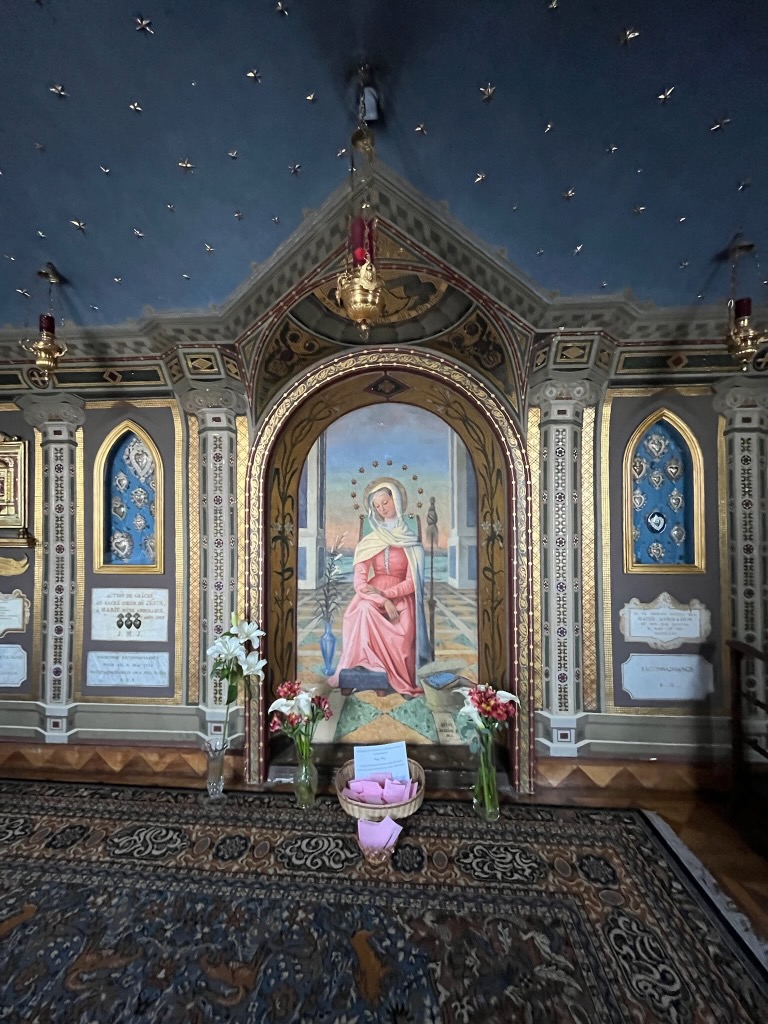
my mama, a girl who grew up in a convent where the nuns taught her to curtsy each time she dashed past the statue of the Pink Madonna (a story is told that one of the nuns–these are Sacred Heart nuns–once tried to paint a portrait of the Blessed Virgin Mary, and what she painted was so godawful, they tossed a rug over the thing, to hide it, and some time later when the rug was pulled off, lo and behold, there was a breathtakingly beautiful Mother of God decked out not in the usual blue but in pink. thus, the Pink Madonna that Sacred Heart girls (and their dutiful daughters) seek out whenever and wherever in the world they sense themselves in breathing distance of one of the few extant copies), my mama, as devout as the day is long, is far more radical than you might imagine for a girl who grew up in a convent in the most parochial burg of cincinnati, ohio. and that might be one of the things i treasure most about my mama.
and maybe that has something to do with my unwavering quest to find my way in this world along a path populated by sages, and not always of the churchly persuasion. i find holiness in unorthodox moments and places and, often, smack dab in the thick of a sentence.
i might not belong to a particular church these days. but i gather a goodly––and godly––congregation of pathfinders along my way. my church, quite often, rises up from the page.
i read, hour by hour, and day after day, with an eye out for wisdoms and truths, and guideposts to stir me. something akin to wandering an orchard, plucking from trees the lushest of fruits. i find my convictions deepened. my heart, often on fire. my intent: to make this blip that is my life as blessed as i can make it. i live by a gospel of love, one with an emphasis on that which is tender, and gentle not harsh. i believe, more and more, in humility. in understanding how little i know. and how much there is still for me to learn. to understand.
we live in a world that some days feels like it’s spewing all that i detest: there is cruelty, and hubris, and parading around as if no one else matters.
but then i open a book. or click on a text from a most blessed friend. and i read words that resonate. that underscore what seems to be Truth with a capital T. and i feel less alone, and less lost.
these are the lines that spoke to me this week in this holy space of my own making; one is from hafiz, the 14th-century sufi poet, another from thich nhat hanh, the blessed buddhist monk who died just two years ago, and the third is from greg boyle, the jesuit priest who founded Homeboy Industries, the world’s largest gang intervention and rehab program, based in east LA, and whose book, barking to the choir, is now on my most-wanted list.
first up, a prayer poem sent by a beloved friend, one from hafiz, the sufi poet, from a translation by daniel ladinsky, and which my blessed friend found in the pages of greg boyle’s barking to the choir:
Every child has known God, Not the God of names, Not the God of don’ts, Not the God who ever does anything weird, But the God who knows only four words. And keeps repeating them, saying: “Come Dance with Me, come dance.”
i love a God who whirls with me, who invites me into the dance.
next up, thich nhat hanh:
Understanding someone’s suffering is the best gift you can give another person. Understanding is love’s other name. If you don’t understand, you can’t love.
oh, that we should enter deep into the wounds of another. and therein find the walls of our own hearts widening and deepening, and our compulsion to hold a trembling hand the surest thing we can do.
and, finally, once down the greg boyle rabbit hole, i just got deeper and deeper, and then i found this:
“For unless love becomes tenderness—the connective tissue of love—it never becomes transformational. The tender doesn’t happen tomorrow . . . only now.”
photo above, of Mater Admirabilis, the Pink Madonna, is from our trip to rome back in may, during which, dutiful daughter that i am, i trekked to the top of the Spanish Steps, rang a bell at the convent of the sacred heart (my mother’s breed of nuns), turned over my passport for entry to the upper chapel where Our Lady resides, and beheld her.
forty-four cakes. three-thousand-two-hundred-seventy-eight candles. that’s how many cakes and candles we’ve missed since my papa died in the winter of 1981. i counted it up because today would have been his 96th birthday. he didn’t make it past 52.
all these years later the second of august is still a day i remember.
i remember the sunny sunday mornings when honeydew melon and handmade cards were strewn at his place at the dining room table, birthday brunch a step-up from the requisite eggs, bacon, and toast after ten-o’clock mass. i remember, in the preambles to birthday dinner, the glistening of his pewter mug, summer’s sultry humidity meeting the cold of his ice cubes and tonic and gin. the quarter of lime floating canoe-like near the rim. eight-minute burgers on the grill, corn on the cob littering all of our chins.
i remember his laugh.
much, though, fades.
i can’t remember the sound of his voice. or the way he called me barbie. i remember a few lines, but not the ones my brothers often remember. i remember the time he told me he’d prayed and prayed and could not understand why he was driving me to the hospital. i remember the time, driving home from my college graduation, when he told me he’d felt his mother right beside him when they called out the names of those who, like him long before, were graduating with highest latin honors, and he watched me rise from my seat in the crowded arena.
i remember how one late summer’s afternoon he called me from the office and asked me to meet him for burgers on the outdoor cafe of a place called jerome’s in lincoln park, a place he deemed “kicky.” my papa liked things that were “kicky” or “cool.” my papa, born of a locomotive engineer and a country school teacher in little bitty paris, kentucky, never shed the marvel of being a big-city ad man in the heady era of Mad Men and martini lunches and sixty-second commercials whose jingles and cutlines stoked the soundtrack of america’s bell-bottomed woodstock-and-watergate age. my papa liked to travel the globe. to give speeches in sydney and meetings in munich. he liked his corporate apartment in mid-town manhattan. he loved new york city. a place he never wanted to move us; he’d moved his moptop crew too many times, he and my mama agreed. one more uprooting might do us in. so he more or less made a weekly commute to the big juicy apple.
and home base for all those years was the two-story colonial with all the big trees at the bend in the dead-end lane. he brought the “neat, keen, cool, fab, it’s a blast” to our dutch backdoor, and on in to the big oval table where, at 6:30 sharp each night of the week except for on sunday when we pushed it to 5:30, we sat down for dinner, all seven of us. if there was something new out there in the world, my papa wanted us to know. didn’t matter if it was a word or a box soon to be labeled “hamburger helper.” he was our conduit, our passport, to all that was grander and jazzier than our sleepy little burg one in from the lake.
those are the things, all these decades later, i still remember––like yesterday. i remember, too, the year after he died when i thought i might never stop crying. how there were nights when i wailed a wild-animal sort of a wail, and bit into my pillow to muffle the sound. i never thought i would know joy again.
i never thought the ache would stop aching.
but here we are: two kids, a long marriage, and a whole career later. my papa had no idea i––a nurse when he died––would take his and my shared love of words and make a life of it. but the first day i sat down in the chicago tribune newsroom and they told me i needed a password, i knew just what i’d type each time i needed to rev up my desktop computer: my papa’s initials and mine; he was a part of every start to every story. and i never dropped his last name, cuz i wanted my papa to stay in the news. and in print. day after day. byline by byline.
here’s where i fell short: no matter how many stories i’ve told my boys and the man i love the most, i have not come close to bringing my papa to life. and, believe me, i’ve tried. no story, no matter how animated, no matter the gleam in my eye, can ever, ever come close. the man was a human high-wattage bulb. he was known for his wit. but i remember the tenderest parts. i’ve tried to bring all of it forth over the years.
but all these years later, it fades. and the truth is, my papa fades too. there’s too much i cannot remember.
grief and time make for an odd, sometimes cruel calculus. yes, the aching abates most of the time. though the piercing can come and come strong. in a grocery aisle. when a certain song comes on. when you’re trying to tell––or to catch every word of––a particular story. (writing these words here this morning, the tears have come too. if i’ve wallowed in moments, in memories, here, it’s only to make it all last. to live in those moments again.)
as much as the gasping for air is no longer a part of the grief, so too the frames of a life reel on, and the erasing begins. after so, so many years, you sometimes forget the one who’s no longer there. not always, and not in those crucible moments, when time itself feels condensed and magnified all at once. i too have felt my papa beside me when my firstborn walked a graduation stage; when my firstborn became a professor of law (a profession my papa once yearned for). i’ve watched how tender my so-called “little one” is, especially to my papa’s widow (“grammy” to both of my boys), and i know my papa would melt. but, truth is, ordinary time mostly hurls by, and i don’t remember. and then i might catch myself with a twinge. or i might not catch myself at all. there’s an anesthesia in grief that i never saw coming. maybe it saves us. maybe it’s cruel.
maybe that’s why there are birthdays, even when the someone is gone. especially when someone is gone. they become remembering days. they are days without cakes and no candles. but, in the silent chambers of the heart and the mind and the soul where time knows no rules, those someones return.
my papa rumbles in me this morning. in the only way i know how, i just brought him back. and i didn’t need to close my eyes, or make a wish, or blow out candles to make it happen.
he’s here. right beside me. in each of these stories. i know it.
happy birthday, dear papa. i love you forever.
at our house, we have an august birthday parade, a 2-4-6-8 of celebrations. so most blessed of birthdays i wish for my brother david (4), my blair(6), my teddy(8). i love you each and all to the moon and mars and beyond.…
tell a story of any someone you miss. any story. any someone. we’ll make this a party.
elwyn brooks white, best known to those who loved him as “andy,” and best known to you and me alphabetically as “e.b.,” taught me as much about love as just about any author i’ve ever read. and that includes the sacred texts of just about any religion i’ve happened upon.
every time i’ve pored over the words of charlotte’s web, or stuart little, or “death of a pig,” among the most masterful essays put to paper, i’ve felt the walls of my heart widen, and the bottom go deeper. perched against pillows in the old four-poster bed where both our boys inhabited the dreamland of their youths, i recall the sobs coming in echoes––from the one who was reading and the one being read to––as i choked my way through the tear-blurred words at the top of a still-splotted page 171: “she knew he was saying good-bye in the only way he could. and she knew her children were safe.” (i can’t even type that last sentence now without the tears coming again, filling my sockets.) “. . . she never moved again.” and then “. . .no one was with her when she died.”
we are reading, of course, of a spider. a spider we have all come to love, named charlotte.
and any writer who could make me love with all my heart an arachnid is a writer about whom i can never ever know enough. so it was with purest, geyser-like joy that i turned the pages this week of the first-ever fully illustrated biography of the legendary elwyn brooks white.
part collage, part scrap book, with excerpts of e.b.’s letters, and sketches, and reprints of early drafts and revisions in his own handwritten manuscript, Some Writer! The Story of E.B. White, by the caldecott honor winner melissa sweet, is at heart a love story told of one of the great disciples of love in its quietest, most undeniable forms.
e.b.’s life’s work, as he saw it, and as he wrote in a letter to a reader of charlotte’s web, boils down, pretty much, to this:
love these days seems to be a commodity of which the world is running short. but andy, or e.b., set out to make us see it, and feel it deep in our bones, by telling us the stories, as he put it, “of the small things of the day, the trivial matters of the heart.” he calls those matters “the only kind of creative work which i could accomplish with any sincerity or grace.”
e.b. white
well, dear andy, my gratitude to you is etched on the chambers of my heart, a graffiti of the highest order. to teach a child that love comes in the corner of a barn or even atop the manure pile where wilbur the pig so merrily huddled, well, that’s a blessing pure and certain. and imperative, i’d argue. and too often missed, i’d add.
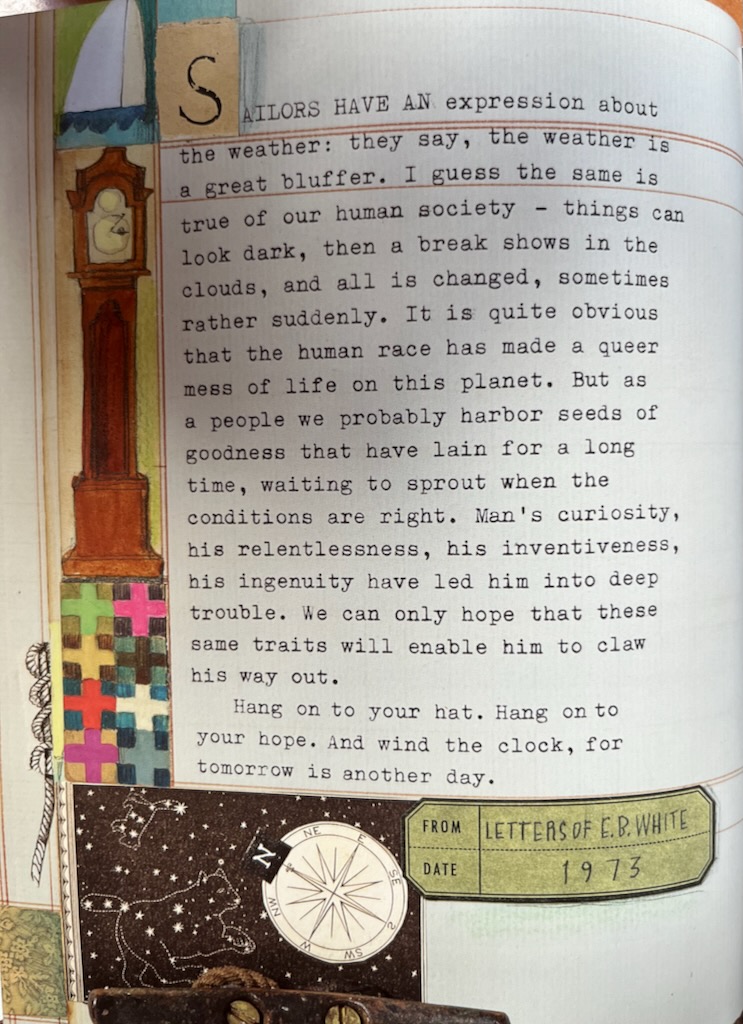
because he’s earned his post as ballast for my wobbly, sometimes-too-tender heart, wasn’t i delighted when i turned to page 132 in this charmed and charming illustrated biography, and found this excerpt from andy’s letters, which seemed to me a prescriptive for these hard times and the dark clouds under which we find ourselves:
“things can look dark, then a break shows in the clouds, and all is changed, sometimes rather suddenly. it is quite obvious that the human race has made a queer mess of life on this planet. but as a people we probably harbor seeds of goodness that have lain for a long time, waiting to sprout when the conditions are right.“
i’ll stop there with my old friend e.b., because that’s the line i want to consider, the line i want us to latch onto and live.
and so, what a curious thing that the next wise soul i wandered into this week was one olga jacoby, a german-jewish englishwoman and mother of four adopted children, who, in 1909 at age 35, had received a terminal diagnosis from her doctor, and sat down to write him a letter on the subject of living and dying without religion, but with moral courage, kindness, and a stunning receptivity to beauty. their correspondence would unfold until jacoby’s death four years later, and her letters, “by turns funny, touching, and intensely sad,” were published posthumously and anonymously by her husband in 1919.
in her first letter, to “my dear doctor,” she boiled down her belief to this:
“To leave a good example to those I love [is] my only understanding of immortality.”
and a year into her diagnosis she illuminated that notion:
“. . . More and more to me this simplest of thoughts seems right: Live, live keenly, live fully; make ample use of every power that has been given us to use, to use for the good end. Blind yourself to nothing; look straight at sadness, loss, evil; but at the same time look with such intense delight at all that is good and noble that quite naturally the heart’s longing will be to help the glory to triumph, and that to have been a strong fighter in that cause will appear the only end worth achieving. The length of life does not depend on us.”
and, she leaves us with this bedrock of lived truth:
“. . . Love, like strength and courage, is a strange thing; the more we give the more we find we have to give. Once given out love is set rolling for ever to amass more, resembling an avalanche by the irresistible force with which it sweeps aside all obstacles, but utterly unlike in its effect, for it brings happiness wherever it passes and lands destruction nowhere.”
who teaches you on the subject of love? what seeds of goodness harbor in you, and how will you coax them to sprout? and how might you put into practice the avalanche of irresistible force practiced by spiders and pigs alike (at least in the rich imagination of one e.b. white) and that, to the dying mother of four, was the most lasting thing that ever there was?
Some Writer! came to me, as so many of the best so-called children’s books do, by way of my best longest friend, auntie mullane, the children’s librarian, who prescribed it as the sure cure for summer blues, or any blues that might befall us in this dark-clouded era.
the light does come. this is a reminder. this is a note to tuck away for the days when the shadows occlude the sun.
we all live among darkness sometimes. sometimes for spells that stretch on for so long we’re sure we’ll run out of oxygen. but we muscle on anyways. because what other choice do we have? even in the darkest times, there are tiny shards that fall on our path. the kindness of someone we didn’t realize was paying attention. the encounter that puffs just enough hope back into our hearts. the wholly unexpected solace of finding ourselves shoulder to shoulder with someone who knows something about the steepness of the incline we’re climbing.
we all find ourselves in chapters so impossibly hard we’ve no choice but to tap into playbooks we’ve not yet scanned. we revert to those fine few things that just might steady us: we remember to breathe; we stand under the sunshine just long enough to plump a few shrunken cells; we giggle aloud at the ridiculous humor that never fails to creep its way in. even in ICUs. and funeral homes.
truth is: ours is a choreography of shadow and peekaboo sunlight. we bank on it. wars end. babies are born. laughter comes. so does the dawn. even the night is speckled with stars.
i’m here to say that after an almost unbearable few weeks, weeks that had me teetering, all but certain this might be the time my heart called it quits, the load is lighter again. my mama is chipper. my mama is finding her way, carving her path, skittering hither and yon, all on her new red convertible. (the name we’ve given her little red rollator, the latest iteration of spiffy walker, with wheels and brakes and a little compartment for stashing your assorted sundries.)
we’ve pulled through. none of us too worse for the wear.
my mama’s return to her lifelong indomitable state of being happens to coincide with the end of my jam-packed calendar of book talks. and after a summer of searching for answers to questions of cancer, i finally found someone who knows my cancer inside and out. and who laid out a scenario i can live with.
feels to me like someone’s rung the school’s-out-for-summer bell, and i might wiggle a jig all the way home.
because this week held one of my favorite feast day — all saints — and because i love looking for saints in places where no one might think to look, i found myself swooned by this blessed sonnet, “a last beatitude,” from malcolm guite, an anglican priest and poet who’s been said to resemble a hobbit, what with his predilection for waistcoats and long-necked pipes (from which he blows smoke rings), and whose tonsorial tastes tend toward the bushiest of beards, and long locks to go with it.
herewith, “a last beatitude” by malcolm guite . . .
And blessèd are the ones we overlook;
The faithful servers on the coffee rota,
The ones who hold no candle, bell or book
But keep the books and tally up the quota,
The gentle souls who come to 'do the flowers',
The quiet ones who organise the fete,
Church sitters who give up their weekday hours,
Doorkeepers who may open heaven’s gate.
God knows the depths that often go unspoken
Amongst the shy, the quiet, and the kind,
Or the slow healing of a heart long broken
Placing each flower so for a year’s mind.
Invisible on earth, without a voice,
In heaven their angels glory and rejoice.
and one last bit of poetry, as autumn, the season of awe is upon us, these lines from rilke’s poem “Onto a Vast Plain”:
Summer was like your house: you know where each thing stood. Now you must go out into your heart as onto a vast plain. Now the immense loneliness begins.
The days go numb, the wind sucks the world from your senses like withered leaves.
Through the empty branches the sky remains. It is what you have. Be earth now, and evensong. Be the ground lying under that sky.
and, lastly, before i skitter off, this line from the thirteenth-century mystic and monastic mechtild of magdeburg:
When simplicity of heart dwells in the wisdom of the mind,
Much holiness results in a person’s soul.
what, pray tell, carries you through your darkest hours?
i’ll be honest (as if i’m ever not): this was an unbearably hard week. and i am exhausted to the bone. the horrors of the world––images and stories i could barely take in––shred us, and scare us; make me wonder if we’re teetering on another apocalyptic precipice. and within the world’s horrors, there is a much-closer-to-home struggle that’s absorbed my every ounce of attention and strength: the not-insurmountable, steep incline of moving my mother into the next much-dreaded chapter of her life. a chapter she had adamantly refused to consider until the bones in her body were broken and the home she has loved for six decades can no longer be a place of safety and refuge.
the days have been long, have been wearing. but time and again through the week, my eyes fell on words that all but saved me. i gathered them up each time, hungrily. voraciously. as if the ones who spoke the words, or wrote the words, or somehow laid the words all in a life-saving line had reached out through the darkness to give me their hand. each time i held on tight. here are the words that steadied me this week. maybe they’ll steady you too.
i turn first to the irish, because where better to turn in the face of a broken world, and a battered heart: this comes from pádraig Ó tuama, who wrote: “there’s an irish phrase, ‘Is olc liom do bhris,’ which we say during a time of grief. a literal translation is ‘your brokenness brings me horror.'”
i couldn’t pronounce the irish if you paid me, but i love that the irish soul immediately understands that sometimes we’re not simply saddened but out-and-out broken under the weight of our sorrows.
but then, at the very moment i needed it, anne sexton came along: as i sat there watching my mother, now bent over a walker, sometimes crying out in pain, i watched my somewhat shy mother shuffle into a dining room filled with strangers. i watched her gently lay her hand on the shoulder of someone she was shuffling by, and i heard her say, “hello, i’m barbara, i’m new here.” and i felt my belly gurgling like jelly, as in the days when i pressed my ear against the kindergarten door, praying my firstborn would make it through the morning, my tender brave boy in a sea of new faces and voices. i watched my mother show me courage in the face of everything she’d prayed would never come to her. and then anne sexton’s words slipped under my nose. and i thought for a minute the heavens must have been listening, or maybe instructing.
Courage
It is in the small things we see it. The child’s first step, as awesome as an earthquake. The first time you rode a bike, wallowing up the sidewalk. The first spanking when your heart went on a journey all alone. When they called you crybaby or poor or fatty or crazy and made you into an alien, you drank their acid and concealed it.
Later, if you faced the death of bombs and bullets you did not do it with a banner, you did it with only a hat to cover your heart. You did not fondle the weakness inside you though it was there. Your courage was a small coal that you kept swallowing. If your buddy saved you and died himself in so doing, then his courage was not courage, it was love; love as simple as shaving soap.
Later, if you have endured a great despair, then you did it alone, getting a transfusion from the fire, picking the scabs off your heart, then wringing it out like a sock. Next, my kinsman, you powdered your sorrow, you gave it a back rub and then you covered it with a blanket and after it had slept a while it woke to the wings of the roses and was transformed.
Later, when you face old age and its natural conclusion your courage will still be shown in the little ways, each spring will be a sword you’ll sharpen, those you love will live in a fever of love, and you’ll bargain with the calendar and at the last moment when death opens the back door you’ll put on your carpet slippers and stride out.
~ Anne Sexton ~
(The Awful Rowing Toward God)
and then, the news of the death of louise glück, the nobel prize-winning poet from cambridge, mass. a poet i once sat inches away from in a bookstore in harvard square, so close to me that i could feel the whoosh of her hand as she swept it through the air, punctuating one of her lines, pushing back her lioness locks of silver-streaked hair. louise died of cancer, and her beautiful words held a deep resonance in this week when i found myself talking to the kindest physician i’ve met in a long summer of looking for answers. in between worrying about my mother, i remembered i too am still looking for light in my own shrouded tunnel. a doctor from mass general, just down the road from cambridge, gave me that light. and she was more than kind in doling it out. but here’s louise:
CROSSROADS by Louise Glück
My body, now that we will not be traveling together much longer I begin to feel a new tenderness toward you, very raw and unfamiliar, like what I remember of love when I was young —
love that was so often foolish in its objectives but never in its choices, its intensities Too much demanded in advance, too much that could not be promised —
My soul has been so fearful, so violent; forgive its brutality. As though it were that soul, my hand moves over you cautiously,
not wishing to give offense but eager, finally, to achieve expression as substance:
it is not the earth I will miss, it is you I will miss.
and those are the words i clung to this week, the words that carried me across an awful abyss.
what words carried you?
p.s. there’s one other poem that saved me this week, because it always saves me: naomi shihab nye’s kindness. here tis:
KINDNESS
Before you know what kindness really is you must lose things, feel the future dissolve in a moment like salt in a weakened broth. What you held in your hand, what you counted and carefully saved, all this must go so you know how desolate the landscape can be between the regions of kindness. How you ride and ride thinking the bus will never stop, the passengers eating maize and chicken will stare out the window forever.
Before you learn the tender gravity of kindness, you must travel where the Indian in a white poncho lies dead by the side of the road. You must see how this could be you, how he too was someone who journeyed through the night with plans and the simple breath that kept him alive.
Before you know kindness as the deepest thing inside, you must know sorrow as the other deepest thing. You must wake up with sorrow. You must speak to it till your voice catches the thread of all sorrows and you see the size of the cloth.
Then it is only kindness that makes sense anymore, only kindness that ties your shoes and sends you out into the day to mail letters and purchase bread, only kindness that raises its head from the crowd of the world to say It is I you have been looking for, and then goes with you everywhere like a shadow or a friend.
I’ve always noticed the light shines through more perceptibly, more piercingly, when the skies are grizzled gray, and there’s a fissure, a peep hole, in the clouds.
And so, in this shadowed episode in which I find myself –– awaiting word on my first lung scan since before surgery, trying to navigate my mama through the roiling seas of rehab and the stark knowing she won’t go home –– I wend my way through the days on watch for grace notes which tumble onto me like snowy flakes before the melt: each one unlike any before or aft, each one magnificent in its own faceted incandescence.
And, in the spirit of blessed Francis of Assisi, I am stringing them into a canticle, a praise song typically referencing Gospel text. I’m not so literate in those Scriptural ways, so I am stringing mine in the vernacular of the everyday:
Praise be the blessed, blessed nurse named Vishruti whose charcoal eyes are ever sparkling, and whose attendance to my mama’s every woe is pure blessing before my most grateful eyes.
Praise be the harvest moon pinned high in the night sky one especially hollow night, and the acolyte Jupiter who clung to Moon’s southwestern rim, as if to catch any drippings once the melt began again.
Praise be my blessed “baby” brother who seems the answer to my every prayer before I’ve even prayed it: the one who keeps every necessary form on file (to ensure nary a hiccup in our mama’s journey), attends to every detail with fastidious care, and who is so blessedly tender with our mama’s every ache and pain and worry that in watching him tears spring to my eyes nearly every time. Praise be that brother who has always fit me like my other half. I’m 1/3/57 and he just happens to be 2/4/68. Mathematically sequenced, and aptly paired, we are.
Um, addendum to brotherly praise (did Francis addend his canticles? hmmm): As I was typing that very verse above, said saintly brother was ambling through a lumber yard, intent on rebuilding our mama’s four-poster bed to make it six inches closer to the ground, thus subtracting risk by six not-insignificant inches. And he’s not even the carpenter brother! Be still my brothered heart….
Praise be the ones who fill my stoop with dahlias, and chicken ala yummy, and farmer’s market bounty. And whose prayers and hand squeezes hold me up, even when I wobble.
Praise be my sweet Fred who holds my hand in the dark of night, even when I don’t let on that I am thinking hard about the day ahead, or the one just left behind…
Praise be Pope Francis who, in his latest encyclical, Laudate Deum, squarely implored us to face these crucial questions:
“What is the meaning of my life? What is the meaning of my time on this earth? And what is the ultimate meaning of all my work and effort?”
Praise be Alice Walker who gave us these lines in The Color Purple:
Listen, God love everything you love — and a mess of stuff you don’t. But more than anything else, God love admiration.
You saying God vain? I ast.
Naw, she say. Not vain, just wanting to share a good thing. I think it pisses God off if you walk by the color purple in a field somewhere and don’t notice it.
What it do when it pissed off? I ast.
Oh, it make something else. People think pleasing God is all God care about. But any fool living in the world can see it always trying to please us back.
Yeah? I say.
Yeah, she say. It always making little surprises and springing them on us when us least expect.
You mean it want to be loved, just like the bible say.
Yes, Celie, she say. Everything want to be loved. Us sing and dance, make faces and give flower bouquets, trying to be loved. You ever notice that trees do everything to git attention we do, except walk?
Alice Walker, “The Color Purple”
Praise be that God who aims to please us, even with the color purple. Praise be the God who’s “always making little surprises.”
And praise be the simple, simple miracle of a smile spread across any human face. I don’t know why God thought to give us the capacity to upturn our lips in tenderness or joy, but oh, there is little so life-saving as that simple twitch of those few muscles.
In gratitude, in joy, in infinite blessing, and with deepest smile, for all the little surprises that steady us through and through…
She stretches from Sharon Olds’ Stag’s Leap to Christine Valters Paintner’s Dreaming of Stones on my bookshelf. Sixteen volumes in all. And that’s just the poetry. Doesn’t count her essays, housed on a whole other shelf. I am talking, of course, of the poet I call my “patron saint of paying attention.” Mary Oliver.
You might also say she’s the poet master of astonishment. She breaks me out in goosebumps and wonder. Line after line after line.
Oh, I’ve heard her poetries dismissed for their “surface simplicity and populist reach.” But when it comes to stirring my soul, I’ve no need for the critics. I side with those who, as was written in her New York Times obituary, find that “her poems, which are built of unadorned language and accessible imagery, have a pedagogical, almost homiletic quality.”
I call them holy.
Give me a writer who can write of the “uncombed morning,” or confess that “sometimes I am that quiet person down on my knees.” Or cobble together words into a stanza that reads: “All things are inventions of holiness / Some more rascally than others.” Give me that writer and I’ll hitch my starship any last day.
These days, this long hard season, I seek saving grace wherever it falls. I find it in an evening’s sky punctuated by dragonflies drifting and darting in parabola. I find it in any sentence that ends “unlikely distant metastasis.” And I most certainly find it in the poet who reminds me: “So quickly, without a moment’s warning, does the miraculous swerve and point to us, demanding that we be its willing servant.”
Count me willing.
Emily D. taught me to look for and love the slant, the wisdom that slides in on a steep-edged, improbable angle. Mary O does that every time. I am reading of a bluefish being washed at the water’s edge, and suddenly I am remembering to be on the lookout. To find God, the Holy, in all of creation. Or, as Emerson put it: “To attend all the oratorios, the operas, in nature,” in life, in the day upon day.
Mary O is the one who puts her ink to the sacred as it spills across creation’s page. How else to describe the one who, when writing of a lone seal pup found on a desolate beach, muses: “. . . maybe / our breathing together was some kind of heavenly conversation / in God’s delicate and magnifying language, the one / we don’t dare speak out loud, / not yet.”
Pay attention to how she places that very last line. The barbed last hook. The one that sticks in your craw just a little bit longer. Whispers a gossamer faith. Mary O was a theologian of the barest brushstroke. You’d barely know you were shaken, but then you quake through to your deepest marrow.
Mary Oliver’s birthday is September 10. She would have been 88.
And here, in her poem “Messenger,” she describes her life’s work:
My work is loving the world. Here the sunflowers, there the hummingbird— equal seekers of sweetness. Here the quickening yeast; there the blue plums. Here the clam deep in the speckled sand.
Are my boots old? Is my coat torn? Am I no longer young, and still half-perfect? Let me keep my mind on what matters, which is my work,
which is mostly standing still and learning to be astonished. The phoebe, the delphinium. The sheep in the pasture, and the pasture. Which is mostly rejoicing, since all the ingredients are here,
which is gratitude, to be given a mind and a heart and these body-clothes, a mouth with which to give shouts of joy to the moth and the wren, to the sleepy dug-up clam, telling them all, over and over, how it is that we live forever.
—by Mary Oliver
Seeing Not Looking
Celtic scholar Esther de Waal considers Thomas Merton’s practice of contemplative photography:
Thomas Merton was of course a writer and a teacher, and a poet, but he was also a photographer, and it is from his photographs that we learn much about how he saw the world, and how he prayed—and the two are of course intimately connected…. He handled a camera as an artist would, and used it as an instrument of delight and perception. It was in the later 1950s that the journalist John Howard Griffin [1920–1980] visited Merton in his hermitage. He had his camera with him and … let [Merton] keep it on extended loan. At first when Merton sent him the negatives, John Howard Griffin was puzzled, for [Merton’s] view was so different from that of most people. Merton photographed whatever crossed his path—a battered fence, a rundown wooden shack, weeds growing between cracks, working gloves thrown down on a stool, a dead root, a broken stone wall. He approached each thing with attention, he never imposed, he allowed each thing to communicate itself to him in its own terms, and he gave it its own voice.
Later on when he was out in the woods with a young friend, Ron Seitz, both with their cameras, Merton reprimanded him severely for the speed with which he approached things. He told him to stop looking and to begin seeing:
Because looking means that you already have something in mind for your eye to find; you’ve set out in search of your desired object and have closed off everything else presenting itself along the way. But seeing is being open and receptive to what comes to the eye…. [1]
He used his camera primarily as a contemplative instrument. He captured the play of light and dark, the ambience, the inner life. But above all he struggled towards an expression of silence through the visual image, so that his photographs show us that ultimately his concern was to communicate the essence of silence.
it’s the month of Elul in the Jewish calendar, a month for accounting of the soul before the high holidays, Rosh Hashanah, the new year, and Yom Kippur, the day of atonement. i’ve been deep in soulful accounting, and bring along this prayer from the blessed Rabbi Nachman, who taught that life should be lived with joy. and centered in prayer.
A Prayer of Rabbi Nachman of Bratslav (1772-1810)
Grant me the ability to be alone; may it be my custom to go outdoors each day among the trees and grass – among all growing things and there may I be alone, and enter into prayer, to talk with the One to whom I belong. May I express there everything in my heart, and may all the foliage of the field – all grasses, trees, and plants – awake at my coming, to send the powers of their life into the words of my prayer so that my prayer and speech are made whole through the life and spirit of all growing things, which are made as one by their transcendent Source. May I then pour out the words of my heart before your Presence like water, O God, and lift up my hands to You in worship, on my behalf, and that of my children!
hummingbird photo (above) by shelia zimmerman, sister of my beloved late friend mary ellen sullivan, may her memory be a blessing, (and it is. every day.)
happy blessed sunday birthday to a personal patron saint of mine, mark burrows.
looks like i was in the mood for capitals this morning, maybe just to prove i know how to find the shift key. hope you don’t mind the tall letters every once in a while. i do understand how it makes a sentence filled with proper nouns a bit easier to read…..
let’s play a bit of book group: what are some of your favorite Mary O lines, or words, or phrases?
p.s.s. i almost forgot: i’m taking The Book of Nature on the road this weekend. sunday afternoon, in fact, when i’ll be at Winnetka’s Book Stall at 2 p.m. for a book talk canceled last spring and now back on the calendar. problem is my little voice has gone missing again, and my vocal cord injections are on the books for tuesday, so it’ll be a bit squawky but the show must go on. it’s also Printers Row LitFest this weekend, so lots of getting pulled in several directions. wherever you are, have a lovely blessed almost-autumn weekend.