pull up a chair

where wisdom gathers, poetry unfolds and divine light is sparked…

Month: November, 2025

the not-so-simple tasks of being alive

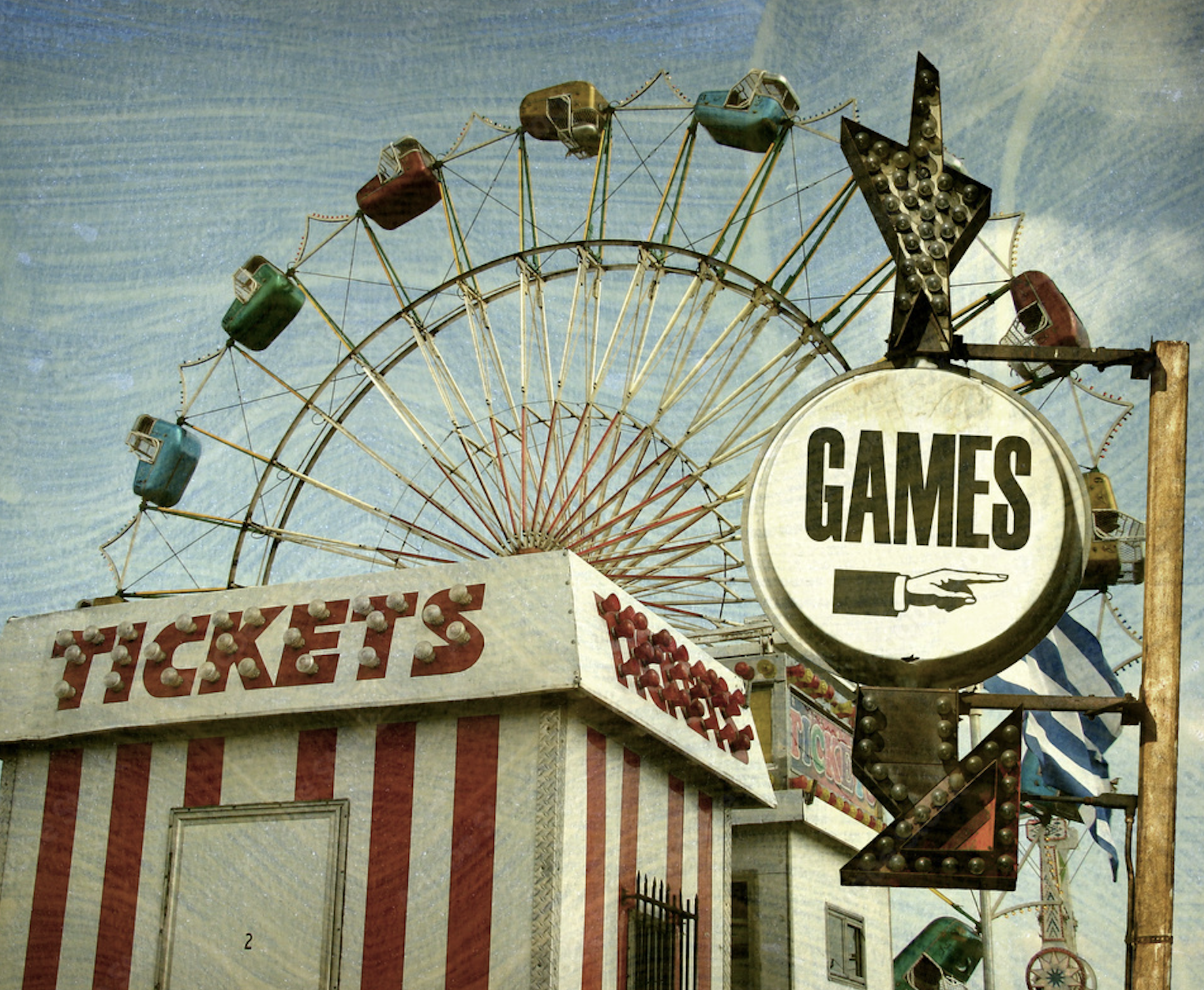
life, sometimes, makes like it’s an arcade of carnival challenges, and to make it to the other side is, in fact, something of a triumph we barely take time to note.

we shouldn’t, though, take it for granted. we are mightier than we think. and there will come times when we truly need to believe how mighty we can be. we’re not here on this earth to dawdle around.

as this week draws to a close, i can testify that these things happened: a new used car was found, bought, driven home, and will soon be ferried to another state; a kid wrestled through the decision of which of three job offers he’d choose, and started the one; husband down for the count with a cough that sounds like it’s hollowing his lungs; cavity filled in the way back of my mouth; latest peek at my lungs behind me (now awaiting results, a fraught interval that always leads to some trembles); and the latest round of edits on Book No. 6 at last sent off to editor (i had to wait till her calendar cleared).

not included in the list, but very much there, are the facts that i spent the week dodging the heck out of whatever virus was mucking up the works, for fear my scan or my cavity filling would get bumped; also, never mind the “check tire pressure” light that went on halfway home from the car lot, and the hurdles to get that untangled. in addition, i arose each dawn, never crashed my own car, swam a few miles, cooked a few mediocre dinners and one or two fair ones, and grocery shopped what seems like ninety-five times.

such is the business of living. each week throws at us a spaghetti bowl of hurdles, some humdrum, some of dimension that leads us to gulping.

it’s the quotidian stuff that comprises our day to day. and to make it through and to the other side is a feat that draws on cords and gears we barely acknowledge. to miss the chance to take note, to not ponder just how resilient we are, just how swiftly we can untangle ourselves from houdini’s chains is to short shrift our capacities.

we live our lives amid stories of what seem insurmountable feats: folks rolling into surgeries that untangle their insides, or shave off a lump on their spine; house fires that leave lives in ashes and soggy remains; kids finding out their cancer is double-D badd. (and those are stories plucked only from the last 48 hours, each one devastating and true.)

the news of the bad guys around us might distract and infuriate and leave us in tears. but the hard work of being human is never far from home. it’s the pit in our belly we awake with, and the headache that drums us to sleep. it’s what we might face before breakfast, and what comes with an unsuspecting wallop midway through the day. it comes in the phone call we never expected, and the one that makes us fall to our knees.

i’m not trying out for a part as the voice of doom here. i’m simply saying what we too often forget: no matter the circumstances, nor the twists in the story, we are all made of strong stuff—stronger than we remember to note.

to get to the other side of the traumas and troubles that hurtle our way is worthy of note, if not ovation. it might do us well to take count of the muscle it takes, and the grit, and the intense imagination, to merely get to the other side.

and here we are, on the far side of all those things that a week ago seemed insoluble.

that alone might stand as proof that even the frailest among us are tough as tough can be. and we can take on just about anything. we are breathed into life with every capacity our lives will demand. and we are living proof of how much we can survive.

you needn’t share this with anyone other than yourself, but perhaps you might find strength in looking back across the arc of your life and seeing what a marvel you are, and all the impossible hills you have climbed. what marvels you the most?


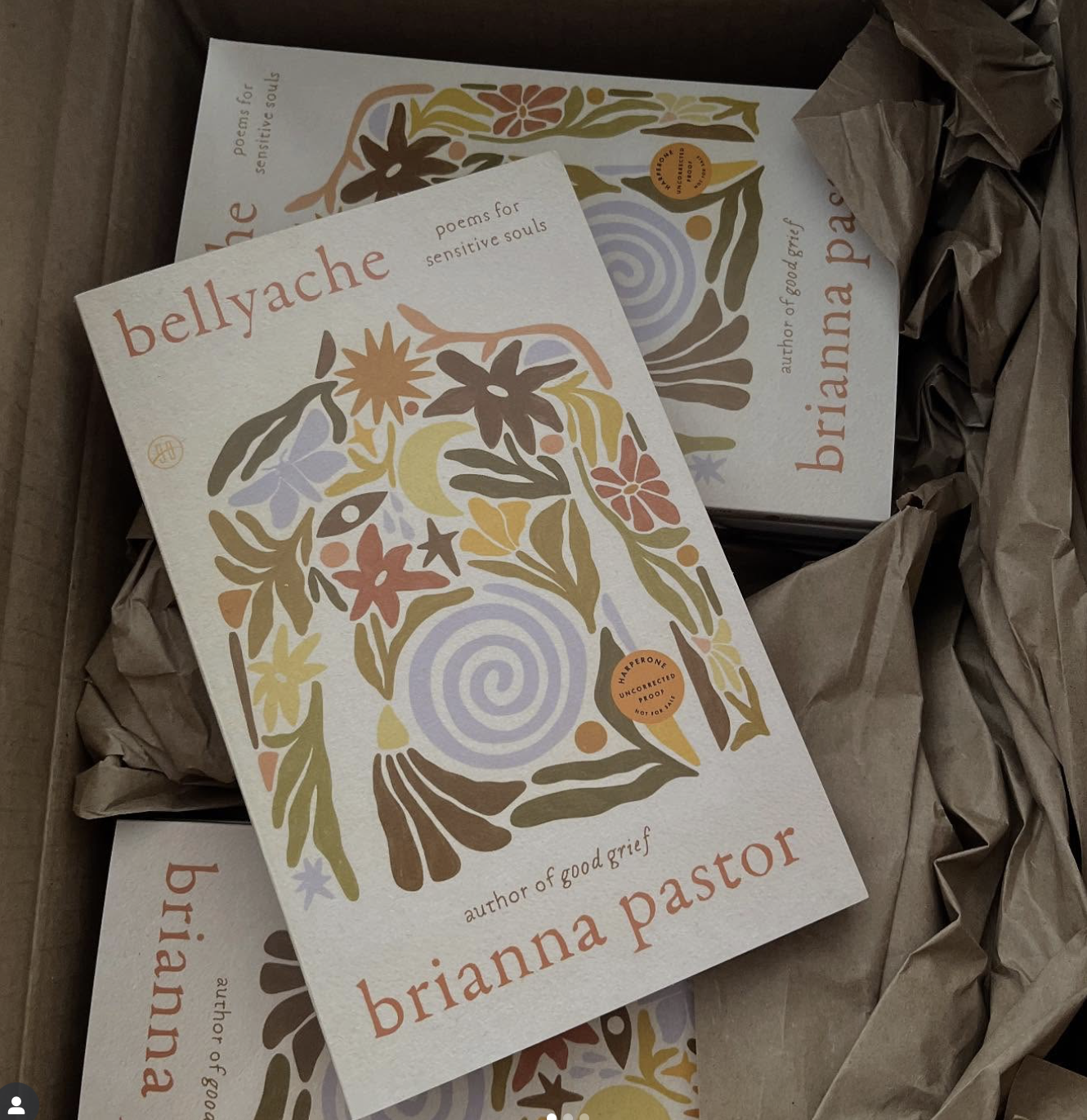
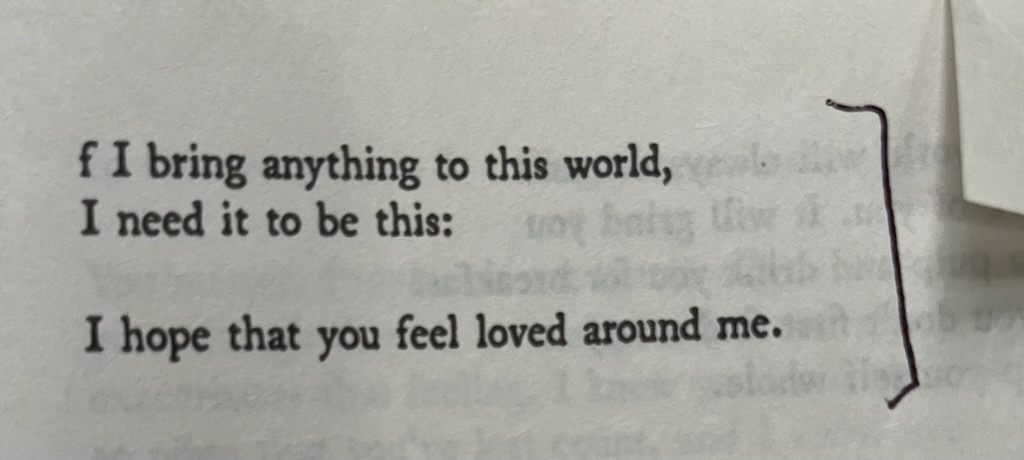
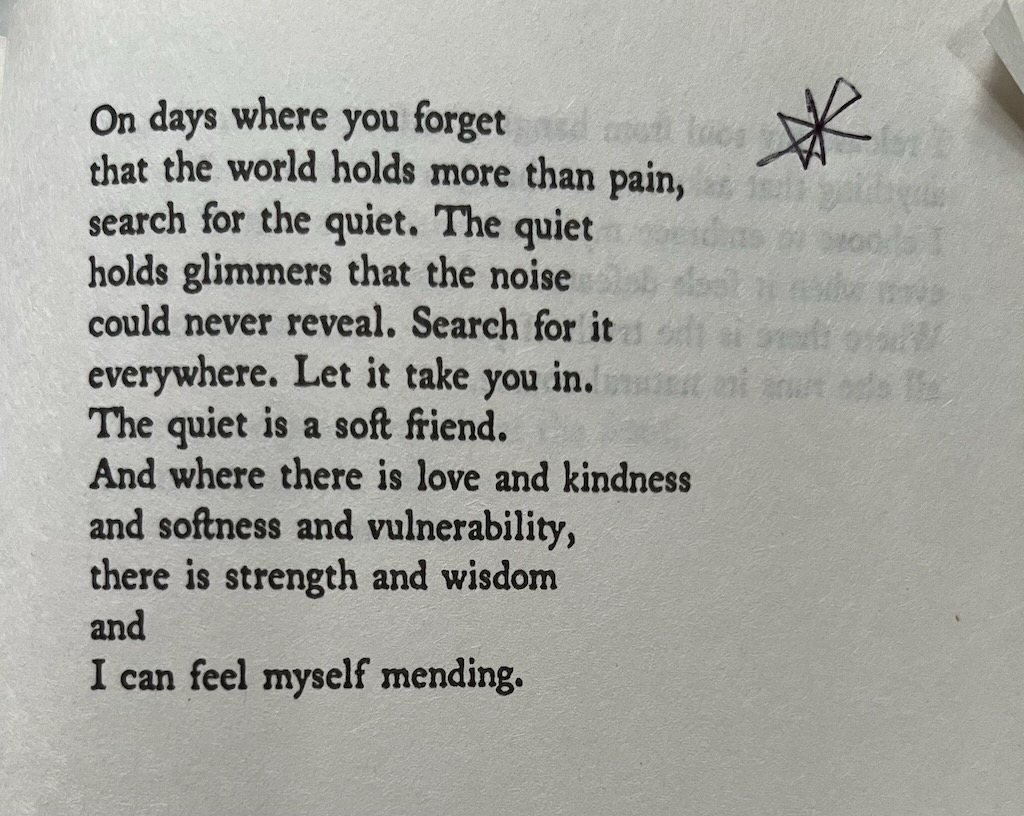
as antidote to all that, i bring you a bit of wonder in the form of the latest book that crossed my transom. it’s titled bellyache: poems for sensitive souls (harper one, 2026), and they had me at the subtitle. it’s by brianna pastor, a poet described in her bio as “a queer writer, empath, advocate, and author of the poetry collection good grief.” the book isn’t due out till february, but i got a review copy, and i’ll share a few marvels here. pastor’s poetry is rooted in childhood trauma and what it means to heal, with sensitivity and love as the non-negotiable parts of the deal. she writes, according to the author note, “about the raw, the uncomfortable, the overlooked, and makes clear that at the root of all things, is love.” it’s not every day that you open a book and find yourself in the midst of a poet whose heart feels so immensely attuned to the pain and the preciousness of tender, tender feeling.

here’s one of my favorites….

and here are two others (the spare simplicity is everything in these love-drenched poems):

and this:

the ol’ ticker still ticks. and then some.

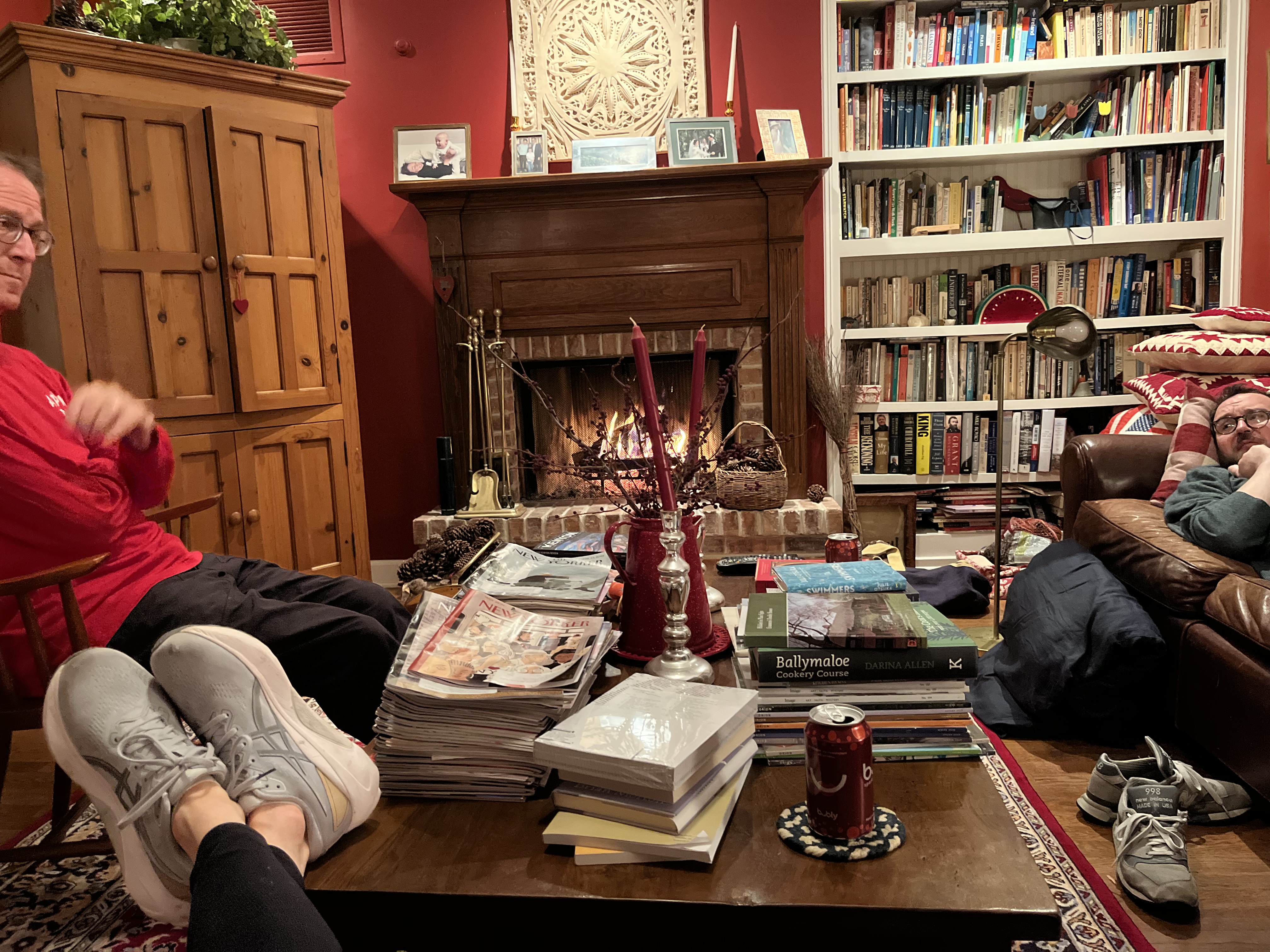
a rare peek inside this ol’ house, where three of us nestled by the fire, catching a moment that no one saw coming…

because of the way my heart leapt midafternoon yesterday as i bumbled into the house, hands all muddy from tossing out the ferns that had frozen in the snow snap, i can claim with absolute certainty that i’m nowhere near dead yet. 

what might i mean by such a rash—you might say “obvious”—pronouncement? 

well, quite simply, my oft-tired ol’ ticker fired off a triple flip the likes of which simone biles would be proud soon as i glanced down at my phone, that indispensable appendage i always forget to keep indispensably by my side, and noticed a smattering of words that seemed to be spelling out something about “the trip to Chicago” followed by “keep the drive daylight” followed by “i will just hit the road,“ all walloped with “on the off chance that you guys aren’t busy tonight.” 

and thus i discovered the manchild who’s been heavy on my heart all week, as i worried about the car that was stuck in the tow lot, and the miracle that he’d not been slammed into metal or glass when his car fishtailed on a slick, dark country road, i discovered there’d be three not two at our dinner table last night. and how perfect that i’d just made a triple-size batch of one of my autumnal mostly vegetable stews. 

never mind that he’s 32, and a law professor these days. never mind that i’ve been at this mama gig for rather a while now (well, 32 years plus the duration of mammalian gestation), it’ll never get old. it’s pretty much an indelible truth that until my last breath on this planet the number one zone in my heart will forever be the can’t-get-enough-of-my-boys zone. 

and so, in less time than it takes to spell indefatigably up to the task, i had fresh flannel sheets on the bed, a basket of farmer’s market apples on the bedside table along with a mason jar of my fresh-made granola, and if i’d had time to string up holiday lights in the room where he grew up, i’d have done that too. along with a chorus of night-crooning angels.

why the back-flipping joy? 

well, living as i am in a personal epoch of carpe diem, in which nearly every dawn i flutter open my eyes and unfurl a big fat gratitude prayer for making it to the sheer marvel of watching sunlight stream in, while simultaneously existing in this moment in history when good news is as infrequent as a meadow of daisies in november, the sheer joy of surprise, especially in the category guess-who’s-coming-to-dinner, is of the highest order. 

and sometimes it’s just plain rejuvenating to remember your heart still knows the steps to the happy dance, and can leap into it on a moment’s notice. 

my zeal for making each moment count is not a dynamic that’s waning. it only gets more and more intense as the chapters of living press in from all sides. 

i seem to have been catapulted full time into that real-life equivalent of frank lloyd wright’s architectural jujitsu compress-and-release, in which the master architect squeezed in the walls of an anteroom so that once you stepped into the chamber beyond you felt the whoosh of expansiveness as the walls and the ceiling let soar. so too with life and its tough spots. in time, they finally relent and release. and you breathe deeper than you remember breathing in days. 

our lives are undulations of breath, on both a grand and an intimate scale. the pattern set soon as the umbilical cord is cut—the lungs, the diaphragm, the ribs rise and fall, empty and fill accordingly. and so it is with our lives on a larger scale, as life seems to toss us into the vise, only to at last let us out. let us breathe. 

i am breathing today. i am breathing as my house fills with people i love to celebrate the birthday of a woman we love, the matriarch of us all. my mama, who’s shown us grace, resilience, and who these days unendingly charms. we’re not marking the date of her birth, she tells us, but we are marking our love. and we are doing it the best we know: we are gathering in joy, and in love, from corners hither and yon. 

and in this old house, when the three of us sat down to stew, we got an extra dollop of breath out of the deal. it was—and is—delicious. 


a bit of social action here at the chair, for anyone who might be so inclined. here in chicago, and even here in the leafy burbs we’ve been shattered by the roving bands of federal agents decked out in the camo gear, faces covered in masks, as they’ve rough-armed and thrown to the ground dozens and dozens and dozens of those whose skin might be brown. contrary to federal messaging, these are good folk earning meager livings the hard way: cutting grass, raking leaves, tending to kids in strollers or buggies, pounding shingles to roofs. and for the sin of trying to live unnoticed lives in a country meant to be safe harbor from thugs and militias, they’ve been plucked from the streets, or their cars, or their classrooms, and sent to a hellhole, leaving behind families to fend for themselves. a little band of us here where i live have armed ourselves with whistles and courage, to stand up to the thugs. and to help in any meager way we can. one among our little band offered this possibility to help stock the grocery shelves at a free market in chicago’s mostly hispanic little village neighborhood, where the fear is rampant and the streets have been swept of their usual buzz. it felt mighty good to send off a grocery cart of simple sustenance. and, indeed, i felt the breath fill my lungs.

here’s what my neighbor wrote….

For those that are looking for an option to offer concrete support to Little Village families impacted by ICE…one of my [neighbor’s] dearest friends (Keri Krupp) is a school social worker at Little Village’s Zapata Academy, which serves 500 kids from pre-k to 8th grade and is in need of support for their free “store” Mercado Zapatista. The Mercado is completely reliant on donations and has become a source of support for many of Zapata’s families — while typically focused on winter apparel and toiletries, it is now also distributing food to families that have been hit by both the loss of income due to ICE and the disruption to SNAP benefits. Her stories are heartbreaking. You can quickly donate through by selecting items from this Amazon wishlist or by sending an Amazon gift card to her work email (kbkrupp@cps.edu).

https://www.amazon.com/hz/wishlist/ls/291BEA7WRUHZ9?ref_=wl_share

At a time when it can be hard to know where to best focus donations, [my neighbor] can personally vouch for Keri’s commitment to the Little Village community and prudent stewardship of Mercado Zapatista, which she began in 2024. Any donations, big or small, will make an immediate difference to Little Village children and their families!  

and thank you for considering.

bless you all. what filled your lungs this week?

remedy against despair

sometimes, it’s just not so complicated. 

how to survive in the modernday melee, i mean. 

how not to get sucked into the cesspool, or the tarpit of utter despair. 

there are flocks of us, bumbling around, looking down at our weathered, timeworn selves, our selves that are wrinkled or missing some parts, wondering what in tarnation little old me can do about this. all of this chaos, all of this cruelty, all of this jaw-dropping gilding and seizing of power, all of this thuggery, what in the heck can i do?

it’s pretty much the question that runs on auto-pilot through the spheres of my brain. 

what oh what oh what?

i turn to the poets, i turn to the pacifists. this week i found myself in the pages of history. more and more i am drawn to the plain old truths of our not-yet-extinguished civilization. 

as a species we’ve been cruel from the start, that’s a streak that runs in us. we’ve had so much darkness it makes me want to run for the hills. no wonder the desert elders of the third and fourth centuries did just that, ducked out in far-flung caves and barely ever came out. they just prayed and prayed, imagined God as their next-door neighbor and turned their humble selves into living, breathing prayer altars. 

but, just as emphatically, there’ve always been those who turned the other cheek, who refused to partake in whatever the scourge of the age. who did not give up on the vision of radiance, of equal justice for all. there have always been those who heeded the words of the jew from bethlehem: blessed are the poor in spirit, the meek, the merciful, those who hunger for righteousness, blessed are the peacemakers. jesus didn’t even make it to ten. he cut off the list at eight. later on, he threw in “love as you would be loved,” which is actually a teaching he would have learned in the temple, leviticus 19:18, “love your neighbor as yourself.” (i hate to break it to christians, but we’ve no corner on that commandment, it’s as old as time, and core of nearly all world religions.)

it’s the revolutionaries, the radicals, the refuseniks who would not succumb, they’re the ones who might hold the clues: how to be a force against daily injustice when all you’ve got is your will and your hope and your deadset compass pointed at kindness, at mercy, at justice for all. 

their point, the refuseniks, ever has been thus: we cannot decide that we’re not equipped. we cannot throw in the towel. the heroes of history usually don’t come with superman capes. it’s people like us, with a limp or a lisp, figuratively or literally, who might look in the mirror and decide, “i’m all i’ve got, so i’d best get to work.” 

which brings us back to the cruelty and chaos du jour.

this week, beating back the latest bout of teeming futility and powerlessness, against the backdrop of scenes i’d not imagined emerging from the american landscape—federalized gangs knocking heads against pavement, crushing ribcages under the weight of full-body clutch holds, beaning clergy in the head with pepper balls, and most recently dragging a preschool teacher from her classroom in front of her gaggle of toddlers—i found myself once again on the prowl for what in the world little old me might do to push back against any of this, to counter the cloak of rampant despair. 

and i found it—curiously, plainspokenly—in the introduction to a book of letters from prison, specifically the gdansk prison during poland’s communist takeover by the totalitarian regime that clamped down cruelly on every facet of daily life in the last decades of the 20th century. 

adam michnik

adam michnik, an irrepressible political activist, is the writer of the letters, a lifelong dissident first arrested at 18 for partaking in the writing and dissemination of “an open letter to the party,” critical of the communist regime. he would become one of the leaders of the solidarity movement that in 1989 ended communist rule in poland, and went on to become editor-in-chief of Gazeta Wyborcza, credited with elevating the newspaper to become “a sort of conscience of the New Poland.” he rightfully lays claim to a life spent provoking debate on democracy and human rights. 

during that lifetime, punctuated by intervals of activism followed by imprisonment, again and again, michnik often found himself in jail cells where he forged his activism with pen and paper, his letters and essays smuggled out of prison, and widely distributed on the far side of the prison walls. 

what i find especially notable about his essays, as i rail against blatant mis- and dis-information in our clickbait age, is that his essays were then and still now are considered models of balance and fairness. what drove him was a singular concern for “deepening his own and others’ understanding, and therefore he [could] not afford the luxury of distortion for partisan reasons.” (emphasis mine). oh, that we should emulate his restraint, seize his clear-eyed purpose. 

while ours certainly isn’t a national moment that rises to the level of “organized evil” of poland’s totalitarian regime, it seems fair to say we’re witnessing “authoritarian adjacent” dictates and dramas, particularly in the demonization of the helpless, and the thuggery thrust viciously upon them. 

and so, turning to even darker moments in history, we find our cues.  

in the introduction of michnik’s letters from prison and other essays, the new yorker’s longtime foreign policy analyst, jonathan schell, captured michnik’s revolutionary counter-revolutionary approach. 

he leads into it by first laying out the norm in mapping revolution, and illustrating how the poles turned it on its head, ultimately triumphantly: “the classic formula for revolution is first to seize power and then to use that power to do the good things you believe in. in the polish revolution, the order was reversed. it began to do the good things immediately, and only then turned its attention to the state. in a sort of political and moral version of the hedonist’s credo, ‘carpe diem,’ the opposition proceeded directly, and without postponement toward its goals. its simple but radical guiding principle . . .”

what comes next seems to me the wisest, most doable action we might take:

“Start doing the things you think should be done, and . . . start being what you think society should become. Do you believe in freedom of speech? Then speak freely. Do you love the truth? Then tell it. Do you believe in an open society? Then act in the open. Do you believe in a decent and humane society? Then behave decently and humanely.”

do not succumb to the ways of the demonizers, the clickbaiters, the shills for distortion, deceit, and demagoguery.

put simply: love as you would be loved.

or, in the words of james baldwin: “the place in which i’ll fit will not exist until i make it.”

so, go make it.

how would you describe the world in which you pray to live?