pull up a chair

where wisdom gathers, poetry unfolds and divine light is sparked…

Month: August, 2025

add this to your constellation of poetries

rebecca elson: astronomer + poetess

i’ve been on rooster time for weeks now, though there’s no rooster pecking about the nearby yards. the rooster resides in my little noggin where it cock-a-doodle-doos round about four, and i patiently wait till five. as if the nuns have granted permission and at last i can dash out from under the bedsheets and into the playground that is my kitchen table at that early early hour.

ostensibly i’m up to write, to think, to edit. and i do get to that. i always do. but first i soften into morning turning pages. in other words: i read.

it sometimes seems my mission here is morphing into something more along the lines of slipping poets under your noses; writers, too. any weavers of wonder i happen to happen upon. this week i happened upon an astronomer poet, a brilliant soul who died too soon at 39. she spent her life mesmerized by the heavens, and hers was the gift of reaching into the stars, scooping up a glug of moon, and giving us a taste.

her name was rebecca elson (1960-1999), a canadian-american who at 16 began her studies at smith college, and would go on to earn her PhD from the university of cambridge, somehow fitting in years at radcliffe college and harvard teaching creative writing as well as an expository writing course on science and ethics. at cambridge’s institute of astronomy she was awarded an isaac newton studentship, meaning they paid for her to be there. it’s where she died, amid a field of star embers, i do hope.

her posthumously-published slim volume of poetries and extracts from her notebooks is titled a responsibility to awe (carcanet press, 2001). that title alone is poetry, and tells you all you need to know. in four short words, some might argue, it lays out our holy purpose. our one assignment while we’re here on planet earth, that little orb floating amid a universe of burning flecks of star dust and helter-skelter sky litter (though there’s nothing remotely litter-ish in even one celestial orb, from jupiter to milky way, to the not-yet-named planet L 98-59 f (identified just last month!, the fifth such planet in a splotch of far-off space unpoetically named L 98-59, a system of “remarkably diverse worlds.” little f is orbiting so close to its star, it’s possible liquid water might exist there, the scientists tell us.)

back to rebecca, known to those who loved her as becky. soon as i read the words astronomer and poet coupled in a pair, i was drawn magnet-like to snatch up a copy of her awe-struck works. it’s considered a contemporary classic, in the world of poetries. and not a line of it disappoints. among the pages that left me awe-struck: an ode to discovering zero; another asking what if there were no moon? (her reply: “there would be no months / a still sea / no spring tides / no bright nights / occulations of the stars / no face / no moon songs / terror of eclipse / no place to stand / and watch the Earth rise.”)

a mind as facile and deep as one that imagines darkest night, scans heavens for answers to questions others never even think to ask, is a mind i want to enter. to add my footprints to the paths that have traversed it. as if, in poring over her way of seeing, i too might see more vividly.

that rebecca/becky died too young of a cruel cancer (isn’t every one a cruel one?) added but another element to my quest to know her by her words. her masterwork is considered her six-stanza poem, “antidotes to fear of death.” she begins (as only a star-studier might): “sometimes as an antidote / to fear of death / i eat the stars.”

from there, extracts from her notebooks follow, and we almost watch a mind at work. as she cobbles poetries, we see the words struck out, the finer ones she chose instead. we see, in a swatch titled “origins,” her change of mind, in the line “shaken in the dark soil soul of space.” soil, a richer word (more unexpected) than soul here. we see adjectives get ditched, as she pares and pares her lines. titles of poems are revised. it’s a nimble mind, exercising in the gym, and we are peering through the windows.

two years after elson’s death, the economist, in 2001, named responsibility to awe (her one published poetry volume, though she published 56 scientific papers in her short life) a “book of the year,” writing “with great poignancy, she shows us the world through the eyes of a human being faced by her finite time.”

the bulletin of the american astronomical society, in their roster of supernovae gone dark, described the breadth of elson’s scientific research, her work ranging from “a search for stars in the halo of our own galaxy to regions of rapid star formation halfway across the Universe. She set strong limits on the contribution normal stars could make to the Milky Way’s dark matter halo, using counts from the Hubble Deep Field to rule out a significant stellar component.”

maria popova, who first pointed me to the poet-astronomer, calls her poem “antidotes to fear of death,” a “stunning cosmic salve for our creaturely tremblings of the heart.” she recorded a recitation of it, set against the mournful strains of cello, for her 2020 “universe in verse” extravaganza, popova’s “annual charitable celebration of the science and splendor of nature through poetry.”

elson, whose book now rests beside me, belongs in that rare constellation, a favorite of mine, of those who study the cosmos and, side-by-side the formulae and theorems, see the poetry, and draw it forth: loren eiseley, lewis thomas, robin wall kimmerer. they and their ilk (there are more and more) hold a sacred space on my bookshelves. without them, there are volumes i’d not see, musics i’d not hear.

the back jacket of responsibility to awe says it best, describing elson’s work as “a book of poems and reflections by a scientist for whom poetry was a necessary aspect of her research, crucial to understanding the world and her place in it, even as, having contracted terminal cancer (non-hodgkins lymphoma, diagnosed at 29), she confronted early death.” the text goes on to say that elson was an astronomer whose work took her “to the boundary of the visible and measurable.” isn’t that the space we’re all drawn to, meant to explore? isn’t that where theologians and mystics ply their minds? isn’t that where simple us might wonder too?

in the end, elson, like all who dare to ponder deep beyond the lunar surface, was “undeterred by knowing how little we can know.”

and thus we all now have our one assignment: to search undeterred for what we can. knowing there is majesty in the mystery, and beauty far beyond what we’ve yet glimpsed. our responsibility, of course, is always, always to awe.

where did you stumble into awe this week?

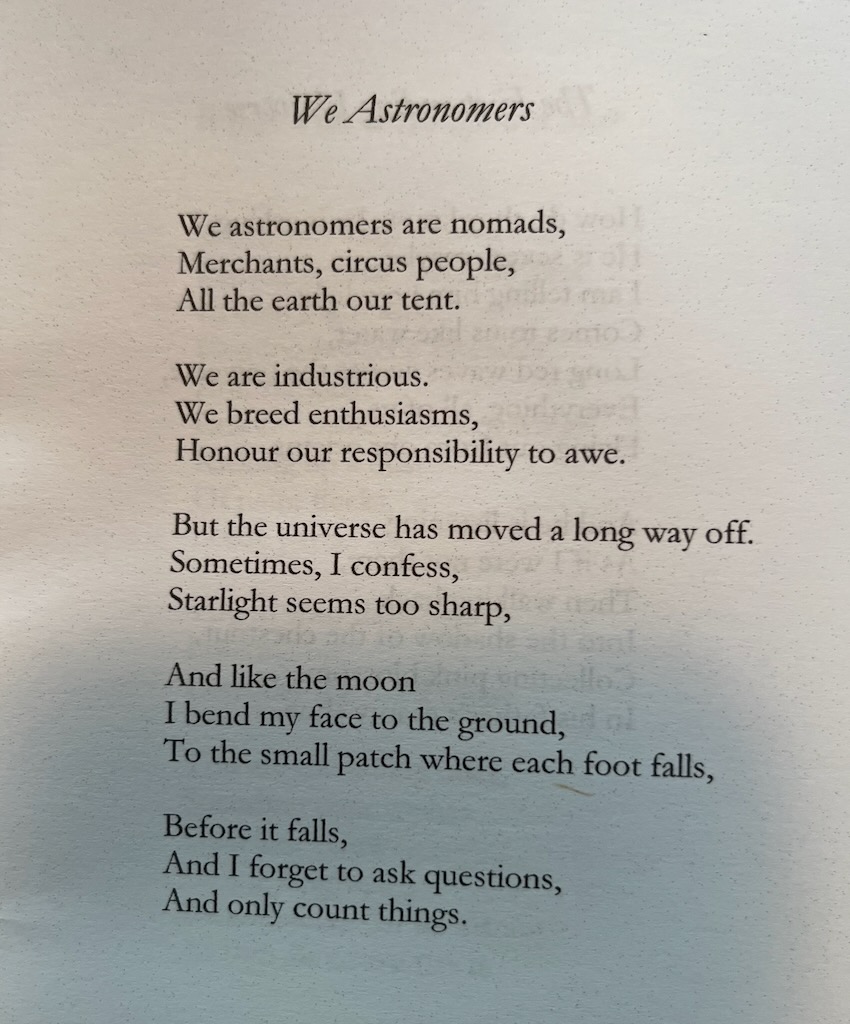
i’ll leave you with a page. . .
have a blessed, awe-filled week….


oh, i promised my dear friend wini i’d share this wonderment she is bringing to town (town being chicago, or the northern environs to be specific). wini is a poet, and she’s worked closely with, and had one of her poems judged “best in class” by the marvelous poet rosemerry wahtola trommer. wini, who makes things happen, invited her and now is inviting all of us for a day of poetries. part workshop, all wonder, it promises to be a day to remember. here are the details, courtesy of wini:

Come experience the gorgeousness of poet, teacher, and storyteller Rosemerry Wahtola Trommer. This event is about more than just poetry; it’s a chance to listen to what is true in your heart and open to “The all of it — the Beauty and Sorrow.

It is beyond lovely to be in-person with Rosemerry, and truly what a treat to sit in community again with like-minded people, and to uplift and celebrate each other’s beauty and light.

I hope you’ll join us. It would be so lovely to see you again.

  • When: Saturday, September 27, 9:00 a.m. – 3:00 p.m. (lunch included)
  • Where: Valley Lo Club, Glenview, IL
  • Details: Three different ticket prices are available.

Buy your ticket here

thank you, wini, for bringing this priceless gift…..

acquiring acquaintances: another name for pen pals

it started because months, or maybe years, ago, i stumbled onto a poem that took my breath away. it was written by a poet i’d not known of, didn’t think i’d ever read. but the poem, titled “Nativity,” stayed with me, a poem that paints the first Christmas scene in strokes and shades that settled deep into my marrow, and forever more are the Christmas i imagine.

it’s a poem that lays the baby Jesus in a rough-sawn barn, the air pungent with animal. “the wind tugging at the shutters.” there is nothing gilded about it. and it was written, i knew right away, by someone at ease with being small, tucked off in a corner keeping watch. it was written, i could tell, by someone whose very veins course with humility, and understood a God who preached the same, a God who asks us to get about the business, the holy business, of loving as we would be loved without noise or bombast or folderol.

the poet’s name is kenneth steven.

it turns out he lives on an isle on the scottish west coast, a place where the wind might tug at shutters. and it turns out he is something of a polymath: a poet, a painter, a children’s book writer, a translator of great works. and, above all, something of a pilgrim, a pilgrim seeking the quiet beauties that punctuate the everyday. he calls them “atoms of delight.”

and he writes of pilgrimage: “the word is often used to describe the journey to a shrine or sanctuary in search of spiritual transformation, which is a meaning i acknowledge. but now pilgrimage has become a much bigger thing for me; it has gone far beyond that rather heavy and medieval sense of going on a journey to visit a holy site. why shouldn’t it be about a walk to a hill loch to listen to the impossibly beautiful singing of red-throated divers? why shouldn’t it be about a child running into the forest in the early morning to find the treasure they dreamed of? these are journeys of the heart, seeking the profoundly precious places where little miracles happen. and why shouldn’t it be about panentheism—the finding of God in all things?”

it’s not hard sometimes to recognize a kindred soul.

what is hard is to imagine finding yourself in conversation with such a kindred someone. but that’s what’s happened. kindness is the thing that opened the door, his kindness. in a world ruled by transaction, where fees are paid and contracts signed for any exchange of goods—be it words or bricks or lumber—kenneth steven lives otherwise.

i found that out not long ago, when, during the editing phase of my next book, i dove into the task called “permissions,” in which for any chunk of text—poetry or prose or lyrics to a song—beyond a certain measure, you must secure permissions from its author. this can be a costly exercise. and it is always one that makes me quiver, wondering what walls i’ll encounter, and what cold-shouldered hubris i might have to tiptoe through.

it’s that poem, “Nativity,” that’s stayed with me all these years. and i’d included the whole of it, eight lines, at the start of an essay that i hope to include in the book.

wondering if i was whistling into the wind, i sent off a proper letter, the digital kind, and shipped it cross the sea. i’d no idea if mr. kenneth steven would ever reply. but, lo and behold, come monday morning, there he was, tucked kindly in my mailbox. and more than generously writing: “of course you are more than welcome to use the poem. i’m sure you’ll mention where you found it.”

and thus, with the stroke of his generous heart, a friendship has unfolded. and a treasure trove of poetries have now brushed through me. and i am richer for this scottish friend who, as a boy, awoke one night at midnight, and hearing a great and ferocious wind, hurriedly dressed and left the house, where he climbed a hill in howling winds, before crossing through a field to reach his favorite tree, where he knew the horse chestnuts would be falling, and he was out to save them, to gather them up. “i felt given a whole world,” he writes in an essay about the midnight escapade. “it was about the autumn and the big winds, and the thrill of running up that long hill and entering the field at last at what felt like the middle of the night.” and the indescribable delight of knowing “that all this treasure was mine.” the treasure: a cloth bag of chestnuts shaken from the limbs, their deep and woody smell, orbs that looked as though they were made of shoe leather.

befriending him, he who writes me every day now, sometimes more than once a day, is magical. is akin to befriending any of the authors from my childhood who’ve long entranced me, drew me into storybook tableaus: tasha tudor; e.b. white; frances hodgson burnett, who wrote the 1911 children’s classic, the secret garden, a book that featured my holy trinity—an orphaned girl, a padlocked garden, and a robin redbreast that finds the key—and once prompted me to fake a fever so i could skip church one sunday to stay at home and turn its pages.

long ago, when i’d be asked if i’d ever want to write a book, i demurred, brushed away the thought. didn’t think i could hold a thought long enough to pen more than a few pages. i didn’t know, though, that the magic of a book comes in all the threads unspooled along the way. threads that carry me to places far and wide, and to souls i’d never otherwise know. but words, like little birds, or prairie seeds, catch on the wind and settle into fertile loam. and we are richer for them.

in much the way, my beloved chairs, through all the words and all the years, have become my dearest treasures.

bless you.

love, bam

have you a penpal in this digital, globe-crossing, email world? someone you’ve not met but who seems a certain friend?

i promised kenneth i would share word of his beautiful meditative podcast, Imagining Things, on the patreon platform. recorded in a studio that seems to be just behind his island home, you can sometimes hear the scottish winds blowing off the atlantic, and a bird or two not far away. (or maybe i’m imagining.) and of course he speaks in a scottish-soaked timbre, and in between reflections he shares poems that will make you hit rewind so you can listen once again, so breathtaking are the lines.

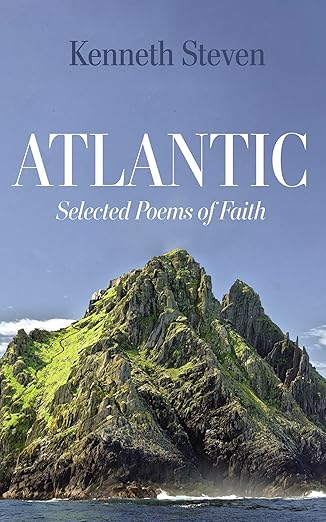
his latest book, one that should be landing on my front stoop within days, is Atlantic: Selected Poems of Faith. but i’m already deep into Atoms of Delight: Ten Pilgrimages in Nature, and Iona: New and Selected Poems.

prodigal professor

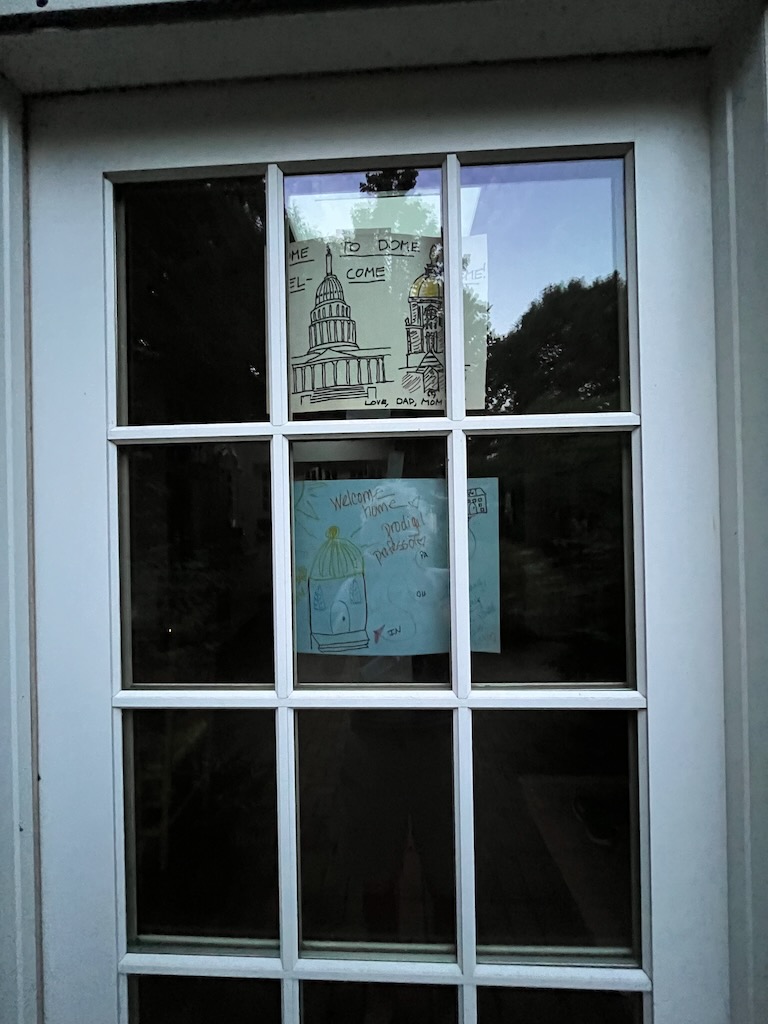
i poured myself out of bed minutes before three last night, as i seem to do like an old swiss clock. and in the murk of the dark, as i stumbled toward the bathroom, a thought crept forth reminding me this wasn’t any old middle-of-the-night trip to the bathroom, this was a night in which the professor was in the house. sleeping under this old roof. back in the room where he grew up.

it’s been 13 years, and a whole lot of law school, and bar exams, and zigzagging across the country. there’ve been trips to the ER that scared the behoozies out of me, and weeks that were hard, and hours that were glorious, but the kid with the dream, the kid who with all his heart was hoping to get back to this middle-of-america, one-of-a-kind american city, that happens to be “home,” is back. for at least a year, an equation my mind is still trying to absorb. any time he’s been here in all these years, it’s only been for a day or two, a week at the most. there was always an end date, a date he’d be leaving, and we’d be back to texting and calling. and missing.

he drove 12 hours to get here. he and a car stuffed to the gills with law tomes and professorial garb. and he’s here now, a truth i witnessed just now with my very own eyes as i tiptoed in the dawn’s thin light past the old room where he’s slumbering. i saw the lump in the bed: proof!

truth is, what prompted him most to want to come home, is that he, like the rest of us, had the behoozies shaken out of him by whatever it is that lurked/lurks in my lungs. we all know the grains of time are gliding from one end of the dial to the other. it’s a subtraction, no matter how you cut it. and so we are hellbent on making addition of it. in the best ways possible. in filling the vessel of time with pure unfiltered joy. pushing our hearts to our sleeves. living a life of heart-thumping gratitude. that’s a word so over-spun it’s lost what it means, but when you get to the heart of it, it’s living a life where the thin veil is lifted, the veil between heaven and earth, and the presence of God, of love, is palpable, is visible in the form of the wonders in which we’re immersed: the soft morning sounds, the laughter of knowing each other by heart, the hand reached across a table and squeezed.

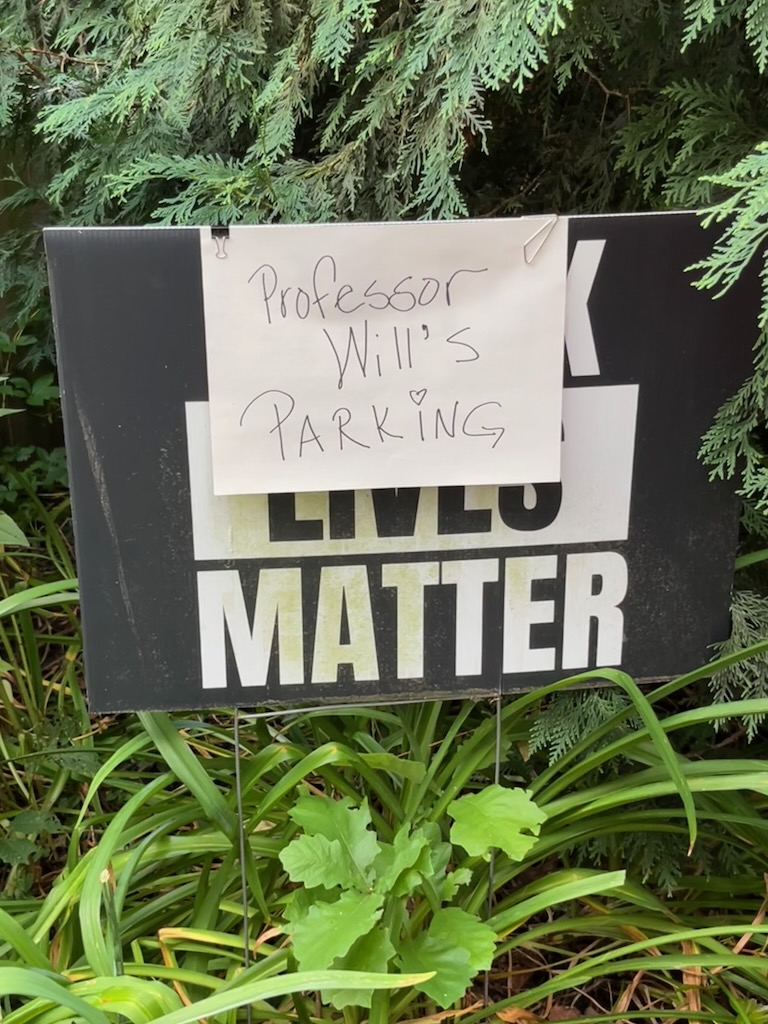
so happens the kid got an invite to teach for a year at a law school not too far away. south bend, indiana, a destination i could reach by lunchtime if i decided at 10 in the morning to head there. he’s moving into an old farmhouse tomorrow, a house out in the country, where apples and peaches hang from the limbs in the orchard out back, and raspberries grow fat on the brambles. it’s a genius invention called a sabbatical home, where one professor hopscotches away, leaving behind a fully-furnished, fully-equipped home (straight down to the pioneer-grade hearth in the hoosier kitchen), and another professor on the visitor’s wheel moves in. keeps the place running, the lights on, till the semester ends.

it’s not lost on me how hard he worked to get here, nor the one or two strokes of pure chance that propelled this along. in these months when i’ve whittled my life to those rare few things that truly matter, being the four of us—mom, dad, and two kids, together, rolled in a ball—is at the tippy top of the list. i’ve imagined the hour when i take my last breath, and what i know is that the last faces i want to see in this life are the three of them, circling round me. i’ll promise to haunt them. and, so help me, i’ll do it. the friendliest ghost there ever was.

for now, though, i’m here and i’m kicking. we all are. and we’re holding on. and i am ever so grateful to the university of notre dame for bringing my beautiful beautiful boy, the professor, back home where we all belong.


radon update, for anyone who wondered: we’re not out of the darn woods yet. in fact, the trail is only more twisted. the little disc i bought on the internet, the one reputed to be so accurate, it’s still flashing bright red, a color that signals far more than caution. it’s readings are high, scary high. but the actual professional radon tester is now on the third round of testing, and each time we’ve passed with enough room to breathe. she’s now as curious as i am as to why the disparity in readings, and we’re about to be stuck in the balance of deciding what to do. it’s no small feat to remediate for radon, though i don’t think it entails knocking out the basement out from under us. my date with the pulmonologist has been moved up from november to next month, and maybe they’ll know from looking into my lungs if there’s any sign of radon’s wreaked havoc. once again: uncertainty, the state of existence i dwell in.

that’s the news from here at the house that might be glowing.

love, babs

do you have a prodigal story?

public health announcement: check your darn radon

so, in the latest twist and turn over here in medical odyssey land, a very fine pair of doctors looked into my lungs the other day, and saw yet another odd thing. and the oddest thing is, they don’t think it’s cancer in the other lobe, but they do think it might be radon. RADON! the number one cause of lung cancer in never smokers.

because we were zooming, the doctors were able to see the room behind me, and a room you might note for its decidedly not modern detail. it’s a fairly old house, though not old by historic standards. it’s 1941, which means it’s older than 1970 when homes started to be built with attention to radon, a radioactive gas naturally occurring in the earth. i’ve been breathing here for twenty-two years.

the good doctors wanted to know if we’d ever checked for radon. yes, yes, i quickly answered, sounding just like the girl who sat near the front of the classroom, waving her hand whenever she knew the answer—especially when she knew it faster than everyone else. (i am poking fun at myself here, lest you not see that!) anyway, back to the radon and the trusty detector i got two years ago when i first learned i had mysterious lung cancer. soon as the doctors finished their question, i pointed straight to the detector so the good doctors could see where i’d tucked it. um, not so good, they replied in unison.

the very good doctor explained that radon can only be detected in the first few inches off the ground, and it has to be measured at the lowest point in the house, where the foundation rubs up against ol’ mother earth. that meant the basement. where i’d never measured, even though i’ve been down there an hour a day walking on the treadmill for as long as we’ve lived here, all twenty-two years.

don’t you know that the second we got off the phone i was lickety-split in the basement with that little detector that until then had always flashed green, giving me the falsest assurance that all was well at chez 522.

took but five minutes for that ol’ detector to turn yellow (not so good) then red (get outa here folks!). and as i felt my heart sinking, and my tummy beginning a series of flipflops, i scampered back up the stairs, to report the damage to my fellow breather in this old house.

any minute now the radon detector lady is going to be knocking at the door with her super-duper testing devices. she’ll track our radioactive gas over the weekend, and come back monday to fetch it and read it. she will write up her report and pass it over to the very kind guy who will come to our rescue, apparently boring a hole through to the earth below, sucking out the noxious gas, and blowing it out through the roof. the mechanics of this are unbeknownst to me, but whatever they want, they can do. PVC pipes running through the living room? no problem. please, just save what’s left of my lungs.

in the meantime, i’ve let my doctor know the results of my home-testing detector, one thought to be accurate. and she’s snared me an appointment with the top pulmonologist at U of C, though i can’t get in till november. i’m thinking this stuff they see in my right upper lobe (my left lower is the lobe now missing) might explain why i get so exhausted, and why i sometimes feel pale as a semi-ghost. and why when i try to breathe and talk and walk, one of the three has to go.

so why i am divulging all this before i know more, before i have answers? because my doctor, who i loved at first sight, told me that too few people are aware of the dangers of radon; i know that, for me, it was merely what sounded like an infomercial droning on in between dramas, or noise on the car radio.

but, people, it’s real. and i have the holes in my lung to prove it, it seems.

my doctor, already known as the world pioneer of a particular lung cancer mutation, suggested we team up together for an awareness campaign. i’m all in. and i wasn’t willing to wait for definitive answers. i’m starting with this, and with you, my beloved, breathable chairs.

what i know is this: my lung is missing a part, my breathing doesn’t come easy too often of the time, and my detector is flashing red rings. i don’t want any of that to happen to you.

my doctor says that chicago is especially bad, with higher naturally occurring radon than other places. but she says that too few of us know. too few of us think of it.

here’s what the EPA, that now shaved-to-the-bone federal department charged with saving our air among other things, has to say about radon: “Radon is a radioactive gas that forms naturally when uranium, thorium, or radium, which are radioactive metals break down in rocks, soil and groundwater.”

gets a wee bit more vivid when you turn to plain ol’ google, now powered by AI: “Radon is a naturally occurring radioactive gas, invisible and odorless, produced by the breakdown of uranium in soil, rock, and water. It can seep into buildings, particularly through cracks and openings in foundations, and accumulate indoors, posing a lung cancer risk if inhaled. Testing and mitigation are crucial for managing radon exposure.”

radioactive, invisible, risk, and crucial, are all words that grab my attention. mightily.

it’s never too early to be warned of a risk that might mess with your lungs, so while i wait for vicki the radon detector to knock on the door, i want you to know that if you happen to live in an old house (the kind i’ve always loved best), and it sits on the ground, or worse yet, was plopped in a hole in the ground (the standard for two-story-or-more construction), you might wanna look into your radon.

i’ve no desire to be the poster child for radioactive invisible gases that can eat away at your lungs, but if that’s who i am then so be it. i offer my troubled breathing for your protection. please, please consider it.


and because that’s rather a dark chunk of news to drop on your laps this morning, i bring you one magnificent poem to even things out.

barbara ras

appropriately, it’s titled, “you can’t have it all,” and it’s glorious…..the poet is barbara ras, an american poet, translator, and publisher, born in new bedford, mass., and traveled extensively in central america. she’s been honored with the walt whitman award, and both guggenheim and breadloaf fellowships. her most recent poetry collection is The Blues of Heaven (University of Pittsburgh Press, 2021), preceded by The Last Skin (Penguin Books, 2010), One Hidden Stuff (Penguin Books, 2006), and her first collection Bite Every Sorrow (Louisiana State University Press, 1998). soon as my radioactive gas is dashed from this ol’ house and my edits are all wrapped up, i am diving deep into ras…..

YOU CAN’T HAVE IT ALL
by Barbara Ras

But you can have the fig tree and its fat leaves like clown hands
gloved with green. You can have the touch of a single eleven-year-old finger
on your cheek, waking you at one a.m. to say the hamster is back.
You can have the purr of the cat and the soulful look
of the black dog, the look that says, If I could I would bite
every sorrow until it fled, and when it is August,
you can have August and abundantly so. You can have love,
though often it will be mysterious, like the white foam
that bubbles up at the top of the bean pot over the red kidneys
until you realize foam’s twin is blood.
You can have the skin at the center between a man’s legs,
so solid, so doll-like. You can have the life of the mind,
glowing occasionally in priestly vestments, never admitting pettiness,
never stooping to bribe the sullen guard who’ll tell you
all roads narrow at the border.
You can speak a foreign language, sometimes,
and it can mean something. You can visit the marker on the grave
where your father wept openly. You can’t bring back the dead,
but you can have the words forgive and forget hold hands
as if they meant to spend a lifetime together. And you can be grateful
for makeup, the way it kisses your face, half spice, half amnesia, grateful
for Mozart, his many notes racing one another towards joy, for towels
sucking up the drops on your clean skin, and for deeper thirsts,
for passion fruit, for saliva. You can have the dream,
the dream of Egypt, the horses of Egypt and you riding in the hot sand.
You can have your grandfather sitting on the side of your bed,
at least for a while, you can have clouds and letters, the leaping
of distances, and Indian food with yellow sauce like sunrise.
You can’t count on grace to pick you out of a crowd
but here is your friend to teach you how to high jump,
how to throw yourself over the bar, backwards,
until you learn about love, about sweet surrender,
and here are periwinkles, buses that kneel, farms in the mind
as real as Africa. And when adulthood fails you,
you can still summon the memory of the black swan on the pond
of your childhood, the rye bread with peanut butter and bananas
your grandmother gave you while the rest of the family slept.
There is the voice you can still summon at will, like your mother’s,
it will always whisper, you can’t have it all,
but there is this.


most importantly of this fine day, it’s my beautiful beautiful miracle boy’s 24th birthday. two dozen sumptuous years of loving the kid whose insistence on “seeing the world” prompted us leap outa the nest, and spend a year of thinking sumptuously in yet another one of the current administration’s targeted campuses, the one in cambridge, MA. he is perhaps the sweetest soul on the planet, with the tenderest heart. he’s the first to reach for my hand any time there’s a step to descend or a sidewalk that might be riddled with bumps. his birthing, two dozen years ago on the night just passed, was dicey there for a while, but with every drop of sinew and soul that i had, i did what the doctor ordered and got him delivered to safety, soon nestled as close to my heart as any human can be. happy birthday, teddster. love, love, love, your ol’ mama.

is that not a face you could love till the end of all time?

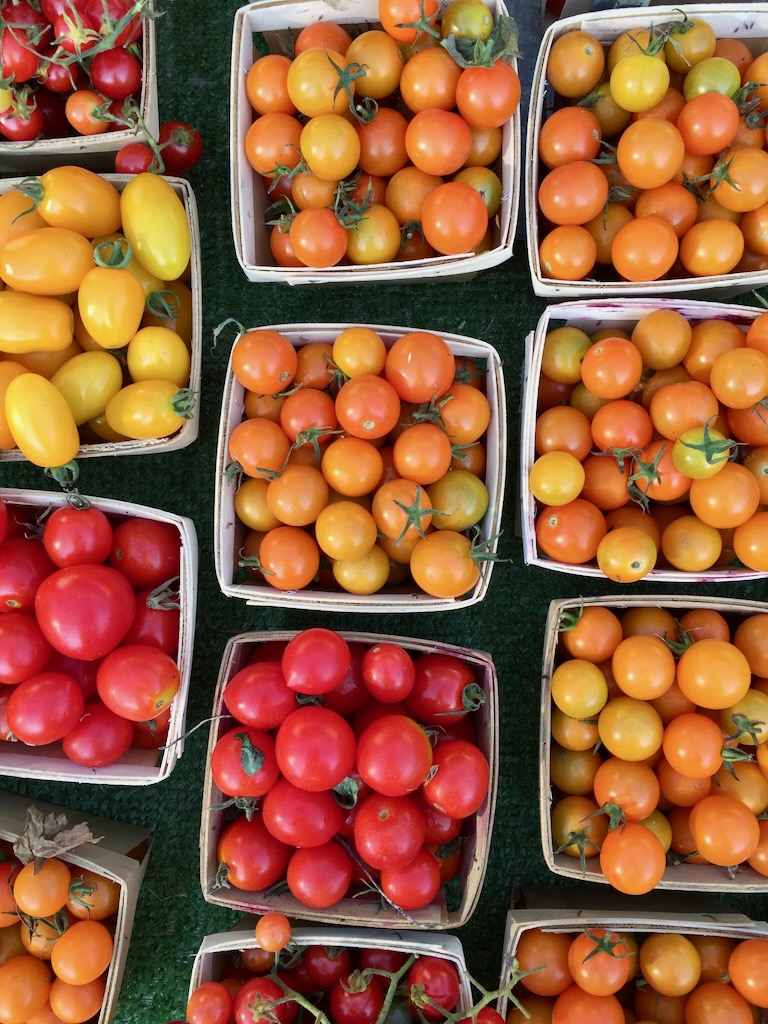
ode to summer’s drippiest fruit: the tomato

in which we begin with news: ol’ babs signed a book contract yesterday; the book, it so happens, is already written (sorta unfurled swiftly, once i started to type), and already back from being edited (the contract was agreed upon back in may, but these things take time to get shuffled around the publisher’s desk.) and now i’m knee-deep in responding to edits, cranking the dial in an attempt to make it worthy of the paper on which it shall be printed, and the bookshelves on which it might take up real estate. more details shall come but what i can tell you now is that the working title is When Evening Comes: An Urgent Call to Love, and the epigraph pretty much points to the heart of the book:

“When the evening of this life comes,” says St. John of the Cross, “you will be judged on love.” The only question asked about the soul . . . “Have you loved well?”
––Evelyn Underhill, The House of the Soul

in a nutshell, it’s a collection of essays exploring the spiritual awakening and very real tremblings that come with cancer. a subject with which i’ve been living for the last two years. so, while i’m deep in the fine art of toiling over the words that will or won’t wind up in the book, i leave you today with the simple tomato, summer’s drippiest fruit, and my all-star contender for the juiciest mouthful of summer.

it’s summer and living is easy. and beginning to drip down our chins. at least in the tomato aisle, that is. because i am deep in the task laid out above, i am leaving you today with the simple tomato. and pablo neruda’s sumptuous ode…

my recipe is this:

pluck the reddest orb faintly tender to the touch. 

slice, or halve into hemispheres, if you’re the poet neruda.

sprinkle with a dusting of sea salt.

add a grind or three of tellicherry peppercorns.

lean over sink.

employ your top teeth and your jaw.

clamp down.

dribble.

repeat. 


and now for the ode, one of the many neruda wrote in the later chapters of his life. what’s more than charming—and so very wise—is that neruda, the chilean poet and nobel laureate, wrote odes to the simplest things, training a poet’s eye—and thus ours—on the wonders right before us. it’s a lifework worth emulating.

while poking around, i found a marvelous ode to the odester on the website of a chap named huck gutman, who happens to be not only a professor of english at the university of vermont, but the former chief of staff to bernie sanders. who knew?!?!

of pablo neruda, the great chilean poet, huckman writes that he is particularly fond of his late ‘odes’. he goes on:

the good poet pablo

“I love these poems in praise of his socks, his suit, lemons, and other everyday objects.  They speak to me very powerfully about the wonderful world we inhabit.  His aim, as I say in the long introduction to his poem, was to speak to those he lived with about the shared wonder of our world.  He set out to speak not to intellectuals or ‘lovers of poetry,’ but to his neighbors in the small coastal town in northern Chile where he lived.  The language of his odes is simple, the imagery rich but drawn from the experience all humans share. In a century when too frequently poetry seems divorced from the concerns and language of everyday life, Neruda embraced the commonplace and made it uncommon, though still shared. 

 “Neruda’s love of the richness of the world was hard-earned.  He lived a full life, of sorrow and suffering as well as joy and love.  He was acquainted with alienation and oppression, with persecution and exile; he also knew the glories of tomatoes. 

 “One of his close friends was Salvador Allende, the socialist who was elected President of Chile and then overthrown by Chile’s right-wing military (with, tragically, the collusion of the American CIA).  Neruda, already ill with cancer, died shortly after Allende perished in the coup which ended both his presidency and Chilean democracy.” 

Ode to Tomatoes 
by Pablo Neruda

The street
filled with tomatoes,
midday,
summer,
light is
halved
like
a
tomato,
its juice
runs
through the streets.
In December,
unabated,
the tomato
invades
the kitchen,
it enters at lunchtime,
takes
its ease
on countertops,
among glasses,
butter dishes,
blue saltcellars.
It sheds
its own light,
benign majesty.
Unfortunately, we must
murder it:
the knife
sinks
into living flesh,
red
viscera,
a cool
sun,
profound,
inexhaustible,
populates the salads
of Chile,
happily, it is wed
to the clear onion,
and to celebrate the union
we
pour
oil,
essential
child of the olive,
onto its halved hemispheres,
pepper
adds
its fragrance,
salt, its magnetism;
it is the wedding
of the day,
parsley
hoists
its flag,
potatoes
bubble vigorously,
the aroma
of the roast
knocks
at the door,
it’s time!
come on!
and, on
the table, at the midpoint
of summer,
the tomato,
star of earth,
recurrent
and fertile
star,
displays
its convolutions,
its canals,
its remarkable amplitude
and abundance,
no pit,
no husk,
no leaves or thorns,
the tomato offers
its gift
of fiery color
and cool completeness.

which lines made you marvel? what’s making your mouth water these days?

tomato madness: slow-roasted cherries from the vine out back