
pull up a chair

where wisdom gathers, poetry unfolds and divine light is sparked…

Month: April, 2025

Dear God, thank you.
Dear God,

Um, I hate to be so bold but we could have used him a little bit longer. (You undoubtedly already know that.) Things are pretty rough around here. Whole swaths of this holy earth, and the people who populate it, seem to have lost their minds. And maybe their souls. 

As You most certainly know, and definitely must have heard, his was the rare voice that could drown out the ungodly noise. The cacophonies of greed and grievance, the ugliness of sin and the Self that thinks it’s higher and mightier. He didn’t let up when it came to the terrible, terrible traumas of war—newborns bombed in hospital nurseries; toddlers drowning in turbulent seas, washing to shore, as if cast-aside flotsam; whole families entombed in the rubble of raining-down concrete and rebar in murderous twists.

He called it where he saw it: called out the avarice of modern capitalism and consumerism, diagnosed it as the fundamental root of the exploitation and suffering of the poor and the vulnerable. Named it “the Devil’s dung.”

He minced not a word in a letter to American bishops this February, when in the wake of the current administration’s drastic deportation campaign, he wrote that while nations have the right to defend themselves, “the rightly formed conscience cannot fail to make a critical judgment and express its disagreement with any measure that tacitly or explicitly identifies the illegal status of some migrants with criminality.”

He didn’t stop there: “The act of deporting people who in many cases have left their own land for reasons of extreme poverty, insecurity, exploitation, persecution or serious deterioration of the environment, damages the dignity of many men and women, and of entire families, and places them in a state of particular vulnerability and defenselessness.”

Il Papa, il mio papa!

Oh, dear God, thank you immensely for making his lifetime line up, at least for a while, with mine. I was starting to fall off the edge there, till the first puff of fumata bianca arose from the Vatican chimney back on March 13, 2013, and the bells from St. Peter’s rang through the city.

Dear Francis filled my lungs again. He preached the version of You that I’d long pressed to my heart, the One taught to me by my post-Vatican II Sisters of Loretto, they who puffed cigarettes behind the convent, traded in their flowy black habits for street clothes and lipstick, all while strumming guitars and singing kumbaya, and all while watching films like “The Red Balloon,” where we little Catholics were meant to evoke the godly meaning from the metaphor.

He was, far as I could tell, a walking-talking, put-your-money-where-your-mouth-is, “love as you would be loved” kind of a guy. He colored wildly outside the lines, as if to shake us out of our stupors, our thinking the ways of the world were the only ways there were. As if to remind that love, honestly, could shatter the worst kind of walls, break through to the tender core at the heart of us all—the one You nestled inside all of us when You breathed us into being. 

His time as the 266th charge of the Church was something of a Kodak carousel of indelible encounters, the ones you cannot forget because they sear you so soundly. (p.s. He was mighty fine with the pen, as well; at least one modern poet called him “the most literary pope of the modern Vatican.”)

He took on no airs. Which made his message all the more of a wallop. He seemed to be saying that we too, in our fumbling, bumbling, banged-up bodies, we too could reach for the heavens. 

His message, quite simply, was to remind that we’re all equipped and ready to cut a swath of radical love through this world. 

And what I really loved about the beloved Argentian Jesuit were the moments when he reached out his arms, and cradled the sobbing child, especially the little boy whose atheist papa had died, and the boy was so very worried about what would happen to his papa. When the little guy was all but choking on his sobs and the words to his question, “Is my dad in heaven?” Francis called out to the little boy, “Come, come to me, Emanuele. Come and whisper it in my ear.” And everyone sobbed, while Francis quelled the boy’s fears and spoke to the crowd: “What a beautiful witness of a son who inherited the strength of his father, who had the courage to cry in front of all of us,” Francis said. “If that man was able to make his children like that, then it’s true, he was a good man.”

Or the little ones born with an extra chromosome who sometimes wandered curiously right onto the altar in the middle of Mass, or a homily, and instead of shooshing the child away, he stood there beatifically smiling, clutching their soft little hand. And went right on with his papal business.
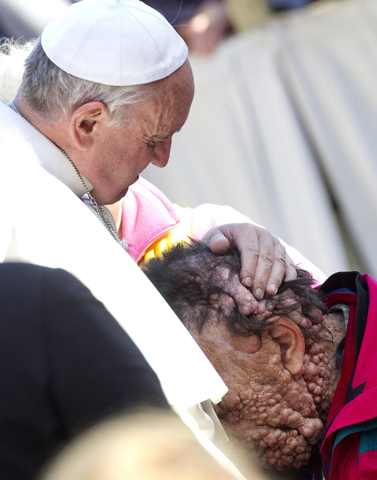
Pope Francis embraces Vinicio Riva, the man with neurofibromatosis.

Or that indelible image of Your Francis first kissing then cradling the man with the eruptions of leathery tumors curdled across his face, his scalp, and clear down his neck. 

And what struck me most, dear God, when I awoke Monday morning to the news that he’d died in the night, was the sudden stunning realization of how breathtakingly he had died—a lesson for us all, and surely for me. I believe he knew these were his last days on earth, when he insisted on leaving the hospital, and knew that until he breathed his last he would teach his last most lasting lessons. In the last week of his life, he visited with 70 prisoners in Rome’s Regina Coeli Prison, from a balcony overlooking St. Peter’s Square he blessed the crowds, and in his Easter Sunday sermon he begged for mercy for “the vulnerable, the marginalized, and the migrants.” He also sent an emissary to preach compassion to the nation’s second-highest ranking executive officeholder and fairly recent convert to Catholicism. 

And then, and only then, he breathed his last. 

I barely have words for the emptiness left in Francis’s wake. It’s rare these days to find a soul who’s proven her or himself worthy of speaking such penetrating truth that the whole world turns an ear to listen. 

We listened, and some of us shouted silent hallelujahs every time. 

We are a world with a spinning moral compass. Up seems down, and right and wrong are inside out and sideways. Hate is cloaked, too often, as a return to the old ways. Truth is chopped into bits and spit back out in bilious flows. 

Are we meant to be the collective voice to fill the new and jarring silence? Is that the point? He constructed the paradigm, handed us the blueprints, and now it’s us who must step to the line, to be brave now? 

Maybe it’s a blessing that much of the world is weeping. Maybe, if we follow our tears, we’ll dig down and rise up. Maybe, like Francis, we can look out at the battle field that is the world and make of ourselves the field hospital set to begin to stanch the bleeding, and work to heal some of the wounds. 

Anyway, God, we’re on it. And thank you, thank you, thank you.

Love, BAM

what memories or moments of Francis most lastingly speak to you?

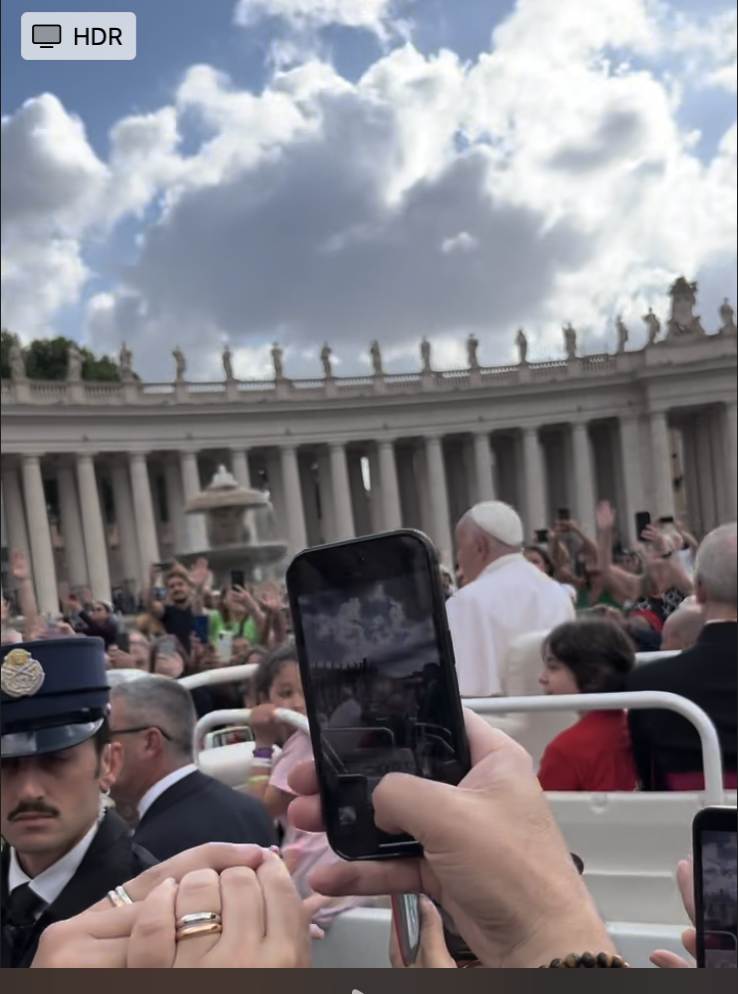
photo above is from the little video i managed to capture when i managed to all but stumble into the path of the oncoming PopeMobile this past summer in St. Peter’s Square….

and p.s.s. a letter to God, i figured, called for capitals. thus, i made rare use of the shift key this morning….

the nautilus of sacred time

last night, from my wooden pew in the great stone nave that is the church where i pray, i listened to the words spoken from the pulpit, and i imagined back in time to the night in a garden when the man and God wept. i imagined his betrayal. i imagined how he was tried on charges trumped, convicted by the roar of a deafened and deafening crowd, then stripped, and flogged, and soon told to carry the cross upon which he would breathe his last and die.

i thought of who this man-God was: how he’d upturned the tax-collectors’ tables, and the moneychangers’ too. i thought of how profoundly he lived and breathed the words of Torah, how he prayed the sh’ma; the v’ahavta, too. (“you shall love Adonai your God with all your heart, with all your soul, and with all your might.”) and i listened to the priest who, in his sermon, said that the man, named Jesus, had on this holy night gathered his disciples, the ones who’d turned over their lives to him and his teachings, and how just before the grueling hours in the garden, he’d shared the Seder, the Passover meal, and one last time taught his truest, lasting lessons.

before he did, though, he broke rank, broke tradition, this soul who lived not by worldly rule. he rose amid the telling of the exodus from egypt, took off his outer robe, poured water in a basin, tied a towel around his waist, and began to wash the dusty feet of those who’d gathered one last time. this man soon to be accused of claiming to be king took on the servant’s role: he bent, pressed his knees to the floor, and one by one, he washed away the grime.

and then he spoke his one last teaching:

“I give you a new commandment,” he began in the hours before betrayal, “that you love one another. Just as I have loved you, you also should love one another. By this everyone will know that you are my disciples, if you have love for one another.”

as i wrapped myself in the whole of those words, spoken by the Jesus who would soon be crowned with thorns, the priest called us to come forward, to bare our bumpy calloused feet, the ones with toes oddly angled, and nails often yellowed or purpled or however one’s toes age. and then we knelt. and washed each other’s feet, a posture of utter and bottomless humility. “thou shalt love as you are loved.” we poured warm water from a pitcher, and we grabbed a freshly folded towel, and wiped each toe and heel and sole. we washed each other’s feet, an act of reverence in which we’re at once stripped of all pretense, exposed—and yet and yet, we’re met with tender loving kindness, our naked flesh bathed and dried, wiped of earthly dust.

against all of this, a newsreel spooled through my mind. in particular, a single prisoner held behind merciless bars. i was stunned in the contrast: how sacred time, year after year, returns us to the ancient, timeless themes, the ones my parents learned and lived, and their parents too. and theirs, and theirs.

i thought of how starkly this year the sacred story stands against the backdrop of the worldly news. how trumped up charges are once again in play. how there are those who’ve been stripped and shorn. made to sit in ungodly postures, crammed like urchins in a tin can. locked behind bars. held by merciless guards.

that newsreel cracked open in my mind a way of seeing the night of betrayal, the trial and the dusty road to golgotha in dimension i’d not seen quite so viscerally before.

as we knelt and washed each other’s feet, i would later read, a senator who would not be refused, who would not leave the prison gate, had persisted. had finally sat beside the man who’d all but disappeared. gave him but a simple glass of water. “love as you would be loved.”

this year, as the world stands gasping, as cruelties beyond our imaginations play out, i found myself wrapped in the timelessness of sacred time. how its truths have not been quashed. how all the cruelties of humankind have still not stilled, nor silenced, the one command of every sacred text: “love as you would be loved.” stand up to evil. kneel and wash the feet of the stranger just beside you. gnarly toes and crusty heels and all.

sacred time is dauntless. worldly time will crumble in our hands.

the rhythms of the church, of sacred time, again and again, point our attention to the timeless. this year, more than ever, i am on my knees and crying out for mercy.

i am cradled in the nautilus of sacred, sacred time where the cruelties of humankind crumble in the face of Holy Breath.

as the altar last night was stripped of every cloth, as every candle snuffed, and we filed out in silence, so too i leave this table unadorned today. and i ask no question. i leave you in silence, in whatever prayers you pray.

may you be blessed in this holy time.

a p.s.: this good friday is especially deep for me this year, as two years ago today i was wheeled into surgery, and came out minus half a lung, and with a worldview forever changed. i see through a clearer lens now, the lens that cancer brings. and i embrace each holy hour like never before. i am, for the first time in at least a decade, home with all my boys this weekend: the law professor, the line cook, the critic, all gathered for the easter-pesach weekend. it gets no holier than this. dear God, for this blessing, i am eternally, eternally grateful.

the great kaleidoscope

“it’s like we’re the great kaleidoscope, all little pieces, but every time you turn it, it’s different. so you and i are made up of exactly the same stuff, but every one of us is unique. there’s only one in all the world. and the same with every petal of a pansy….i’m the star thistle, and the grass, and the dirt. i am you; you are me.”

i tumbled into this most breathtaking old soul, majestic soul, and i shall let her do the talking today. i quickly grew so enchanted by her voice, her deep and gravely voice, a voice that must have traveled rocky roads, that i began to take notes, and i am leaving those notes here: part transcript, part poem. i’m not catching every word but the words i’m catching are those i do not want to lose. it’s as if a great elder has come today to impart something. to share a light, the light she came to know was her one thing to share. to leave with the world.

may we all be so.

may we all by illuminated by this nearly 96-year-old, who is a veritable masterpiece of all that matters. 

and here are notes, in prayer form, in poetry…

that i can still breathe easy
i don’t want to have just visited this world
i want to be a child of wonder and astonishment

i’m having my second childhood now, my happy childhood
i was always the outsider, i was always pointed at,
i always felt terribly self-conscious
so i have fun now

i’m just learning about play
because i didn’t know what play was when i was a child
i think play means exploring, experimenting, being curious,
looking, seeing, being in the body
not being afraid

it’s about the miracle and mystery of being alive

“we shall not cease from exploration
and the end of all our exploring
will be to arrive where we started
and to know the place for the first time”

that’s t.s. eliot.

i had cancer once
and . . .
and afterwards i had surgery
and i felt like i had to give myself a reaon that i was spared.
that i got my life back
and then, over many years,
i saw that i had
something to give, my light

something ineffable that i don’t know
that light of harmlessness and harmony
and singing and being joyful and rejoicing and being grateful

we’re here to experience the wonder of being in a body. . .
to know that we are each other
that we’re the same
we’re made of all the same stuff . . .
we’re little bits of stars, we’re dust

it’s like we’re the great kaleidoscope
all little pieces
but every time you turn it, it’s different
so you and i are made up of exactly the same stuff,
but every one of us is unique.
there’s only one
in all the world.
and the same with every petal of a pansy….

i’m the star thistle, and the grass, and the dirt.
i am you; you are me.

. . . my prayer is to go gently
and as much aware of myself leaving with gratitude and joy
and the satisfaction, “i’m done, i’m outa here. and it’s ok”
it’s all such a mystery

thanks, i wanna say thank you
not try to figure anything out, or understand it

but just be in awe

what’s the secret?
it’s go slow
for me . . .

[breaks into song. . .]

this beautiful film was made by two south african filmmakers who go by first names only as far as i can tell, justine and michael. their mission: to explore our shared humanity. their enterprise is known as reflections of life, formerly green renaissance. i do believe there is a trove worth plumbing…..i do not know the name of this blessedly beautiful nonagenarian so i shall name her simply Wisdom.

as we enter into supremely holy time, in both the jewish and the christian spheres, (are we not always in supremely holy time?), our friend here prompts the question how will you choose to live in awe?

no exit

there seems so little worth my saying these days. the stock markets plunge. the pink slips abound. research labs, the ones that might save lives, are all but padlocked. it’s been argued that measles might be cured with megadose of good ol’ vitamin A, and why not wipe out bird flu by letting it run rampant? (i could not find either fix in my old nursing texts, circa 1976.) 

the urge for me to go mum and wait it out has never felt stronger. i use my political voice in other realms, but feel reticent to bring it here, which has brought me a wee bit of backlash from one or two who think i ought to use this platform as a public square for political discourse. 

i’ve always considered this a space away from the melee, a place where we play by otherworldly rules of kindness, gentleness, mercy. (over my dead body, those will never be abandoned—here or elsewhere.) the mission here, from the very start, has been to train our focus on the timeless truths that course through the quotidian. politics, as worldly as it gets, is messy. by definition, a battle of wills and ways. there’s little room for sacred, and sacred is my aim.

maybe 1,217 posts in 220 months is far exceeding my welcome. maybe the age of trump is my flashing exit sign. but maybe that’s false surrender. 

maybe i’m just too chicken to face the backlash sure to come even if i try to frame my arguments in civil discourse. the flummox here is that the ones i love who see things another way, they are not hearing the same news i am. that’s the breakdown. or a breakdown. the definition of trusted news source seems to have brittled over the years. when i say trusted, i mean objectively combing through the facts, listening to a swath of voices, each expert in her field. (being a talk show host, or a peddler of ivermectin does not make you an expert, in any way, shape, or forum.) and, forgive my peculiarities, but i like my facts delivered without sass, or ridicule, or put-down. vengeance makes me rhymes-with-comet.

“trusted” in the age of trump seems to mean “you see things the way i do, so i will choose to listen to you.” and, by the way, “i’ll trust you’ve done our homework.” all else is evil. is out to get us. is symptom of demented mind.

we cannot converse if our words and thoughts and big ideas whiz by on orbits all their own. and without a grain of truth to stand on, we’re not standing and we have no standing. if i’m in my silo, and you’re in yours, and ne’er the twain shall meet, then we might as well build a wall and cut the continent in half. you take mountains, we’ll take prairie. no one gets the five great lakes. 

even my propensity for gathering bits of poetry and prose is feeling rather flimsy. is it hyperbole to say we’re on the verge of the collapse of democracy? what to call the dismantling of a century of intricate, mold-breaking science and biotechnology? what happened to the beatitudes—blessed are the meek, the poor in spirit, the meek, the merciful? whither the golden rule: love as you shall be loved? be it in africa, or gaza, or ukraine; in blue cities, red swaths, or canada or mexico or greenland? 

though i’m tempted to hold back on poetries this week, to leave this simply as a placeholder, i shall forge quietly ahead with one or two worth tucking in your noggin.

Once upon a time,
When women were birds,
There was the simple understanding
That to sing at dawn
And to sing at dusk
Was to heal the world through joy.
The birds still remember what we have forgotten,
That the world is meant to be celebrated.

When Women Were Birds by Terry Tempest Williams


from my friends at SALT Project, a bit of anne lamott (whose birthday is april 10) laid out in verse form. this is from an interview in 2011 with NPR’s michele norris, a once-upon-a-time chicago tribune writer, who asked annie how the meaning of easter had changed for her over the years:

When I was 38,
my best friend, Pammy,
died, and we went shopping
about two weeks before she died,
and she was in a wig
and a wheelchair. 

I was buying a dress
for this boyfriend I was trying to impress,
and I bought a tighter,
shorter dress than I was used to.
And I said to her,
“Do you think this makes my hips look big?”
and she said to me, so calmly,
“Anne, you don’t have that kind of time.” 

And I think Easter has been about
the resonance of that simple statement;
and that when I stop,
when I go into contemplation and meditation,
when I breathe again and do the sacred action
of plopping and hanging my head
and being done with my own agenda, 

I hear that, ‘You don’t have that kind of time,’
you have time only to cultivate presence
and authenticity and service,
praying against all odds
to get your sense of humor back. 

That’s how it has changed for me.
That was the day my life changed,
when she said that to me.
+ Anne Lamott


and here’s a little nudge from former u.s. secretary of labor robert reich on speaking up in these tough times:

Every one of us has a town square. It may include our social media accounts, our local book club, or our dinner table. Use your town square to speak out in favor of democracy and against what [that which you see as anathema to decency]. Do not shy away from difficult conversations; seek them out. Engage the curious. Educate those who seek information. We all have a role to play, so don’t assume your voice is too faint or your platform too small.

point taken, mr. reich. point taken. i’ll talk decency anywhere and everywhere.


and finally, as i’ve spent these past few weeks tapping out a manuscript for what might be a book, i found these closing lines from WS Merwin’s poem remembering his mentor, John Berryman, to be well worth taking to heart:

I asked how can you ever be sure
that what you write is really
any good at all and he said you can’t

you can’t you can never be sure
you die without knowing
whether anything you wrote was any good
if you have to be sure don’t write


do you remember the most beautiful thing you read this week, or saw this week, the thing that gave your heart a lift????