pull up a chair

where wisdom gathers, poetry unfolds and divine light is sparked…

Month: November, 2024

sated with room for more…

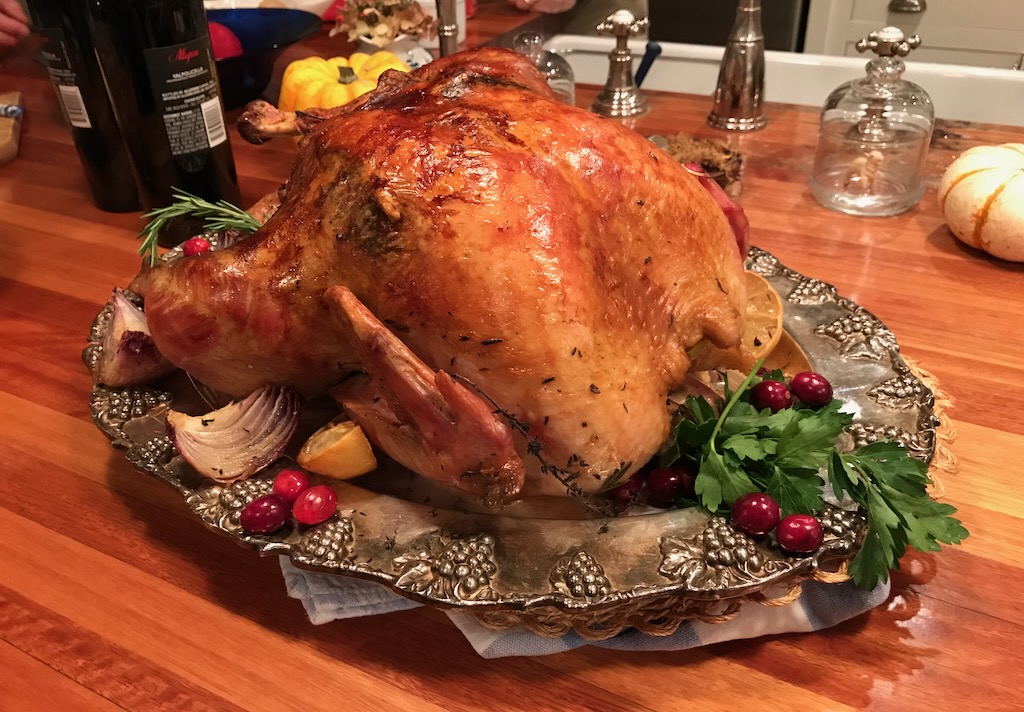
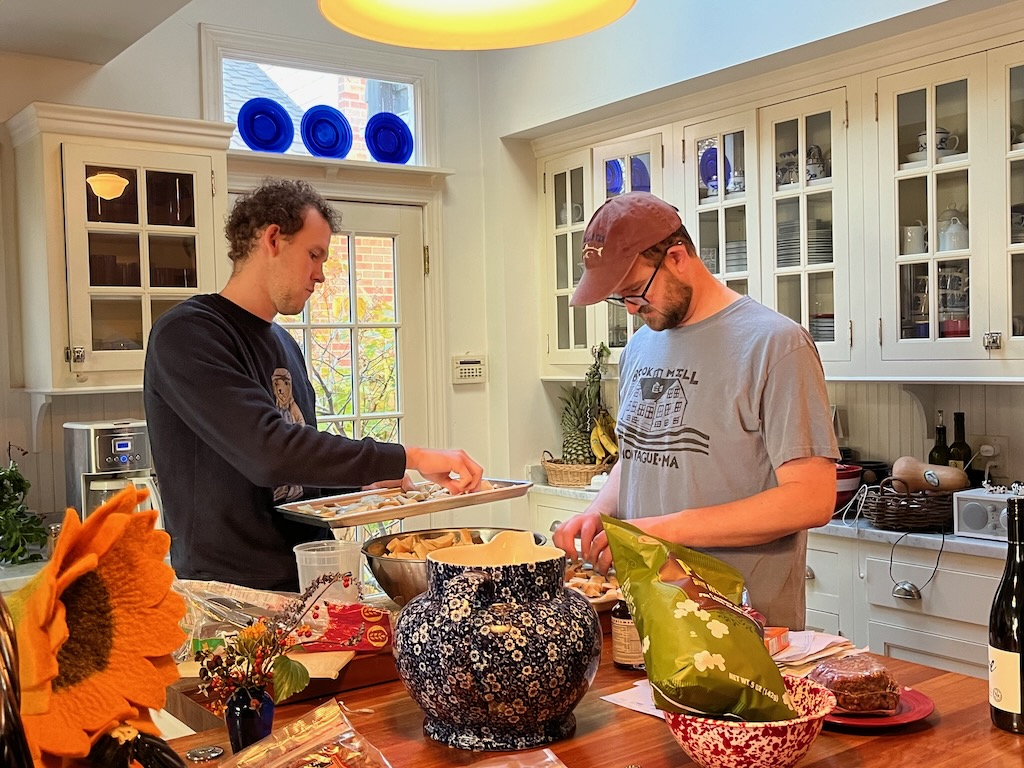
it’s the morning after. the floor by the stove is splattered with something we know was delicious (it’s what happens when a kid who works in a michelin-star kitchen takes to the skillet and starts flipping the beans from pan to air to pan again, with aerial cartwheels in between). the silver and plates still need to be tucked away for their long winter’s rest. the refrigerator shelves are groaning. but the counter is clean, the coffee is on, and there are four more hours till the TSA beckons Boy No. 1, and his plane takes to the sky.

i am as sated as a girl could possibly be. but insatiable always when it comes to time with people i love. our table was full, the fire was roaring, and the house was all but decibly quaking (the requisite fire alarm sounded, football whistles were blowing, aretha was crooning straight through it all, and 11 of us were firing words in every direction). it was perfect. and perfectly loud.

some years back, i counted my way through the blessings of a day. and this year, as with the currier & ives thanksgiving plates, i’m hauling it out of safe-keeping, for one more round of service.

i’ve even more thanks to add to this year, beginning and ending with being right here. holding tight to the hands of the peoples i love. and falling against the very broad chest of the boys who i birthed some years ago. their heartbeats pressed to my ear will be the song that carries me forward through the adventures ahead.

here’s my centenary of blessing…

enchanted by celtic and jewish and ignatian understanding that we are called to anoint the holy hours of our every day with blessing — 100 blessings precisely, in the case of the jews — i decided to unspool my own centenary of thanks across the arc of a day. 

 in this season of bountiful thanks, as we gather roots from the ground, and fowl from the field, i march through time, sewing blessing into the whole cloth of my day. (it’s a might bit long, so you might want to take this in doses, a swallow here, another there. forgive me for counting clear to 100…)

a centenary of blessing, of deep and undying Thank You…

In the liminal landscape between asleep and awake, thank you, Holy One, for heart still beating, for breath, for first thought, the one that tickles us into consciousness. Thank you for darkness before dawn, morning after morning a reawakening to the metaphor, the truth, that in our darkest hour we might hold on just one more minute, for surely the stars will dim, and horizon’s edge will be doused in tourmaline and tangerine, and finally radiant gold. (4)

Thank you, by the way, for celestial paint set.

Thank you for bed, and blanket. Thank you for the one I love who lies beside me, whose breathing I know by heart. Thank you for the lump that’s warm, that’s there when I reach across sheets in the night, in the morning. Thank you for deepening love and the long winding road that brought him to me, to my heart.

Thank you for the dawn itself, that sacred cloak of in-between, when crescent moon dangles just above, but night gives way to morning’s light, and heaven’s dome, at the seam of earth and sky, soaks up scant threads of all-absorbent amber rose. Thank you for the stillest hour when all that moves is barest breeze that rustles leaves, and far off, the stirrings of the lake that never cease. (13)

Thank you for this old house, with arthritic floor boards, ones that creak at just the same juncture, with just the same footfall. Thank you for kitchen, and heat that is cranked. Thank you for whiny old cat there at the door. Thank you for coffee beans and hissing pot, and the old chipped mug that fits snug in my palms. (20)

Dear Maker of All That’s Blessed, thank you for the sound of those footsteps clomping onto the floorboards above, and the certitude that — so far this day — all is well. Thank you for shower, hot and pulsing and shaking off sleepy-eyed resistance to standing upright.

Thank you for porridge I stir at the cookstove. Thank you for the sustenance I dollop in spoonfuls, the alchemy of cooking for those we fuel for the day. Thank you for faith in the vespers unfurled, in between handfuls of raisins and walnuts and jewel-toned dried fruits, the ones we toss with abandon into the bubbling pot.

Thank you for clementines, and sugary cinnamon. Thank you for butter, slathered and melted. Thank you for school bus drivers who wait. Thank you for the click of the door when at last the morning rush is over, is ended, and no one is reaching for car keys, muttering under her breath.

Thank you, Blanketer of Wonder, for the quiet stitched into the morning’s hours, the quiet so thick I can drink in the tick and the tock of a grandfather’s clock. And the squawk of the bluejay, and the chatter of sparrows. (35)

Thank you for work to be done. Thank you for dishes piled in the sink, whose scrubbing and rinsing gives me a moment to think, to ponder the day. Thank you for typewriter keys who call me, and fingers that play on the alphabet rows. Thank you for sentences that write themselves, and words that are birthed from deep down inside.

Thank you for wisdom, the sort that comes in unexpected flashes, when you only know you’ve found it as you feel your heart go thumpety-thump, and you sit bolt upright, or feel the goosebumps sprout up and down unsuspecting flesh. That wisdom might come reading along the pages of news, or in a poem slipped under your transom, or from a stranger passing by. Plenty often, it comes through the holy gospel of a wonder child, as you catch one last phrase tossed over a shoulder at the schoolhouse door.

Thank you for all that’s poetry — wisdom-steeped or just plain beautiful, breath-taking. And thank you for Gospel of any brand — be it birthed from holy child, everyday saint, or even the so-called kook who stands on the street corner, proclaiming through a megaphone.

Thank you, yes, for telephones, for that rare sound of a voice that nestles against the tenderest heart. That, within the first breath of the very first syllable, brings comfort, collapses miles and aloneness, amplifies the hours absorbed in coming to this holy bond of deep knowing each other, inside and through.

Thank you even for the bits of news — of whatever ilk, good or bad or nasty — that percolate the hours of each day, make one slice of time so vastly different from the next, stitch drama to the script of life, offer us the chance to absorb each and every frame from an angle never before perceived. (45)

Thank you, most of all, for the deep down knowing that you, Holy Depth and Gentleness, never leave me adrift. Never let my quakings take me down. Ever bring me light, and tender touches. Ever hold me up, against the chilling winds. And bring me to communion with all that’s glorious and bountiful in this rugged, rugged landscape.

I might be among the few who salute the cloudy skies of November on my long list of thanks. Ah, but those angora gray skies, they comfort me, harbor me. I’ll take the somnolence, the introspection of a gray day any day. So thank you for cloudy and gray.

And I’d be remiss if I didn’t mention how thankful I am for hearts that continue to tick, day in and day out, despite the trials we toss their way, as we worry and fret, then, without notice, shriek in deep joy and excitement. Poor ol’ heart, the one that landed in me anyway, it might not have realized it was signed on for a roller-coaster ride of such seismic proportion.

Speaking of ticking, thank you for the schoolhouse clock that does just that, minute by minute, hour upon hour, heartbeat against the wall.

Thank you, too, for windows. And for the flutterings and flashes just beyond the glass, as clouds of gentle creatures take off and land, from sky to limb and back again — each time, lifting just a little bit of my soul.

Thank you for doors, the ones that let in unexpected someones, someones we love. And keep out the wind and the cold.

Thank you for fires that roar and logs that crackle. Thank you for the one that’s turning the so-called sleeping room, across from the kitchen, into a chamber of flickering gold. Thank you for the two lumps under blankets, snoozing by the fire as I sit here, now typing. (59)

Thank you, Lighter of Night, for the cloak of darkness that comes early now, velvety backdrop for twinkling of stars, and moon that holds me, most every eve, in its trance.

Thank you for dusk, dear Lighter of Light, the far edge of the day, beginning of nightfall, when the last seeds of illumination are scattered, are rosy.

Thank you for dinner hour, and the blessing of slow simmering stew. Thank you for the bounty of greens from your earth, and spices from pods and seeds and stamens.

Thank you, God, for the trees and the gnarly limbs, and the hummingbird now buried deep in my garden.

Thank you for candlelight. And the lights of Your making: moonlight and sunlight and dappled radiance scattered like seed across the landscape. Thank you for twinkling stars and streaking ones, too — chalk marks etched across the slate of the night sky. (76)

Thank you for drifting off to sleep, and dreams that color our imagination. Thank you even for revelations that come to us in the awful interludes of tossing and turning. Thank you for wanting to wake up again, to climb from the bed. Thank you for the blankets we tuck under the chin of our sleeping child.

Thank you, dear God, for the child. For the breathtaking chance to infuse all that’s good in this world. Thank you for lessons taught while holding a hand, or wiping a tear. Thank you for band-aids that quell the hurt, and words that do the same. Thank you for everyone who lifts up our child, the teachers who inspire, the coaches who are kind. And the lady down the block who never fails to plant a fat wet kiss on that child’s pink cheek. (90)

Thank you for the year drawing to a close, and this pause to nod our heads and whisper gratitude. Thank you for the kaleidoscope of turning season, the ever-shifting call to attention. Thank you for crunching leaves, and tumbling snow flake.

Thank you for love in all its iterations. For birth, and death, and all that animates the interstitial hours. Thank you for those who walk beside us, who put a hand to the small of our back, or reach out to carry us across the bottomless abyss. (100)

Thank you, God, for all of this. And more. So, so much more.

what do you count in your litany of deep and undying thanks?

countdown. . .

i clambered up from the basement yesterday morn, and found myself face-to-face with a whiteout. snow falling in thickets. snow whirling wildly. snow, snow, and more snow for hours and hours and hours. 

it was all the currier & ives i needed to supercharge my countdown clock. the one that’s percolating at quicker and quicker clip as the days turn closer to wednesday a week, the eve of thanksgiving itself, when not just one but both of the boys i so love will––for the first time in almost a year––unfurl their dreams on the pillows of their long-ago boyhood beds, all nestled cozily under this mostly dependable, nearly centenarian roof. 

and i will savor the joy of kissing both on the forehead as i trundle off to bed hours before my wide-eyed night owls, or should we all stay up till the same insensible hour i will give it my best waltons’ bedtime holler, and call out from under my bedsheets and across the hall and down a few stairs, “good night, will. good night, Bear. good night, old house. sweet dreams, my beautiful boys.”

it’s been a long hard autumn, held in the vise of worries and fear the likes of which i’d not recommend. and so this coming thanksgiving is the emotional equivalent of frank lloyd wright’s trademark compress-and-release, in which the great architect intentionally magnified the vast spaciousness of a room by first pressing in the walls and the ceiling of the space leading into the room, so that upon stepping through the tight corridor and into the vaulted chamber the sense of openness would be perceived as vaster than ever. 

and so it is with the human dynamic of fear, grace, and gratitude: to walk through unbearable days, days that stretch into weeks, and weeks that stretch into more than a month, and then to find yourself falling into the arms of the human beings you most long to hold onto; it’s the pinnacle of paradise on earth, to be released from the vise and enwrapped in a love without end. 

cancer sharpens that point. cancer sometimes brings on seasons of uncertainty that are quickly populated with ghosts and demons that defy containment. i’m learning the undulations of cancer that are colored in shades of gray. interminable shades of gray. questions that come without answers. doctors who call with unwelcome news. and barely stay on the line long enough to answer a single question. and then you hang up and feel the floor drop out from under you. sometimes––if you’re me––you take the short road to doom. because that’s what worriers do. we worry. we pray for holy release.

in time, we get a grip. regain our bearings. hold our chin high, dry our tears, practice at being brave. whistle into the in-blowing winds. hold tight to the hands of the one or two who know how dark it’s become, and we fall to our knees, or fold to the ground and enter the depths of divine meditation. i’ve spent more hours with eyes closed, palms open, sitting in silence, beckoning the perpetual God-flame within, than ever before. i’ve been tempted to beg, “more time, please.” but i don’t any longer believe i can––or hold any special claim to––change God’s equation, so what i pray for is grace. is heightened attention. what i pray for is an emphatic aliveness that infuses each turn of the day with unbarred acceptance. i don’t want to blink and miss something holy.

those prayers––for grace, for keen attention, for seeing deeper than ever day in and day out, for pausing to savor––are answered, blessedly. and my own season of unending thanks coincides with that of this nation founded on pillars of moral perpetude, and the hope of equal justice for all.

the essence of my life’s gratitude has always been the improbable miracle that i became a mother. that i birthed not one but two glorious humans, and devoted the best of my heart, my soul, my breath, my being, to carving out for them a space in which they’d be cocooned in the purest love i could imagine, could muster. along the way, i’ve tossed every life line i could whenever they needed, and now, lo and behold, they’re the lifelines and i’m the one needing.

and so all these past 45 days, i have longed for only one thing: hours more to sit side-by-side the ones i so fervently sumptuously love. to giggle at their antics. to marvel at their wild-eyed wonder tales. to feel their hands squeeze mine, to be wrapped in their arms, my ear pressed to their chest, absorbing the heartbeat i’ve loved since the very first ultrasound when that echoing lub-dub-dub poured over and through me like the holiest chrism. 

this is a countdown like never before. and my heart is more than open for business. the business of loving my boys. in real time. under one shared and sheltering roof.

thanksgiving morn, a few years ago.

here’s a poem, fittingly, a prayer poem by the great madeleine l’engle, who lived by words but found herself wordless in prayer. which, indeed, is sometimes the way to our deepest depths…

Word

I, who live by words, am wordless when
I try my words in prayer. All language turns
To silence. Prayer will take my words and then
Reveal their emptiness. The stilled voice learns
To hold its peace, to listen with the heart
To silence that is joy, is adoration.
The self is shattered, all words torn apart
In this strange patterned time of contemplation
That, in time, breaks time, breaks word, breaks me,
And then, in silence, leaves me healed and mended.
I leave, returned to language, for I see
Through words, even when all words are ended.
I, who live by words, am wordless when
I turn me to the Word to pray. Amen.

––Madeleine L’Engle


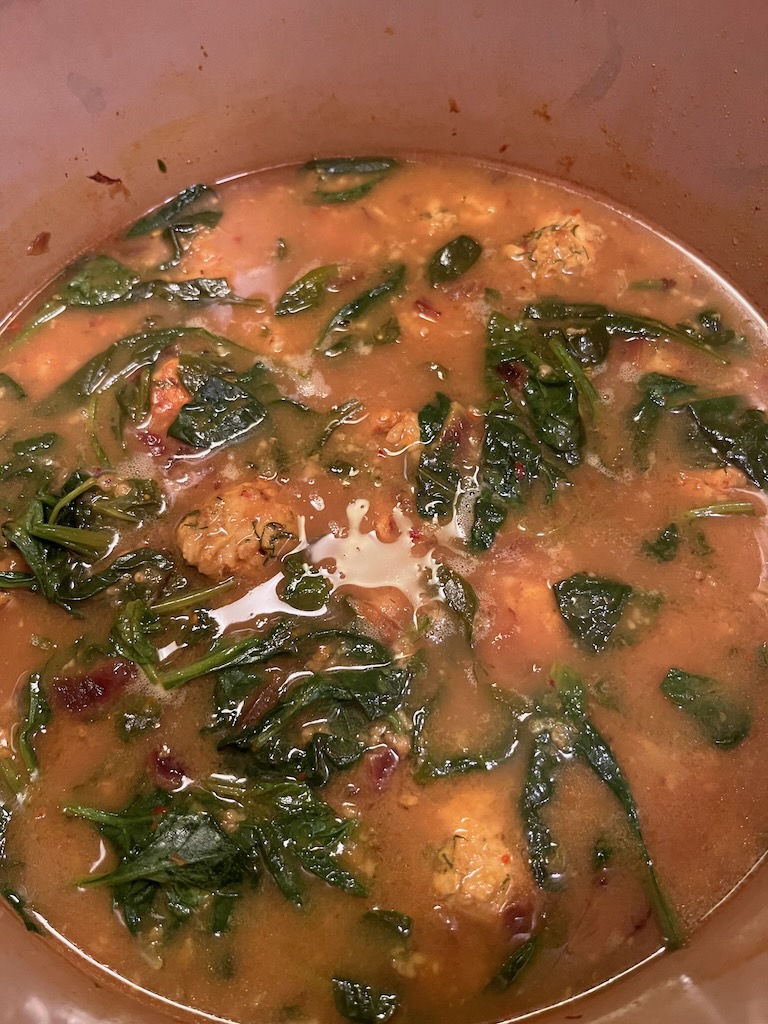
and here, because i love to imagine ladling steaming bowls of soup to people i love, is my new favorite stoup recipe, lemony chicken-feta meatball with spinach from my friends at NYT Cooking (you will be licking the bowl; it’s that good):

Lemony Chicken-Feta Meatball Soup With Spinach
By Yasmin Fahr
Yield: 4 servings
Total Time: 30 minutes

Note from NYT: Some might be suspicious of the rolled oats called for in this recipe, but used in place of breadcrumbs, they help create a light and tender chicken meatball. A half-cup more is simmered in the broth, which thickens it and provides a pleasant texture. The meatballs, made with ground chicken, feta and fresh dill, swim in a lemony, spinach-filled broth that’s comforting and light, perfect for lunch or dinner. Serve any leftovers with a fresh squeeze of lemon juice to brighten the soup.

INGREDIENTS
1 pound ground chicken or turkey, preferably dark meat (i use white meat)
½ cup crumbled feta
¾ cup old-fashioned rolled oats
1 small red onion, halved (½ diced, and ½ grated, then squeezed with a paper towel to remove excess liquid)
⅓ packed cup fresh dill leaves and fine stems, finely chopped
1 tablespoon ground cumin
½ teaspoon plus 1 tablespoon ground turmeric
Kosher salt and black pepper
3 tablespoons olive oil
½ teaspoon red-pepper flakes, plus more for serving
4 cups low-sodium chicken broth
4 packed cups baby spinach (about 5 ounces)
2 lemons (1 juiced and 1 cut into wedges for serving)

PREPARATION
Step 1
In a medium bowl, add the chicken, feta, ¼ cup oats, the grated onion, most of the dill (reserve about 2 tablespoons for garnish), the cumin, ½ teaspoon turmeric and 1 teaspoon salt. Gently combine without squeezing too hard or overworking the meat. Lightly wet your palms and shape the meat into small balls, a little smaller than the size of a golf ball, about 1½ inches. (You will have approximately 25 balls.)

Step 2
Heat the oil in a large Dutch oven or wide pot over medium until shimmering. Add the diced onion, season with salt, and cook until it begins to soften, about 2 minutes, stirring occasionally. Add the remaining 1 tablespoon turmeric and the red-pepper flakes, and stir until fragrant, about 30 seconds. Push the onions to the sides as best you can, then add the meatballs. (They will be close together, and that’s OK.) Cook until browned on two sides, 5 to 7 minutes total.

Step 3
Pour in the broth and remaining ½ cup oats, then gently tilt the pot to the right and left to distribute the oats and broth without disturbing the meatballs. Bring to a gentle boil, then immediately reduce the heat to maintain an active simmer. Season with salt. Cook, gently stirring occasionally to make sure nothing is sticking to the bottom, until the oats have softened and the meatballs are cooked through, about 4 minutes more.

Step 4
Stir in the spinach and lemon juice until the spinach is wilted, about 2 minutes more. Adjust the seasoning to taste. Spoon into bowls, top with pepper and the remaining dill. Serve with lemon wedges.

what is your heart longing for this season of through-and-through thanks?

unearthing the wisdoms entwined in the past. . .

in which these uncharted times have me leaning on the wisdoms of great minds and expansive souls who’ve navigated their own immensely dark and tough times…

more and more i find history is my balm. i think back to the eras of darkness across the arc of time and the indomitable human spirit that has never yet been extinguished, no matter the force of the counterwinds. 

albert camus

curiously, albert camus––whom i’d never thought of as any sort of balm––has served well in that role. though considering the era in which he was writing, it’s no wonder it was darkness he saw through, shone a fierce beam of light on the way through the horrors of europe during the holocaust. 

so often it’s the artists and writers, the makers of films and penners of poems, the ones endowed with an eye to see beyond the occlusions, the ones who imagine what others can’t conceive, who cast the lifeline beyond the capacities of strategists and political operators, power brokers and thieves. 

in his 1940 essay titled “the almond trees” (a species that brilliantly blooms in winter), found in his Lyrical and Critical Essays, camus weighs in on happiness, despair, and how to amplify our love of life.

only twenty-seven when he wrote this, here is the french-algerian philosopher who gave us the plague, the fall, the stranger,and the myth of sisyphus:

We have not overcome our condition, and yet we know it better. We know that we live in contradiction, but we also know that we must refuse this contradiction and do what is needed to reduce it. Our task as [humans] is to find the few principles that will calm the infinite anguish of free souls. We must mend what has been torn apart, make justice imaginable again in a world so obviously unjust, give happiness a meaning once more to peoples poisoned by the misery of the century. Naturally, it is a superhuman task. But superhuman is the term for tasks [we] take a long time to accomplish, that’s all.

Let us know our aims then, holding fast to the mind, even if force puts on a thoughtful or a comfortable face in order to seduce us. The first thing is not to despair. Let us not listen too much to those who proclaim that the world is at an end. Civilizations do not die so easily, and even if our world were to collapse, it would not have been the first. It is indeed true that we live in tragic times. But too many people confuse tragedy with despair. “Tragedy,” [D.H.] Lawrence said, “ought to be a great kick at misery.” This is a healthy and immediately applicable thought. There are many things today deserving such a kick.

echoing the sentiments of an earlier manifesto written in the immediate wake of the first world war, the 1919 “declaration of the independence of the mind,” again by a french philosopher, this time romain rolland––and signed by such luminaries as bertrand russell, albert einstein, bengali poet and nobel laureate rabindranath tagore (a favorite of mary oliver), social worker and activist jane addams (chicago’s own), upton sinclair, and hermann hesse––camus argues that this “kick” is to be “delivered by the deliberate cultivation of the mind’s highest virtues”:

If we are to save the mind we must ignore its gloomy virtues and celebrate its strength and wonder. Our world is poisoned by its misery, and seems to wallow in it. It has utterly surrendered to that evil which Nietzsche called the spirit of heaviness. Let us not add to this. It is futile to weep over the mind, it is enough to labor for it.

But where are the conquering virtues of the mind? The same Nietzsche listed them as mortal enemies to heaviness of the spirit. For him, they are strength of character, taste, the “world,” classical happiness, severe pride, the cold frugality of the wise. More than ever, these virtues are necessary today, and each of us can choose the one that suits him best. Before the vastness of the undertaking, let no one forget strength of character. I don’t mean the theatrical kind on political platforms, complete with frowns and threatening gestures. But the kind that through the virtue of its purity and its sap, stands up to all the winds that blow in from the sea. Such is the strength of character that in the winter of the world will prepare the fruit.

elsewhere in lyrical and critical essays, we find the line that practically serves as camus’s epigraph: “in the depths of winter, i finally learned that within me there lay an invincible summer.” 

toni morrison

no less than toni morrison takes the baton, elaborating that the task of the artist is as a grounding and elevating force in turbulent times, in her essay titled “no place for self-pity, no room for fear,” included in the 150th anniversary issue of the nation, the monthly founded by abolitionists in 1865, not long after the adoption of the thirteenth amendment abolishing slavery.

morrison writes:

This is precisely the time when artists go to work. There is no time for despair, no place for self-pity, no need for silence, no room for fear. We speak, we write, we do language. That is how civilizations heal.

I know the world is bruised and bleeding, and though it is important not to ignore its pain, it is also critical to refuse to succumb to its malevolence. Like failure, chaos contains information that can lead to knowledge — even wisdom. Like art.

marcus aurelius

and finally let us turn way back the clock to ancient wisdoms, in this case those of good ol’ marcus aurelius, the roman emperor whose meditations were suggested to me the other day by one of my more astute and heavenly comrades. the meditations, written in the late second century of the Common Era during the emperor’s military campaigns against germanic tribes along the danube, are thought to be a window into his inner life, uncannily recognizable to our own deep-down whisperings. i borrowed the stoics from the library, but have already decided i need a paper copy all my own, the better for underscoring and stars in the margins. here’s but one of marcus’s wonders, from book II of his meditations, thought to be written in about the year 170 C.E. (uncanny how true wisdom is timeless, as this fits the november of 2024 as fulsomely as it fit nearly two millennia ago):

Begin the morning by saying to thyself, I shall meet with the busybody, the ungrateful, arrogant, deceitful, envious, unsocial. All these things happen to them by reason of their ignorance of what is good and evil. But I who have seen the nature of the good that it is beautiful, and of the bad that it is ugly, and the nature of him who does wrong, that it is akin to me, not [only] of the same blood or seed, but that it participates in [the same] intelligence and [the same] portion of the divinity, I can neither be injured by any of them, for no one can fix on me what is ugly, nor can I be angry with my kinsman, nor hate him. For we are made for co-operation, like feet, like hands, like eyelids, like the rows of the upper and lower teeth. To act against one another then is contrary to nature; and it is acting against one another to be vexed and to turn away. 

what timeless wisdoms do you find anchoring, or elevating? and where might lie your invincible summer; how might you summon it?

here’s a challenge: imagine what’s possible. work toward it. begin with a baby step.

undaunted

only when it is dark enough can you see the stars…

Undaunted is the word that came to me. Once the shock began to dull. Once I quelled the queasing in my belly. Once I decided I won’t surrender this blessed world, won’t shift the course of the project I call my most urgent life’s work. 

I am undaunted.

My life’s work is accelerated these days. Its urgency is upon me, upon us all. 

My life’s work aligns with that of every sage and mystic that ever has been: I am devoted to molding myself closer and closer to the holiness I was made to be, we were all made to be. Because this world is a sacred work in progress, and we are its players. We are the ones with the hearts and minds and hands to bend the arc of justice, to kindle more and more brightly the flame of the sacred. To reach toward the holiness infused through our every breath, every utterance, every inkling. The whole of it. At every turn. To be gentle, and kind. To tenderize the fibers of our heart. Especially the ones that have been torn and shorn over the years. 

This is a path beyond the politics and power seekers of the world. I answer to a call from deep within, the eternal flame of the Divine breathed into us all in the beginning. In our beginnings. And the very beginning.

We’re called to play out our work in the milieu of the everyday, on a plane peopled with those who might test us, or just as certainly––often, more certainly––those who reach out a hand, and carry us along. Shimmy us onto their shoulders, if need be. And we in turn will do the same when we’re the ones whose knees aren’t buckling.

It’s contagious more often than not, this reaching toward kindness, toward peeling open the heart, digging deep, living for joy.

I’ve come to know that it’s a work best played out in incremental barely-noticed exchanges: the heart-melting smile shared in a crowded hallway; the hospital scheduler who takes the time to squeeze your hand, knowing you’re afraid; the grocery-store clerk who wipes away the tear that has crept down your cheek.

I once dreamed of solving world problems, curing life-crippling ills. Now, all I ask of each day is that I find moments to be bigger than I’ve been before, to reach deeper into the well of ordinary kindness, to bow my head and heart in deep thanks for every drop of beauty, wonder, decency. 

That work is unaffected by whatever plays out on the world stage. The powers that be hold no power over our souls, and we needn’t succumb. Needn’t employ the crude or the cruel we witness too, too often these days; in fact, we need amplify the opposing forces. Be radical in our generosity. Our empathies. Our magnanimity. Our humility. And our righteous indignation when called for. 

It so happens that this week found me being schooled in some of these very practices, and through the doorways of two great world religions. On Monday, a magnificent soul who happens to be a Hindu yogi, sat me down, lit a candle, and taught me the ways of deep meditation, turning my focus inward to the eternal flame of the Divine within; I am practicing every day. On Wednesday, I walked into the first of a series of classes at our synagogue on an ancient Jewish spiritual practice called the Mussar, centered on the verse in the Torah that tells us, “You shall be holy.” By drawing on seventeen soul attributes, and spending an arc of time––a season, a month, a week––keenly attuned to each, we exercise the muscles of our deepest being to become holy, to work toward our “primary mission in this world…to purify and elevate the soul.” The practice begins with humility. 

In simplest terms, as the great Chasidic teacher known as the Kotzker, once put it: “Fine, be holy. But remember first one has to be a mensch.”

No one can stop us. Mensches will be we.


I’ve spent the week gathering around me a wagon train of wisdoms, a line from the Talmud, a prayer from Judy Chicago, a profoundly wise passage from EM Forster, another from Hannah Arendt, a post from Rebecca Solnit, and finally a paragraph or two from Kamala Harris’ gracious concession speech…..


from the wisdom of the Talmud, found in what’s known as the Pirkei Avot, which translates to Chapters of the [Fore]Fathers, a compilation of ethical teachings and maxims from Rabbinic Jewish tradition. It is a part of the Mishnah, a code of Jewish law compiled in the early third century of the Common Era.

“Do not be daunted by the enormity of the world’s grief. Do justly now, love mercy now, walk humbly now. You are not obligated to complete the work, but neither are you free to abandon it.”


A Prayer for Our Nation
by Judy Chicago

And then all that has divided us will merge
And then compassion will be wedded to power
And then softness will come to a world that is harsh and unkind
And then both men and women will be gentle
And then both women and men will be strong
And then no person will be subject to another’s will
And then all will be rich and free and varied
And then the greed of some will give way to the needs of many
And then all will share equally in the Earth’s abundance
And then all will care for the sick and the weak and the old
And then all will nourish the young
And then all will cherish life’s creatures
And then all will live in harmony with each other and the Earth
And then everywhere will be called Eden once again.


The English novelist, essayist, and broadcaster E.M. Forster (January 1, 1879–June 7, 1970) took up questions of societal empathies in an essay titled “What I Believe,” originally written just before the outbreak of WWII and later included in the out-of-print Two Cheers for Democracy, his 1951 collection of essays based on his wartime anti-Nazi broadcasts. Here’s Forster:

I distrust Great Men. They produce a desert of uniformity around them and often a pool of blood too… I believe in aristocracy, though… Not an aristocracy of power, based upon rank and influence, but an aristocracy of the sensitive, the considerate and the plucky. Its members are to be found in all nations and classes, and all through the ages, and there is a secret understanding between them when they meet. They represent the true human tradition, the one permanent victory of our queer race over cruelty and chaos. Thousands of them perish in obscurity, a few are great names. They are sensitive for others as well as for themselves, they are considerate without being fussy, their pluck is not swankiness but the power to endure, and they can take a joke… Their temple… is the holiness of the Heart’s affections, and their kingdom, though they never possess it, is the wide-open world.

With this type of person knocking about, and constantly crossing one’s path if one has eyes to see or hands to feel, the experiment of earthly life cannot be dismissed as a failure.


Politcial theorist and philosopher Hannah Arendt reminds us our reach for change needn’t be in the boldest strokes in The Human Condition, her 1958 study of the state of modern humanity, thought to be more striking now than at the time of its first publishing. Here’s but one sentence underscoring that claim: 

“The smallest act in the most limited circumstances, bears the seed of… boundlessness, because one deed, and sometimes one word, suffices to change every constellation.”


Rebecca Solnit’s message the morning after the election:

You are not giving up, and neither am I. The fact that we cannot save everything does not mean we cannot save anything and everything we can save is worth saving.  You may need to grieve or scream or take time off, but you have a role no matter what, and right now good friends and good principles are worth gathering in. Remember what you love. Remember what loves you. Remember …what love is. The pain you feel is because of what you love. 


and finally, these two passages from Kamala’s gracious concession speech:

Fight in the voting booth, in the courts and in the public square. And … in quieter ways: in how we live our lives by treating one another with kindness and respect, by looking in the face of a stranger and seeing a neighbor, by always using our strength to lift people up, to fight for the dignity that all people deserve. The fight for our freedom will take hard work. … The important thing is don’t ever give up. Don’t ever give up. Don’t ever stop trying to make the world a better place. … This is not a time to throw up our hands. This is a time to roll up our sleeves. This is a time to organize, to mobilize, and to stay engaged for the sake of freedom and justice and the future that we all know we can build together.

and she closed with this…

You have the capacity to do extraordinary good in the world. And so to everyone who is watching, do not despair. This is not a time to throw up our hands. This is a time to roll up our sleeves. This is a time to organize, to mobilize, and to stay engaged for the sake of freedom and justice and the future that we all know we can build together. Look, many of you know I started out as a prosecutor and throughout my career I saw people at some of the worst times in their lives. People who had suffered great harm and great pain, and yet found within themselves the strength and the courage and the resolve to take the stand, to take a stand, to fight for justice, to fight for themselves, to fight for others. So let their courage be our inspiration. Let their determination be our charge. And I’ll close with this. There’s an adage a historian once called a law of history, true of every society across the ages. The adage is, only when it is dark enough can you see the stars. I know many people feel like we are entering a dark time, but for the benefit of us all, I hope that is not the case. But here’s the thing, America, if it is, let us fill the sky with the light of a brilliant, brilliant billion of stars.

what bright stars did you see this week? and how do you intend to carry on?

to those who note the rare use of caps this week, indeed sometimes you need to stand tall and say it loud and with proper capitalization, and so it is this fine morning. i mean what i say, and i say it undaunted.

a sky so big it holds me

when i need to talk to God, and i do plenty often these days, there is one certain place i know God will be waiting. i know it because i feel it. and feeling God is much more than knowing. at least to me it is. 

the place where God all but reaches down and swoops me into God’s arms is at the shoreline, where the vault of blue heaven is vast, is infinite, where the water’s edge might take on any one of uncountable modes: it might be uncannily calm, so calm the ripple is but a purling, a burbling so barely perceptible it’s as if the lake is tickling the sand; or it might be roiling and cacophonous, so deafening you can barely hear the words rising from your own throat. 

i could stand there all day, my toes planted in sand, my head tilted back, eyes wide. heart thrust forward and up, up. 

i’ve been walking there each day with my beloved. our footfalls in the sand the only sign we’ve been by. sometimes, if i go alone, i curl small as a hedgehog and settle into the grasses that rise from the hillocks of sand. i stay till the last of my prayers are unfolded, laid at the lap of the One Who Is Listening.

it’s as holy a place as i know. 

to feel God reach down and hold you, to know that the vastness above is deep and wide and forever enough to absorb each and every whisper and plea, to know that the deepest cries of your heart might be heard, to feel the soothing that comes as if your trembling shoulders are now wrapped in angora skeins, that is to me the very essence of a God who’s bigger and deeper, more infintely tender and close, than anything or anyone i could ever, ever imagine. or behold.

some days i need a God of extra-big volume and size. a God big enough to hold me, to press against me so firmly that all of my worries, like wrinkles, are melted away. those are the days i look to the heavenly dome. where mine is a God who knows me inside and out. sometimes my insides are so very scrambled and messy. 

it’s the closest i’ve come to that magnificent image of saint john of the cross, the one who rested his head against jesus’ chest at the very last supper, who let it be known that he was listening for the heartbeat of God. an indelible image that’s become a life-giving instructive (a particularly celtic one) for us all: to listen wherever we go for the unending pulsebeat and presence of God.

sometimes, inside the rooms of a house your worries can clang around noisily, too noisily. they can crowd out all of the air, and make you want to climb out of your skin. that’s where the heavens come in, where the shortest reach between me and my God is the indigo dome of the night at the beach, or the undulations of blues and grays in mid-afternoon. dawn at the water’s edge is a whole other slide show, one played out in the fieriest streaks of the rosy-red color wheel. 

and those are the days i all but run to the shoreline, to the water’s edge, where the alchemy of sand, sea, and sky are stirred into a medicinal balm, a sacred balm, like no other. and the God to whom i run always, always is there for me.


here’s a little extra beauty from the late poet anne sexton, whose story is drenched in struggle and sorrow, but who reached for the light coming in through the cracks. i tell a little bit of her story down below, but first, the poem:

Welcome Morning

There is joy
in all:
in the hair I brush each morning,
in the Cannon towel, newly washed,
that I rub my body with each morning,
in the chapel of eggs I cook
each morning,
in the outcry from the kettle
that heats my coffee
each morning, 
in the spoon and the chair
that cry “hello there, Anne”
each morning,
in the godhead of the table
that I set my silver, plate, cup upon
each morning.

All this is God,
right here in my pea-green house
each morning
and I mean,
though often forget,
to give thanks,
to faint down by the kitchen table
in a prayer of rejoicing
as the holy birds at the kitchen window
peck into their marriage of seeds. 

So while I think of it,
let me paint a thank-you on my palm
for this God, this laughter of the morning,
lest it go unspoken. 

The Joy that isn’t shared, I’ve heard,
dies young.

  • Anne Sexton
anne sexton

sexton, a 20th-century american poet, was considered one of the Confessional poets, along with maxine kumin, sylvia plath, and robert lowell. after the birth of her first daughter, she suffered from post-partum depression, had her first so-called nervous breakdown, and was admitted to a psych hospital. she suffered depression the rest of her life, a life that ended in suicide when she was 45.

although her poetry was criticized by some as “soap opera-ish,” others praised it for the ways it expressed “the paradoxes deeply rooted in human behavior and motivation. her poetry presents multiplicity and simplicity, duality and unity, the sacred and the profane.”

one of sexton’s earliest champions, erica jong, reviewing her 1974 The Death Notebooks, argued for sexton’s poetic significance, claiming her artistry was seriously overlooked: “she is an important poet not only because of her courage in dealing with previously forbidden subjects, but because she can make the language sing. of what does [her] artistry consist? not just of her skill in writing traditional poems … but by artistry, i mean something more subtle than the ability to write formal poems. i mean the artist’s sense of where her inspiration lies …there are many poets of great talent who never take that talent anywhere … they write poems which any number of people might have written. when anne sexton is at the top of her form, she writes a poem which no one else could have written.”

where are the places in your world where your prayers feel especially heard? where a holy comfort might enwrap you? and you just might feel held? and, thinking of sexton’s poem, if you were to write a litany of morning joys, what would be among your joys?

prayers for this country as we cross over the threshold of this next election. prayers for peace, prayers for truth, prayers for grace….