pull up a chair

where wisdom gathers, poetry unfolds and divine light is sparked…

Month: October, 2024

pay attention to this one most blessed day. . .
i am sitting here in a shaft of golden light spilling across the worn planks of this old maple table. i am looking out at a world ablaze in iterations of gold. as if the world out my window is a benjamin-moore paint strip, all in the key of saffron. 

i sighed a deep sigh when i tiptoed down the stairs this morning, and filled my lungs with the glorious knowing that this day held no appointments. no doctors. no dentists. no needs to stand or sit in front of a crowd and talk about the words i’d poured onto a page. 

this day is a big blank slate. a slate to fill with the simple wonders of being alive. and i intend not to waste it, not a drop of it. and urgently so.

it’s the unintended gift of holding on for dear life to the life that you love with every cell of your being. 

it’s a day i might otherwise not have noticed quite so keenly. but i see more vividly now. the blessing of holding on dearly to life is that you see each new dawn for the miracle that it is. 

it might have been just another weekday. but suddenly, perceptibly, it is the answer to my deepest prayer, a day to simply be alive and breathing it in. every pore of it. the earthy rummesence of autumn leaves crisping and crinkling and falling in heaps to the ground. the last gasp of the garden, exploding in singular vibrancies that beg to be remembered all through the winter. the air, a mix of chill with undertones of heat as if the earth’s autumnal respirations draw forth the last breaths from summer’s stockpiled embers. 

to knowingly not waste a day is to live at fullest attention. while we can. while we’re upright and ambulant. 

sometimes we realize we shan’t take it for granted. 

sometimes we need a reminder. 

i am reminded. 

i am living inside a body that reminds me to savor it, to inhale it. to all but rub it over my skin, to  let it soak in through each wide-open pore. 

we all have days when our hours are clogged with the usual distractions. we forget the marvel of a friday reliably following a thursday. we look to the calendar as if it’s the sovereign of how we spend our time. we are chained and unchained. we’re obliged to to-do’s, and we forget that all the in-betweens might just be the hours we’re most deeply alive. we might, at any moment, put down the chores, surrender the assignments. we might seize the day in whatever outline or equation rises from the blur. 

we might call a friend whose voice we’ve not heard in too long. we might find a log in the woods, plop ourselves down, and keep watch––close watch. we might fill a bowl with the indulgences of autumn, the leaves and the seeds and the roots, all meant for seasonal sustenance. 

we might light a candle. sit in a shaft of sunlight, watching the dust motes ride the air. we might roll up our sleeves, or get down on our knees, and plant a few bulbs for the joy of it––for the allure and the promise and perpetual hope of the springtime to come.

more and more, one of the first prophets i turn to for wisdom is the incomparable maria popova, she of marginalian wonders. in a cataloging of eighteen wisdoms she’s extracted from her eighteen years of gathering wisdoms (she must have started her brain pickings––now re-named the marginalian––a mere two months before the first chair was pulled up, for we too are about to mark 18 years of chairing), she included this bit of wonder and wisdom that says it as beautifully as it might be said:

Choose joy. Choose it like a child chooses the shoe to put on the right foot, the crayon to paint a sky. Choose it at first consciously, effortfully, pressing against the weight of a world heavy with reasons for sorrow, restless with need for action. Feel the sorrow, take the action, but keep pressing the weight of joy against it all, until it becomes mindless, automated, like gravity pulling the stream down its course; until it becomes an inner law of nature. If Viktor Frankl can exclaim “yes to life, in spite of everything!” — and what an everything he lived through — then so can any one of us amid the rubble of our plans, so trifling by comparison. Joy is not a function of a life free of friction and frustration, but a function of focus — an inner elevation by the fulcrum of choice. So often, it is a matter of attending to what Hermann Hesse called, as the world was about to come unworlded by its first global war, “the little joys”; so often, those are the slender threads of which we weave the lifeline that saves us.

and she includes these lines from poet and former zen monk jane hirshfield’s “the weighing”:

So few grains of happiness
measured against all the dark
and still the scales balance.

and if all that isn’t enough joy stoking for the day, here’s one other wonder and wonder-soul i learned of this week at a book talk where to my delight and pure joy i was pointed toward good souls i fully intend to get to know more deeply and intimately. (i never cease to be amazed at the goodness lurking in utterly unexpected nooks and crannies of this world.)

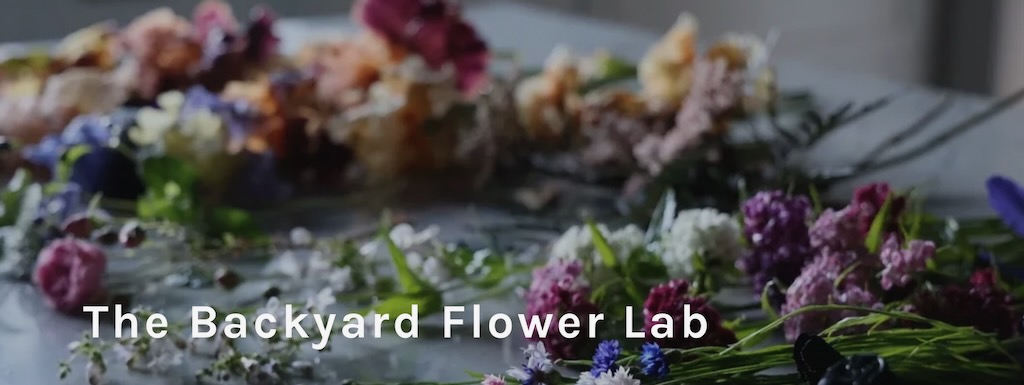
here is a woman—one with a PhD in human anatomy and cell biology, no less—who happens to live in a house with a four-acre flower garden who coaxes beauty from the earth for the sole purpose of giving it all away, filling the flower fridges at hospices and homeless shelters, and the larders at food pantries near and far. she calls it the backyard flower lab. and it sounds like a holy slice of sustenance to me. i intend to point my old wagon in the direction of her flower farm before the sun sets on this day, and i will see where the adventure takes me. her name is april potterfield (which sounds to be a perfect plucked-from-the-storybook name for someone who grows beauty for joy), and you can find her on instagram at @thebackyardflowerlab.
what prompts you to find joy and seize the slender threads of which we weave our lifelines? and what are some of your favorite ways of doing so?

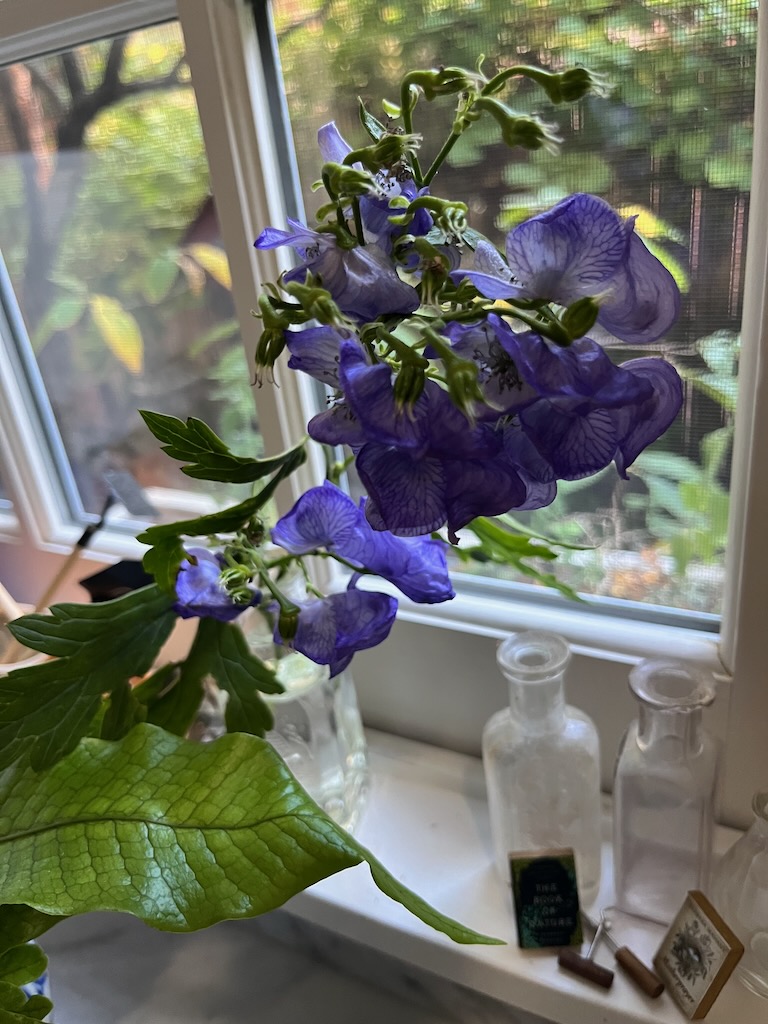
 the cobalt beauty perched on the windowsill above is an autumn vibrancy from my garden, the closing note of a summer’s-long love song. i call it monkshood, but it has other names: aconite, wolfsbane, leopard’s bane, devil’s helmet, or blue rocket. the name aconitum comes from the greek word ἀκόνιτον, which may derive from the greek akon for dart or javelin, the tips of which were poisoned with the substance, or from akonae, because of the rocky ground on which the plant was thought to grow.

deep thanks to maria popova who week after week for years now has filled me with wonder, with curiosities, and most of all with the breathtaking beauty of her intellect and imagination…

in the tabernacle of an autumn’s night

these are days of awe, all right. the earth and heavens––at least here on the northern half of the globe—are turning in, the shadows growing longer. yet the last gasps of summer’s bounty do not fade without an exuberance of autumn. the sky somehow seems more star-stitched. and the moon, the moon at its most zaftig of the month bathes all in amber wash. 

it’s as if all is ringing out in exclamation. one tree more golden than the next. berries so abundant on the bough, the boughs are bent in botanic downward dog.

i can almost hear the whisper of the woods, and even my ramshackle garden, calling out, don’t forget us, don’t forget how glorious we were and are, the delights and wonders we’ve offered since the symphony of spring began: the perfumes, the unfolding petals, the sweetness of the fruits, the earthly prayer of wind rustling through the leaves. 

it’s a paean in minor key––part elegy, but mostly gratitude and grace.

to partake of it is holy.

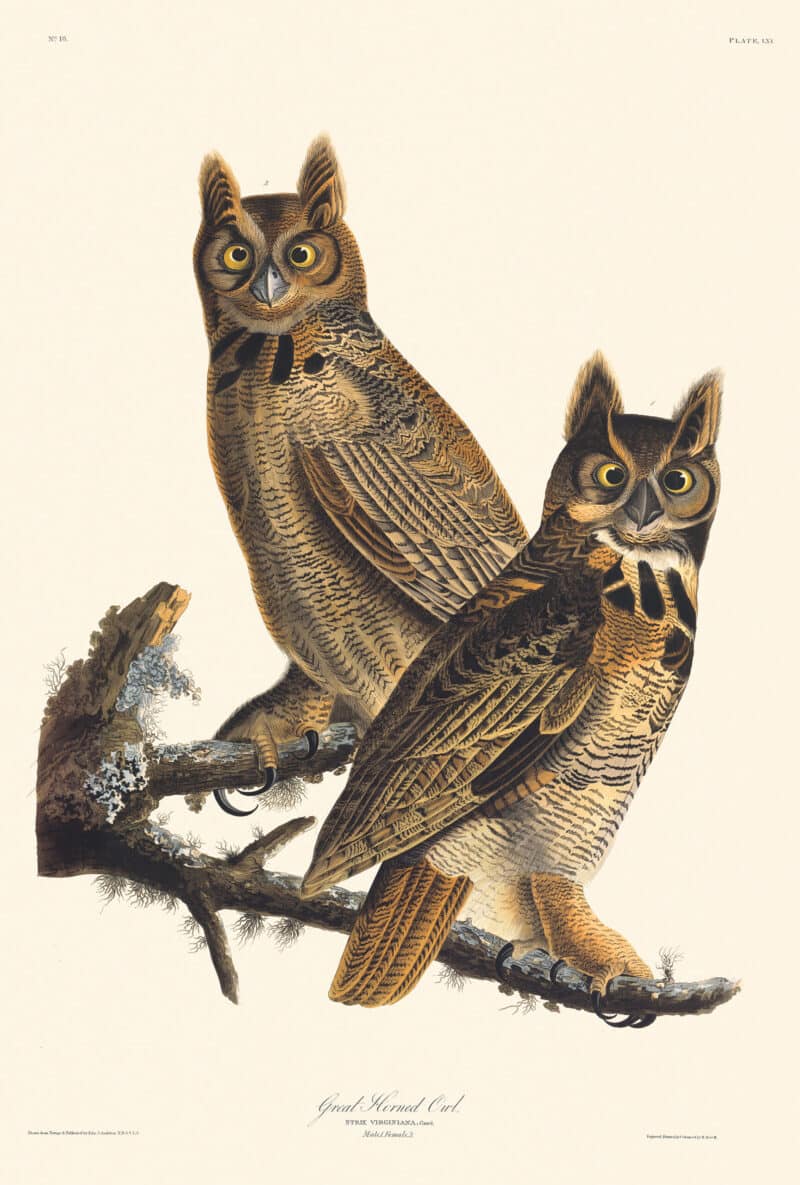
the other night i stepped into the chill of just-past dusk, ferrying a crumb-strewn pizza box to the recycling bin, and before two footfalls had crossed the bricks, the haunting whoot-whoo-whoo of a great horned owl called out from somewhere in the trees. 

john james audubon: great horned owl

owls might be my spirit bird. i learned reverence for owls from my grandma lucille, who wore one in a jeweled brooch she pinned to her bosom, and tucked in many a nook and cranny of her ivy-covered house. far back as i can remember, the front of her ice box was forever festooned with strigiform, a magnet onto which she’d glued an owlish silhouette cut from felted wool and adorned with alphabet-letter pastas as its eyes and ears and markings. not one for idling, my grandma once or twice was spied by little me with ear pressed hard to windowpane, rapt by the nightcall from the woods.

i too stand rapt. 

of all the notes that rise from avian throats, the owl’s are the ones that stir me deep down where the prayers rise up. at the first of the whoot-whoo-whoo the other night, i felt myself break out in goosebumps. then i lifted my eyes, drank in the light of that nearly full hunter’s moon, and prayed. mightily. 

i sometimes think that trips to the recycling bin are my surest daily invitation into prayer. into the cloak of night. against the silence of a day gone hush. the tabernacle in which i offer up my nightly office is one that stations me on the cracked concrete slabs of my alley. trash cans line the side aisle. and the nave is vast. is infinite. in between where trees and old garages block the view, the sky opens wide and deep. here where i live, sky is a bit of a commodity. sunsets aren’t free for the viewing, blocked by those mainstays of suburbia: house and tree and fence. but the night sky, the obsidian up above, is blocked by no one or nothing and it is enveloping enough to soak up my every verse of prayer. 

and so i stood there flinging madly. add-on after add-on. a madwoman hungrily hanging her prayers out to dry. as if a clothesline of prayer i string across the alley, flinging each one skyward as i inch my way down the line. 

it’s a sacred thing to stand beneath a wheel of yellow moon, with a whoot-whoo-whoo as chorister, and to pour out your insides to the heavens. 

i pray the heavens heard.


here’s a bit of what else stirred me this week . . .

vassar miller was an american poet and writer, who served as poet laureate of texas in 1982 and 1988. born with cerebral palsy, her father encouraged her from a young age to write by typewriter, which she did prodigiously. and powerfully. she once said that the purpose of her life was “to write. and to serve God.” it brings me great joy to bring her here to this holy table.

Morning Person

God, best at making in the morning, tossed
stars and planets, singing and dancing, rolled
Saturn’s rings spinning and humming, twirled the earth
so hard it coughed and spat the moon up, brilliant
bubble floating around it for good, stretched holy
hands till birds in nervous sparks flew forth from
them and beasts — lizards, big and little, apes,
lions, elephants, dogs and cats cavorting,
tumbling over themselves, dizzy with joy when
God made us in the morning too, both man
and woman, leaving Adam no time for
sleep so nimbly was Eve bouncing out of
his side till as night came everything and
everybody, growing tired, declined, sat
down in one soft descended Hallelujah.

+ Vassar Miller


and this beauty from christian wiman…

Prayer
By Christian Wiman

For all
the pain

passed down
the genes

or latent
in the very grain

of being;
for the lordless

mornings,
the smear

of spirit
words intuit

and inter;
for all

the nightfall
neverness

inking
into me

even now,
my prayer

is that a mind
blurred

by anxiety
or despair

might find
here

a trace
of peace.

Christian Wiman, “Prayer” from Once in the West, published by Farrar, Straus and Giroux. Copyright © 2014 by Christian Wiman.

what stirred you to awe this week?

the names we are called, and the names that call us

my little irish grandma mae, as my grandpa, “choo-choo papa,” received his 50-year gold watch from the L&N Railroad, for which he was a locomotive engineer on the cincinnati-to-corbin (ky.) line

the email from synagogue came back in the spring. the rabbis and cantor had been thinking for awhile about some of us. an odd lot of us. we were the ones who’d found our way, through one inlet or another, into the river of jewish life — at synagogue and at home — yet “don’t identify as jewish.” (that wording, so very of the cultural times, cracks me up. in the old days wouldn’t we simply have been “not jewish”?) 

they, this lovely trio of clergy, all young, brilliant, and devoted to their callings, recognized that we were in many ways bringing our lives to the poetries and prayers of judaism, and that judaism’s poetry and prayers had found its way fairly deep into our lives. they wanted to honor that. 

they weren’t asking that we convert, weren’t asking us to sign on any dotted line. 

but they had a radical idea, deeply radical when set against the context of a tradition that long saw intermarriage as the great scourge, one of the most grievous threats to the ancient and blessed religion. the radical idea of our rabbis and cantor was to give us each a hebrew name. but not without deeply engaging in weeks of contemplation and discussion, coming to synagogue on wednesday nights as summer turned to autumn, as the air grew cooler, and the trees more golden and crimson. 

we talked the first night about the journey into judaism, they asked us to talk about moments of pain, times we felt excluded, rejected, pushed to the margins. or when we’d felt welcomed. we talked about being an outsider versus insider. did we feel we had a voice in the conversation, in the congregation, at our own kitchen tables, and even more broadly in the jewish world?

they asked us to tell the stories of each of the names we’d been given at birth, and the names we’d chosen to carry through life. they asked us to unspool the narrative of nicknames that ebbed and flowed through our stories. 

and they asked us to think deeply about what a name means. and to pull from our lives and from Torah particular names of particular souls who somehow stirred us. with whom we felt some deep, almost palpable pull.

i knew fairly quickly whose pull i was feeling. but before settling on my little irish grandma, the only grandparent i never knew, one with whom i’ve long felt an uncanny cord, i briefly considered sarah, she who — like me — thought she was “barren,” and found out at the ripe old age of 90 (i was nearly 45) that she was “with child.” and who greeted the news by laughing out loud. sarah, like me, is the archetypal old mother.

we had homework: a sheet of essay questions pondering names, all of which were meant to evoke for the rabbis a few hebrew names that might be fitting for each of us. after poring over our essays, they sent us our custom-curated list of possibilities. i didn’t choose from high up on the list; i found my name deep down in the unlikelier choices. but, turned out, it was a tight fit. a name with the same roots, the same meaning, whether celtic or hebrew. (you’ll see below.)

once we had our names, and had written the stories of how we came to those names, and why, we were invited to synagogue for a special friday night Shabbat service, where we’d be called to stand in a half circle on the bimah (the raised platform from which the Torah is read). one by one, we’d speak our names, and tell our short stories. 

before we told our stories, the rabbi, who i love, and whose name is ally or allison, (i don’t know her hebrew name, i just realized), set the stage with the eloquence and grace i’ve come to think of as her trademark, her inimitable magnificent, heart-melting way.

“Jewish tradition believes that names have great power,” she began. and then she read this poem from the israeli poet zelda, who is known widely by only her first name: 

israeli poet, zelda

“Each of us has a name given by God and given by our parents.
“Each of us has a name given by our stature and our smile and given by what we wear.
“Each of us has a name given by the mountains and given by our walls.
“Each of us has a name given by the stars and given by our neighbors.
“Each of us has a name given by our enemies and given by our love.” 

in a sentence that took my breath away before she called us from our pews to stand in our half-circle, to step to the podium, she said that we’d “earned these names through sacrifice and grit, through tenderness and care. they earned these names through their openness, their tolerance, their expansive and soft hearts.”

that sentence made me riffle through the rolodex of my life, through the hard conversations at the kitchen table, the tears on long telephone calls when a Jew and a Catholic were hashing it out in the three years before we married, trying to decide whether we could work it out, whether we could braid two faiths, two traditions, two deep ancestral ties into something that might even be greater than the sum of its parts. made me think of the blessing ceremonies in our tiny little garden on Wellington Avenue, when a rabbi and a priest poured their words, their wisdoms, and their blessings on two baby boys we were both blessing and naming (with eight years between each). made me think of the pair of Shabbat candlesticks, layered with wax from candles dripping and dripping over the years. made me think of the lamb stew we’ve stirred at the cookstove, my beloved and i side-by-side. 

i thought how, indeed, both of our hearts have softened, have opened, have grown.

and then it was my turn to step to the podium, clear the tears from my eyes, and read these words to those gathered:

I’ve spent much of my life peeking beyond the borders of what was before me. Yearnings have always stirred me––reaching for what I don’t yet know, reaching for the holiness I deeply believe in, reaching for loves long after they’re gone. 

And there is a particular grandmother, the only grandparent I never met, who has always, always animated my imagination. I yearned to know this daughter of Irish immigrants, a Kentucky schoolteacher, who, according to family lore, was the first woman to graduate from college in the commonwealth, who snagged the highest score on her county’s teachers’ exams, and just as importantly, could wring a chicken’s neck!––a praiseworthy prelude to many a Sunday supper in the Bluegrass State. 

Her name was Mae, Mae Shannon, and her only child, her beloved child, was my beloved long-gone papa, Eugene Shannon Mahany. 

Until now, my connection to Mae has been purely by heart, and through a few fading photographs that show we share an uncanny resemblance. 

Her name, Mae, is a Celtic derivitive of Mary or Margaret, and one of its meanings is “pearl.” So, too, the Hebrew name Margalit—yet another “pearl.” 

Considered the gemstone of inner wisdom, the pearl is one of creation’s wonders, formed through the mysterious interplay of oceanic depths and the celestial pull of the tides. 

The pearl is formed when the mollusk, or bivalve, senses an irritant—a grain of sand, perhaps—which it enwraps by secreting layer upon layer of minerals, all extracted from seawater. Sand to seawater to pearl.

Ergo, pearl equals protection, luminous protection. Its very creation, an equation of awe. And the pearl, a moonlike orb, is thus said to be a vessel for water’s energy, to carry the lucid movement of the tide’s ebb and flow. It’s believed to hold deeply healing powers. 

Its beauty, formed in unseen depths. 

Radiance, evolved over time. 

The pearl, Margalit––the Hebrew name of my choosing––my tie at long last to the little Irish grandma I so long to sit down beside. And whose inner luminous wisdom I so yearn to absorb. 

And mightn’t she be wonderstruck to discover she’s inspired her only granddaughter’s new Hebrew name.

love you, dear chairs. by your names that i know, and your names that i don’t.

what’s the story of your names?

p.s. our rabbis are pretty sure that ours is the first congregation in the U.S. to undertake such a process, the giving of hebrew names to those who don’t identify as jewish.

and tonight we begin the highest and most solemn of high holy days, yom kippur, the day of deep atonement.

tefillah (תפילה) for a sweet new year in the season of awe

it is the soft dawn of a new year here, the jewish new year, an ancient calendar i’ve been drawn into, enfolded by, graced by, for all the decades since i met my beloved. he was the one who caught my eye back in the long ago, leaving the newsroom before sundown on friday nights to go to synagogue. i was moved by that devotion. leaving the newsroom on a friday night, back in the days when the big fat sunday newspaper was being “put to bed,” all the sections laid out, the stories edited, photos cropped and captioned, leaving the newsroom before deadline on a friday night meant you were breaking a mold. and you’d better have had a very good reason.

he broke my mold, all right, that tall bespectacled fellow loping toward the door. broke open a love of sacred creation, broke open an ancient text, the poetries and prayers that rose from the rocky, dusty, sometimes fertile terrain of a land indeed holy.

it would be a couple years before i found out the reason the bespectacled fellow was heading out to synagogue early on those friday nights: that was the hour of the singles’ shabbat service. he was looking to meet a nice jewish girl, and theirs was the six o’clock service. oh, well. that didn’t quite work the way he’d intended.

nor did i ever expect to be so deeply entwined with the religion of ancient ancient times. though there were hints. way back in high school, i asked a jewish friend of mine if i could come to her family’s seder, the passover meal at which the story of the exodus is told and retold. she answered that her family didn’t really mark the occasion, but maybe that year they’d make an exception. so there i was at their table, turning the pages of the exodus story, searching for the hidden matzah at the end of the meal. i came back year after year.

and all these years later, i’m the one who opens the jewish cookbook as the holidays near. over the arc of time, we’ve inscribed customs into the trace of the year: rosh hashanah, the new year, is when lamb stew (a middle-eastern iteration with chickpeas, and raisins, and apples and rice) is on the stove, though this year, just the two of us, we opted for the modern-day jewish classic, chicken marbella from the silver palate cookbook.

i crack open the prayer book too. crack it open weeks and weeks ahead of time, for the prayers are what draw me deep into the currents of the great river of judaism. awaken me to the mysteries and sumptuous beauties all around. remind me to see the miraculous in the most ordinary: the dust mote wafting by, the shadow of a tree, the call to pray “in the moments when light and darkness touch.” sometimes it’s the language, a simple line chiseled over time, that breaks me wide open, like this one: “prayer is our attachment to the utmost.”

let that one filter in…

sometimes i think my blessing is that i am still new to all this, so the way the words are unspooled is still fresh enough to catch my attention, my breath. i am often the one quietly gasping in the pews. or here at my kitchen table.

one last thing before i unfurl my prayer, my tefillah, for the new year: the other night at synagogue, just before the prayer for healing, the rabbi told of a midrash taught over time. she began by pointing to the eternal light that hangs above the arc where the Torah scrolls are kept. she noted that in the ancient temples the light that burned was from a wick floating in oil, specifically olive oil, the only oil allowed to burn in the eternal light. and then she went on to talk about the olive, the abundant small but ubiquitous fruit of the hillsides of the holy land. she noted that the oil from an olive is released only when it’s pressed, and crushed. and then, in that majestic humble way of hers, she taught us a lesson i’ll never forget: “when the olive is crushed it’s brightest light comes forth.”

ponder that the next time you feel the world pressing in from all sides, when you feel crushed. your brightest light might soon be burning.

here is my prayer for the new year. . .

tefillah for a sweet new year in the season of awe

O One who robes this world in threads of crimson and bronze, who reaches in the paint pot for persimmon, goldenrod, and concord grape, the palette of autumn ablaze,

under newborn moon, under deep black dome of night, i bend my knees and pray…

i ask for blessing abundant. i ask stingily, you might think. 

but then, you look around the world, see the tally from which i draw, and realize i’m barely beginning.

i pray first for forgiveness, for the sins of this selfish, self-obsessed culture of course, but more immediately and closer to the bone, for the sins of my own failings: my unwillingness to stray too far beyond the comfortable, to not muster the radical courage to cut a bold swath, to heal what’s deeply broken; for my inability to see my own blind spots; for the flippant dismissals i sometimes make too quickly; for being afraid, to the point that it occludes my seeing and breathing, my being. 

i pray for peace, peace of nations and peace of each unsettled heart.

i pray for wisdom to discern that which lasts and that which crumbles over time. 

i pray for grace which i define as radiance that will not fade in the face of shadow, will not step aside when life inflicts sharp elbow.

i pray for the hand that reaches out to dry the tears of the one whose cheeks are splotted, streaked, and sodden. even when, especially when, those cheeks belong to a someone we do not know. yet the simple presence of those tears signals how deep, how stinging, the hurt must be, the pain. i pray for the woman who sat beside me at synagogue and could not stanch her tears.  

i pray for those who go through life fists clenched, driven by a fury that won’t allow unfurling. won’t release the tendons taut, won’t uncoil the hands God gave so we could do the work of loving, of reaching, and cradling in times of turbulence and tumult.

i pray for the echo of laughter’s peals rising from the kitchen tables, the diner counters, the park benches, those flat plains where good souls congregate to dig down deep and tell their stories.

i pray for morning light to rush in before eyelids flutter open so that when they do all is golden, nearly blinding, in its insistence to start the day awash in luminescence.

i pray for mothers who buried their children this week. i pray for the papas whose hearts were hollowed by deaths too soon, too impossibly inexplicable. i pray for memory to fill in the cracks, to begin to piece together the jagged edges of the shattered vessel that is the grieving heart. 

i pray and i pray for the children––afraid, broken, scared out of their wits, looking into a night sky not for stars but for rockets’ red glare.

i pray for silence from the bombs and the hell screech of rockets. 

i pray for those pummeled by rain — be it the rain of those rockets or the deluge of storm and hurricane winds.

i pray we see You in the sparks that animate the woods, the streams, the darkened skies. i pray that all the cosmos becomes as if a light-catching prism of holy wonder and wild astonishment that points to the One Creator God.

i pray we see You, too, in the gentle murmur of kindness, of tenderness, of heavenly mercy that is certain trace of Holy Presence.

i pray, dear holy, holy God, for these days of awe to fuel us for the long winter to come. let us stock the larder, fill the shelves that line the walls of heart and soul. let us go forth, each and every blessed day, fully awake to the miracle of those we love, and those we don’t yet know whose lives, like ours, contain untold tragedy as well as untrumpeted triumph, and whose wholeness any day just might depend on the goodness of those who do not pass them by unnoticed. 

amen. and thank you.

what lines would you add to our prayer, communally or privately?

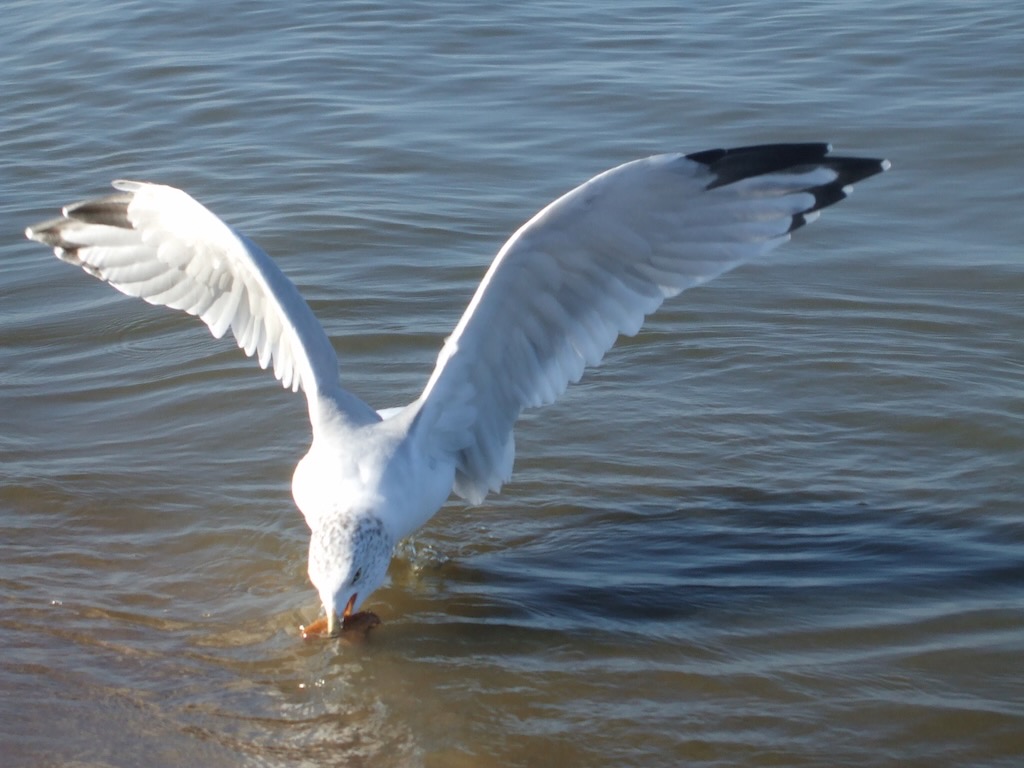
the gull above is diving into lake michigan to gather up a chunk of bread one of us has tossed into the water, a symbolic casting of our sins into the lake in an act of absolution.

the line, “prayer is our attachment to the utmost,” is from rabbi abraham joshua heschel, and the full line is: “unless we aspire to the utmost, we shrink to inferiority. prayer is our attachment to the utmost.”