“Do any human beings ever realize life while they live it?––every, every minute?”
“No.”
Pause.
“The saints and poets, maybe––they do some.”
it’s these three lines plus the pause from thornton wilder’s “our town” that stopped me cold this week. released to the world in 1938, the three-act classic set in grover’s corners, a celebration of “ordinary people who make the human race seem worth preserving,” was once described by edward albee as “the greatest american play ever written.” i’m sure that claim is dusted over now, but its timelessness is proven. and these lines between emily and the stage manager, rising off the page after the commonplace litany of ticking clocks, and sunflowers, food and coffee, new-ironed dresses and hot baths, are the ones that called out to me across the arc of time.
it is the question that preoccupies me. it is the spiritual quest at my core: can i stay awake to the marvel around me? can i sift through the detritus and chaff that inevitably litter the days, and seize the glittering wonders? can i palpably know that these are the days i’ve been given to give what i have, to tap into the holiness within and leave at least some in my wake?
and thornton wilder was putting those questions on the stage nearly a century ago. and before wilder, and since wilder, countless sages have put forth the very same prod. are we awake yet? are we taking this all for granted? are we forgiving those who’ve trespassed against us, and asking forgiveness for the sins of our very own making?
we are meant to pay attention. we are meant to be kind. we are meant to love and love gently yet fiercely. we are meant to notice the ticking of clocks, the falling of rain, the sunglorious glow of one fat red tomato.
it’s the saints and the poets who sometimes remember. who point us, perhaps, in the certain direction. it was that reminder, the ranking of poets right up there with saints, that captured me too. that underscored and amplified a truth i know to be true: the imperative prompts so often come in the unlikeliest, quietest voices among us. in the script of a play nearly a century old.
maybe my world is shrinking, or maybe pragmatism comes with creaky knees and hair turned pewter white. once upon a time i dreamed i might figure out a way to end world hunger. nowadays i spend my days worrying about how to make peace on the little block of houses where i live.
i’ve somehow shrunken my visionary zeal, realized i’m no melinda french gates and will never swipe the planet of those scourges — polio and TB and cluster bombs — that wreak a hardly-holy hell.
what consumes me nowadays is the hard task of human beings bumping up against each other with their curious quirks and rough spots. long ago, when i had my nose in books about saving the planet from the scourge of hunger, when i failed to set the dinner table cuz i was on the phone with a friend in tears, my mama used to drive me nuts with her refrain: “charity begins at home.” i thought that was just another way of getting me to mind my chores.
but, decades later, i get it. i get how hard it is to attend to the one simple command at the core of nearly every world religion: love thy neighbor.
yes, love the lady who shrieks out her window. love the guy whose dog barks through the night. love the ones who park their fancy car in the middle of the alley and don’t think they might be blocking your way.
it’s in the fine grain that we stumble. and that where the grit pits our knees.
it’s pie in the sky — and a cheap way out — to talk in platitudes. it’s a whole other thing to meet that someone on the sidewalk, to look into her eyes, and talk it out. to say i am so sorry you were hurt. to say, i’ll fix it. to invite someone in for coffee — after she’s made it clear she doesn’t much like the way you leave your christmas lights strung up till easter.
i’m not the one who’s in trouble at the moment. but i happen to know that of the eight houses on my side of the block, four are deep in scuffles. and it sickens me to know that in a single ZIP code we cannot find a way toward peace.
and it throws me back to that radical jesus, and maimonides not too long after, and buddha, and mahatma gandhi and mother theresa too, all of whom made it seem so clear, who gave us three words to live by: love thy neighbor.
work it out.
dig deep in your soul’s well, and pull up forgiveness. find compassion. try to imagine how deeply the hurt must be for someone to yell out their window to “mind your own ******’ business.”
this humanity is complicated stuff. not everyone seems to have read the same play book. and no matter how hard we wish, we cannot write the script, nor spew the lines for all to recite.
so how to be the instrument of peace? how oh how, is the question i ask over and over. i don’t have too many answers here. but i do know this: my one holy task, the one way i am choosing to spend my days, is to try. to wake up every morning with that code in mind. to catch myself in the rough spots, just before the fall. and to ask if there’s a kinder, gentler, humbler way to be.
it’s down here in the weeds of our own backyards where the hardest part comes. where it boils down to something more than everyday civility. where if someone’s house was burning, i might run toward the window to catch whatever was being thrown out the windows. where if someone fell on the sidewalk, bleeding, i’d run and hold her hand. wipe her tears. cradle her till the doctors came.
it’s not so hard to send off money to the middle east. what’s hard is walking down the sidewalk, or watering the garden, when someone turns the other way.
it’s in the squeeze of that human vise when we need call on our better, finer, wiser, kinder angels, to not only turn the other cheek, but to figure out a way to span the divide. to sow love where there is hurt. to be the living, breathing instrument of peace.
for that i pray. day after day after day.
diana butler bass, an author and historian who calls herself a public theologian, is someone whose voice i’ve been listening more intently to these past couple years. she points her focus on the intersection of modernday culture (often political culture) and religion and spirituality, and she scythes through any hint of hypocrisy and flat-out baloney. she stands, unflinchingly, for the good. this past week, she was writing about bread and wine and wisdom, and i stumbled into this one paragraph (bolded below) which held me for a long while. wisdom is something i look for, hope for, reach for. i love the way bass takes the hard turns in our lives and sets them as the building blocks upon which the wisdom rises. i love that “bad choices” is part of her mix of what might lead to wisdom. it’s not just that we’re the recipients, that bad things “just happen to us.” sometimes, she wisely puts it, we bring the dark times on. we can be culpable. we can stumble. and do dumb things. words we wish we could stuff back in our mouths. invitations we wish we didn’t turn down. chances we wish we were brave enough to have tried. she makes me wish i could turn back the clock of time just long enough across the arc of my life to tap little me on the shoulder to let me know the dark days i was stepping into were going to be the days that in the end would grow me into the wise old woman i’d long prayed i’d become. here’s diana on hard-won wisdoms…
Central to bread and wine is the exact same principle: In order to become what they are, they must be transformed from one thing into another. When a leavening agent is introduced to flour and water, it becomes a dough that bakes into bread. When yeast consumes the sugar in juice, it ferments the fruit and turns it into wine. Wheat and fruit are, in effect, broken down and simplified by an outside agent, turning them into bread and wine. That’s what fermentation does.
But this process takes time. Bread must be worked, kneaded, left to rise, reworked, and baked. Wine is the result of weeks or months or even years of yeasts breaking down sugar and slowly turning fruit into alcohol. Bread and wine are staple foods for everyone, and yet they demand great patience of bakers and vintners. Neither happens immediately. One must learn the craft of these foods over time. They cannot be rushed. Staples, yes. Slow foods, absolutely. The best things to grace our tables — those things that sustain us and give us joy — result from an intentional and gradual undertaking.
Wisdom is like that, too. How does one pursue wisdom? Where do you find it? Perhaps it is like bread and wine. It begins as something else — an experience, a loss, suffering, bad choices. But when some leaven — like the Spirit — is introduced, these original ingredients are transformed into wisdom through a process of fermentation that takes time. Wisdom cannot be rushed. You learn, you craft, you wait. Eventually, what was becomes something else — something lasting and satisfying.
i didn’t mean for this to line up quite so charmingly, but another thing that utterly grabbed me this week was this bit of poetry sent by my beloved poet friend win. it’s a poem called “butter knife.” bread and butter, how perfect. but first a word about win, who this year started up a wisdom gathering she sends out every monday morning. it’s called metta monday, and in it she gathers up a bouquet that stirs me, fuels me, and often draws out a tear. her well is deep, and she harvests broadly, drawing on sages and poets and zen masters. i’m not quite sure how you’d sign up for it, but if you leave word here, i will be sure win finds you. she starts your week with a rocketblast of all you need to make it to the other side. . .
click here for butter knife, a poem by hollie mcNish about wonder, and specifically about the wonders and wizardry of the human body and the interplay between blood, sweat, tears and the soul….where “teardrops can be conjured out of thoughts…” it’s a beauty! we might all climb on the hollie mcNish train….
do you have a story to tell of watching love blossom and break through darkness?
if you asked me today what church i belong to, i might stumble into an answer that wasn’t much of an answer. it might go round about. explain that sometimes i feel like an orphan. yes, there is a place where i go on the sundays when i’m on duty. i’m an altar girl at a church that welcomes my presence, where the sermons are great, but where i’m not much of a signer-upper which makes me feel a bit like a slacker. i have a synagogue, where sometimes i wander in to talk with the rabbi. where i can find myself in the deepest of prayer.
but the truth i’ve been wrestling with all summer long is that, mostly, i feel lost, adrift.
i didn’t grow up with a deep congregational sense. i talked to God most of the time from behind the closed door of my childhood bedroom. i found God in the notes i wrote, night after night during high school, to a motley band of the broken-hearted, the lost, and the otherwise looking for warmth. for a friend.
good thing i grew up with a mama who quoted emily dickinson more than anyone else. who taught me the lines of this poem that’s been ground into my soul in the finest of fine-grain elixirs:
Some keep the Sabbath going to Church – (236)
Some keep the Sabbath going to Church – I keep it, staying at Home – With a Bobolink for a Chorister – And an Orchard, for a Dome –
Some keep the Sabbath in Surplice – I, just wear my Wings – And instead of tolling the Bell, for Church, Our little Sexton – sings.
God preaches, a noted Clergyman – And the sermon is never long, So instead of getting to Heaven, at last – I’m going, all along.
the other thing my mama taught me––the one line she etched onto my soul was this: don’t let the Church get in the way of God.
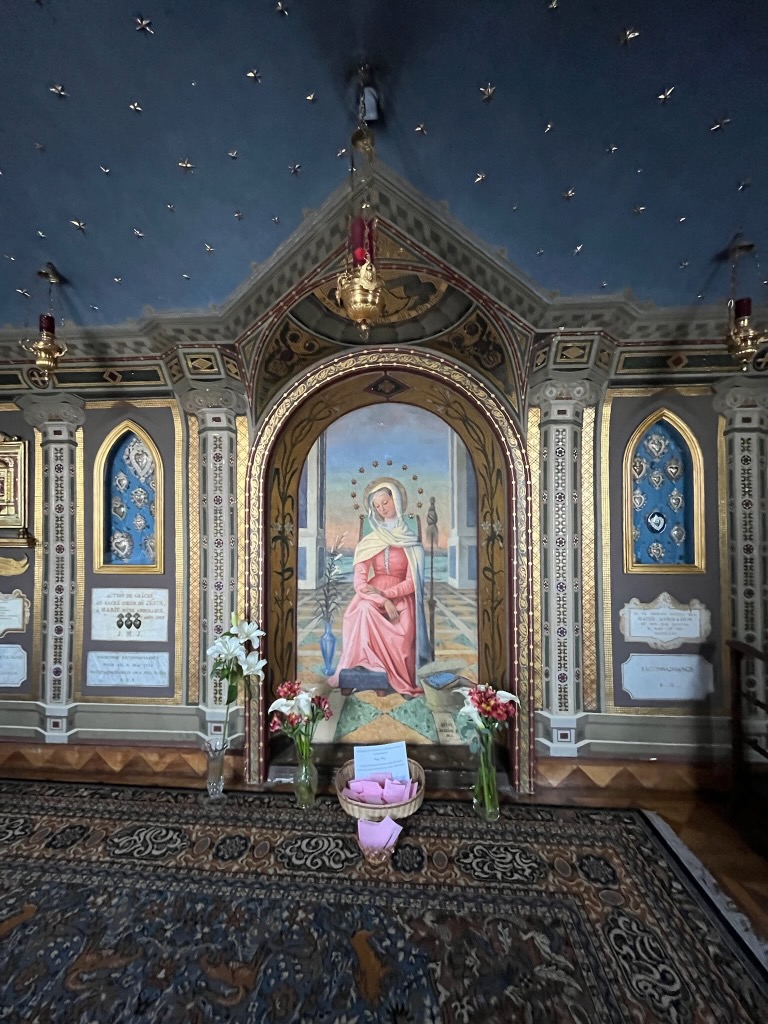
my mama, a girl who grew up in a convent where the nuns taught her to curtsy each time she dashed past the statue of the Pink Madonna (a story is told that one of the nuns–these are Sacred Heart nuns–once tried to paint a portrait of the Blessed Virgin Mary, and what she painted was so godawful, they tossed a rug over the thing, to hide it, and some time later when the rug was pulled off, lo and behold, there was a breathtakingly beautiful Mother of God decked out not in the usual blue but in pink. thus, the Pink Madonna that Sacred Heart girls (and their dutiful daughters) seek out whenever and wherever in the world they sense themselves in breathing distance of one of the few extant copies), my mama, as devout as the day is long, is far more radical than you might imagine for a girl who grew up in a convent in the most parochial burg of cincinnati, ohio. and that might be one of the things i treasure most about my mama.
and maybe that has something to do with my unwavering quest to find my way in this world along a path populated by sages, and not always of the churchly persuasion. i find holiness in unorthodox moments and places and, often, smack dab in the thick of a sentence.
i might not belong to a particular church these days. but i gather a goodly––and godly––congregation of pathfinders along my way. my church, quite often, rises up from the page.
i read, hour by hour, and day after day, with an eye out for wisdoms and truths, and guideposts to stir me. something akin to wandering an orchard, plucking from trees the lushest of fruits. i find my convictions deepened. my heart, often on fire. my intent: to make this blip that is my life as blessed as i can make it. i live by a gospel of love, one with an emphasis on that which is tender, and gentle not harsh. i believe, more and more, in humility. in understanding how little i know. and how much there is still for me to learn. to understand.
we live in a world that some days feels like it’s spewing all that i detest: there is cruelty, and hubris, and parading around as if no one else matters.
but then i open a book. or click on a text from a most blessed friend. and i read words that resonate. that underscore what seems to be Truth with a capital T. and i feel less alone, and less lost.
these are the lines that spoke to me this week in this holy space of my own making; one is from hafiz, the 14th-century sufi poet, another from thich nhat hanh, the blessed buddhist monk who died just two years ago, and the third is from greg boyle, the jesuit priest who founded Homeboy Industries, the world’s largest gang intervention and rehab program, based in east LA, and whose book, barking to the choir, is now on my most-wanted list.
first up, a prayer poem sent by a beloved friend, one from hafiz, the sufi poet, from a translation by daniel ladinsky, and which my blessed friend found in the pages of greg boyle’s barking to the choir:
Every child has known God, Not the God of names, Not the God of don’ts, Not the God who ever does anything weird, But the God who knows only four words. And keeps repeating them, saying: “Come Dance with Me, come dance.”
i love a God who whirls with me, who invites me into the dance.
next up, thich nhat hanh:
Understanding someone’s suffering is the best gift you can give another person. Understanding is love’s other name. If you don’t understand, you can’t love.
oh, that we should enter deep into the wounds of another. and therein find the walls of our own hearts widening and deepening, and our compulsion to hold a trembling hand the surest thing we can do.
and, finally, once down the greg boyle rabbit hole, i just got deeper and deeper, and then i found this:
“For unless love becomes tenderness—the connective tissue of love—it never becomes transformational. The tender doesn’t happen tomorrow . . . only now.”
photo above, of Mater Admirabilis, the Pink Madonna, is from our trip to rome back in may, during which, dutiful daughter that i am, i trekked to the top of the Spanish Steps, rang a bell at the convent of the sacred heart (my mother’s breed of nuns), turned over my passport for entry to the upper chapel where Our Lady resides, and beheld her.
in which the somnolence of summer has settled into its seasonal adagio so much so that pickling a red onion or two, and slow-reading the poetries and musings of one wendell berry is as fever-pitched as it gets around here. welcome to my slo-mo world of the week.
it started when i stumbled on the poem below, a poem that captures the quietude of a couplet of humans who’ve breathed in unison for so long they can fill the silence richly. so it is here in this old house of late, where only two of us now reside. where we know the choreography of most days by heart. and come and go as in a wordless waltz. there’s an ease now, one i never imagined, as i balked mightily long ago about the idea of two lives squeezed under one roof and in a labyrinth of too-tight rooms. but over time, across all these years (near 33), the respirations of our souls have aligned, at least enough to feel our echo in the lines below. those lines, by wendell berry, the poet, novelist, and conservation farmer whom i count as one of my heroes, were just enough to take me down the rabbit hole that is the life and work of kentucky’s homegrown literary treasure. and, besides, mr. berry’s birthday was this week, the fifth of august, wedged, it so happens, between the birthdays of two of the three humans whom i count as pillars holding up my world and whose arrivals to the planet are marked across the week in that steady beat of 4-6-8.
here’s the poem that got me started:
They Sit Together on the Porch By Wendell Berry
They sit together on the porch, the dark
Almost fallen, the house behind them dark.
Their supper done with, they have washed and dried
The dishes–only two plates now, two glasses,
Two knives, two forks, two spoons–small work for two.
She sits with her hands folded in her lap,
At rest. He smokes his pipe. They do not speak,
And when they speak at last it is to say
What each one knows the other knows. They have
One mind between them, now, that finally
For all its knowing will not exactly know
Which one goes first through the dark doorway, bidding
Goodnight, and which sits on a while alone.
i shared the verse with the one with whom i share these walls, and he wrote back that he found it “haunting,” which made me see the lines anew. and was just enough to prompt a bit more poking around, again reminded how much i love the poetries that come with accumulated lifelong wisdoms. and that’s where i then re-bumped into this 2019 dispatch from the new yorker, a days-long interview between bard and scribe, one distilled and put to paper. it’s worth a read in whole (link below will take you straight to it), but i’ll pluck a few parts should your summer’s day demand a snappier pace than mine (or should a paywall keep you out):
the dispatch, titled Going Home with Wendell Berry, is by amanda petrusich, a new yorker staff writer and writer-in-residence at the gallatin school of individualized study at NYU. a 2016 guggenheim fellow, she writes often about music, and blessedly for us she takes the occasional road trip down kentucky way. in this case, she wound her way to where berry’s farmed for more than four decades, a little town that goes by the name port royal. sixty-three miles from the dot in the blue-grass map my papa called home (paris, KY), and one mile from the meandering kentucky river, it’s a town you might think ol’ garrison keillor pulled from his imagination. (in 2010, its population, according to the U.S. Census, was all of 64 humans.) it’s a town one writer (sandra mcCracken, a singer-songwriter) described thusly (and not too surprisingly given the threadworn quilt that is rural america these days): “Port Royal is a patchwork strip of storefronts, a blink-and-you’ll-miss-it sort of spot made up of a local bank, a post office, a general store with a built-in diner (with little printed signs about their town’s famous author, Wendell Berry), and an old Baptist church. I am sad to report that, like most small towns in our country, Port Royal looks as though it is dying.”
here’s how the new yorker‘s chronicling of that luscious conversation between journalist (petrusich) and poet (berry) begins:
Two and a half years ago, feeling existentially adrift about the future of the planet, I sent a letter to Wendell Berry, hoping he might have answers. Berry has published more than eighty books of poetry, fiction, essays, and criticism, but he’s perhaps best known for “The Unsettling of America,” a book-length polemic, from 1977, which argues that responsible, small-scale agriculture is essential to the preservation of the land and the culture. The book felt radical in its day; to a contemporary reader, it is almost absurdly prescient. Berry, who is now eighty-four, does not own a computer or a cell phone, and his landline is not connected to an answering machine. We corresponded by mail for a year, and in November, 2018, he invited me to visit him at his farmhouse, in Port Royal, a small community in Henry County, Kentucky, with a population of less than a hundred.
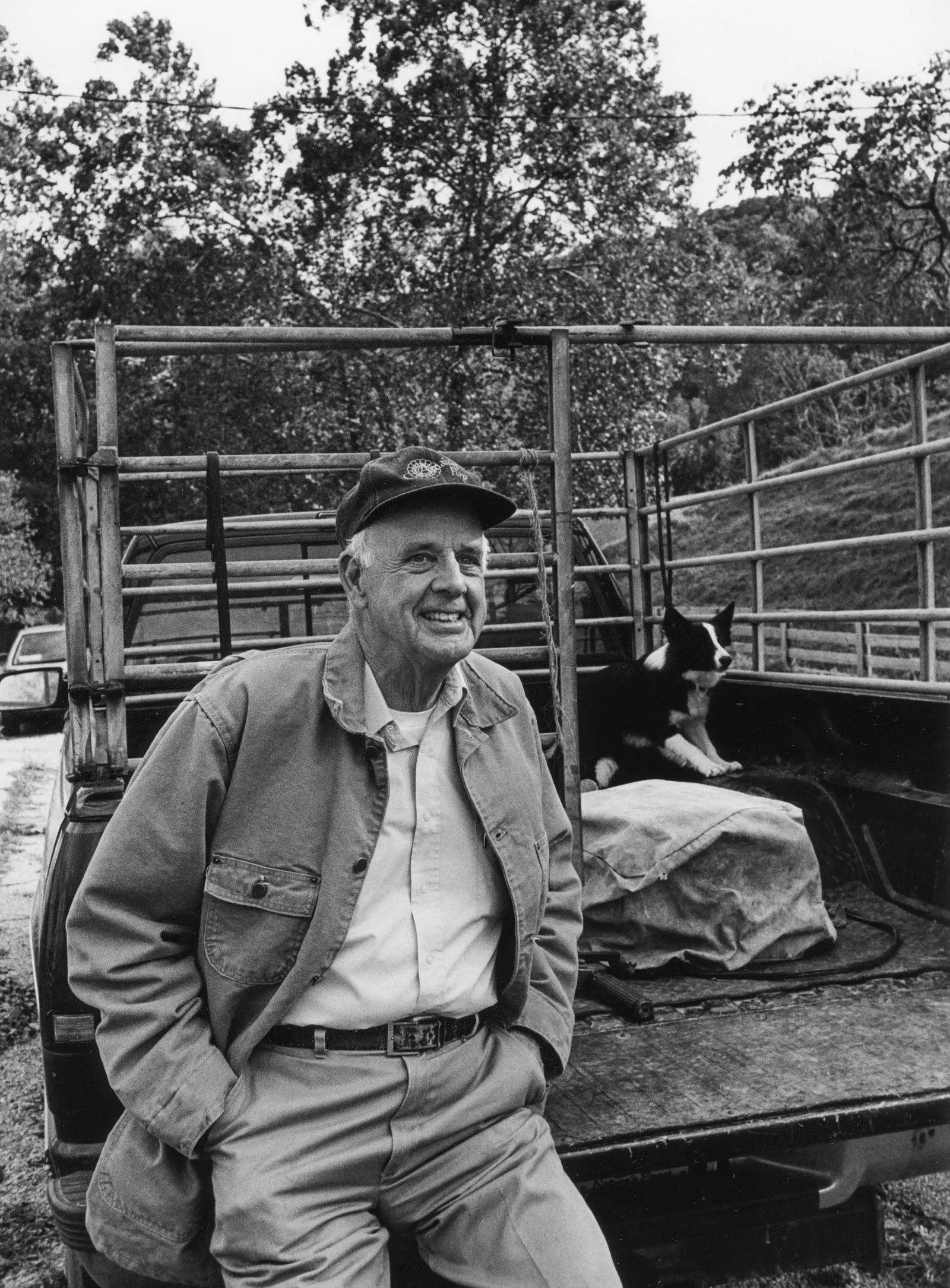
Berry and his wife, Tanya, received me with exceptional kindness, and fed me well. Berry takes conversation seriously, and our talks in his book-lined parlor were extensive and occasionally vulnerable. One afternoon, he offered to drive me around Port Royal in his pickup truck to show me a few sights: the encroachment of cash crops like soybeans and corn on nearby farms, the small cemetery where his parents are buried, his writing studio, on the Kentucky River. Berry’s connection to his home is profound—several of his novels and short stories are set in “Port William,” a semi-fictionalized version of Port Royal—and his children now run the Berry Center, a nonprofit dedicated to educating local communities about sustainable agriculture. Our correspondence would continue, but, before I left, Berry gave me a broadside letterpress of his poem “A Vision.” I think often of some of its final lines, which clarify, for me, what it means to truly know a place:
Memory, native to this valley, will spread over it like a grove, and memory will grow into legend, legend into song, song into sacrament.
here’s but one of the questions captured from their conversation (with a few lines in bold for emphasis):
Q: Have you always farmed here?
A: Right away, we had a large garden, and we kept two milk cows. We fattened two hogs to slaughter, for our own meat. We had a flock of chickens. And we had some fruit that we produced ourselves, and some that was wild. We were sitting down during that time to a lot of meals that came entirely from under our own feet by our own effort. And our children came up in that way of living. The integration of the various animals and crops into a relatively small acreage becomes a formal problem that is just as interesting and just as demanding as the arrangement of the parts of a novel. You’ve got to decide what comes first, and then you work your way to the revelation of what comes last. But the parts also have to be ordered. And if they’re ordered properly on a farm, something even more miraculous than most art happens: you have sustainability. Each thing supports the whole thing.
and here’s another exchange:
Q: It’s funny, clarity is often undervalued in art. One of the things I admire about your writing, especially the essays, which feel like polemics, is that you’re very clear in your arguments. They’re beautifully supported. In the new book, you talk about how you often read seeking instruction. I’m curious how you balance that idea with reading for beauty, savoring the visceral pleasure of words.
A: You’re being fed in an essential way by the beauty of things you read and hear and look at. A well-made sentence, I think, is a thing of beauty. But then, a well-farmed farm also can feed a need for beauty. In my short story “The Art of Loading Brush,” when Andy Catlett and his brother go to a neighbor’s farm, there’s a wagonload of junk, and it’s beautifully loaded. Andy’s brother says, “He couldn’t make an ugly job of work to save his life.” In the epigraph I use from Aldo Leopold he questions if there’s any real distinction between esthetics and economics.
and here, in case you’re even a little bit hooked, is a poem worth reading in whole. it’s from a 1965 volume of Poetry magazine, and it’s excerpts from an early Berry wonder, titled, “The Handing Down,” a poem about a grandfather and grandson sitting on a porch and the quiet conversation that unspools between them. read those excerpts here.
oh, and about those onions. . . my kid, the one who turned 23 yesterday, finds himself a line cook these days at a chicago eatery of some notoriety; girl and the goat, it’s called, and stephanie izard, who dreamed up the joint seems to have a particular fondness for things pickled. she pickles everything from kumquats to mushrooms to beets. i decided pickled red onions might be a summery thing to do, and besides i like a little crunch amid the strata of my sandwich. and, as with many a task in my kitchen, i pickle the easy way. no cauldrons steaming for me. no sterilizing jars and lids. i dumped a little of this, stirred in some of that, and by next morning, i had a jar of garnet rings shimmering in my fridge. i’m not fond of sugar these days (i never was, and then a dear friend told me cancer is fond of sugar, making it something of a foe of mine, thus i’ve perma-sealed my lips to sugar’s sweetness), so i searched for pickling roadmap that steered clear of the sugar bin. here’s what i found: (and ps i have no real clue what whole30 compliant means, so feel free to disregard.)
what captured your fancy this week, quick-clipped or slow?
forty-four cakes. three-thousand-two-hundred-seventy-eight candles. that’s how many cakes and candles we’ve missed since my papa died in the winter of 1981. i counted it up because today would have been his 96th birthday. he didn’t make it past 52.
all these years later the second of august is still a day i remember.
i remember the sunny sunday mornings when honeydew melon and handmade cards were strewn at his place at the dining room table, birthday brunch a step-up from the requisite eggs, bacon, and toast after ten-o’clock mass. i remember, in the preambles to birthday dinner, the glistening of his pewter mug, summer’s sultry humidity meeting the cold of his ice cubes and tonic and gin. the quarter of lime floating canoe-like near the rim. eight-minute burgers on the grill, corn on the cob littering all of our chins.
i remember his laugh.
much, though, fades.
i can’t remember the sound of his voice. or the way he called me barbie. i remember a few lines, but not the ones my brothers often remember. i remember the time he told me he’d prayed and prayed and could not understand why he was driving me to the hospital. i remember the time, driving home from my college graduation, when he told me he’d felt his mother right beside him when they called out the names of those who, like him long before, were graduating with highest latin honors, and he watched me rise from my seat in the crowded arena.
i remember how one late summer’s afternoon he called me from the office and asked me to meet him for burgers on the outdoor cafe of a place called jerome’s in lincoln park, a place he deemed “kicky.” my papa liked things that were “kicky” or “cool.” my papa, born of a locomotive engineer and a country school teacher in little bitty paris, kentucky, never shed the marvel of being a big-city ad man in the heady era of Mad Men and martini lunches and sixty-second commercials whose jingles and cutlines stoked the soundtrack of america’s bell-bottomed woodstock-and-watergate age. my papa liked to travel the globe. to give speeches in sydney and meetings in munich. he liked his corporate apartment in mid-town manhattan. he loved new york city. a place he never wanted to move us; he’d moved his moptop crew too many times, he and my mama agreed. one more uprooting might do us in. so he more or less made a weekly commute to the big juicy apple.
and home base for all those years was the two-story colonial with all the big trees at the bend in the dead-end lane. he brought the “neat, keen, cool, fab, it’s a blast” to our dutch backdoor, and on in to the big oval table where, at 6:30 sharp each night of the week except for on sunday when we pushed it to 5:30, we sat down for dinner, all seven of us. if there was something new out there in the world, my papa wanted us to know. didn’t matter if it was a word or a box soon to be labeled “hamburger helper.” he was our conduit, our passport, to all that was grander and jazzier than our sleepy little burg one in from the lake.
those are the things, all these decades later, i still remember––like yesterday. i remember, too, the year after he died when i thought i might never stop crying. how there were nights when i wailed a wild-animal sort of a wail, and bit into my pillow to muffle the sound. i never thought i would know joy again.
i never thought the ache would stop aching.
but here we are: two kids, a long marriage, and a whole career later. my papa had no idea i––a nurse when he died––would take his and my shared love of words and make a life of it. but the first day i sat down in the chicago tribune newsroom and they told me i needed a password, i knew just what i’d type each time i needed to rev up my desktop computer: my papa’s initials and mine; he was a part of every start to every story. and i never dropped his last name, cuz i wanted my papa to stay in the news. and in print. day after day. byline by byline.
here’s where i fell short: no matter how many stories i’ve told my boys and the man i love the most, i have not come close to bringing my papa to life. and, believe me, i’ve tried. no story, no matter how animated, no matter the gleam in my eye, can ever, ever come close. the man was a human high-wattage bulb. he was known for his wit. but i remember the tenderest parts. i’ve tried to bring all of it forth over the years.
but all these years later, it fades. and the truth is, my papa fades too. there’s too much i cannot remember.
grief and time make for an odd, sometimes cruel calculus. yes, the aching abates most of the time. though the piercing can come and come strong. in a grocery aisle. when a certain song comes on. when you’re trying to tell––or to catch every word of––a particular story. (writing these words here this morning, the tears have come too. if i’ve wallowed in moments, in memories, here, it’s only to make it all last. to live in those moments again.)
as much as the gasping for air is no longer a part of the grief, so too the frames of a life reel on, and the erasing begins. after so, so many years, you sometimes forget the one who’s no longer there. not always, and not in those crucible moments, when time itself feels condensed and magnified all at once. i too have felt my papa beside me when my firstborn walked a graduation stage; when my firstborn became a professor of law (a profession my papa once yearned for). i’ve watched how tender my so-called “little one” is, especially to my papa’s widow (“grammy” to both of my boys), and i know my papa would melt. but, truth is, ordinary time mostly hurls by, and i don’t remember. and then i might catch myself with a twinge. or i might not catch myself at all. there’s an anesthesia in grief that i never saw coming. maybe it saves us. maybe it’s cruel.
maybe that’s why there are birthdays, even when the someone is gone. especially when someone is gone. they become remembering days. they are days without cakes and no candles. but, in the silent chambers of the heart and the mind and the soul where time knows no rules, those someones return.
my papa rumbles in me this morning. in the only way i know how, i just brought him back. and i didn’t need to close my eyes, or make a wish, or blow out candles to make it happen.
he’s here. right beside me. in each of these stories. i know it.
happy birthday, dear papa. i love you forever.
at our house, we have an august birthday parade, a 2-4-6-8 of celebrations. so most blessed of birthdays i wish for my brother david (4), my blair(6), my teddy(8). i love you each and all to the moon and mars and beyond.…
tell a story of any someone you miss. any story. any someone. we’ll make this a party.






 pull up a chair