pull up a chair

where wisdom gathers, poetry unfolds and divine light is sparked…

Month: June, 2024

where my rabbit hole led me this week. . .

one in a series of summertime esoterica, in which for no particular reason my attention is drawn to this, that, or the other thing…

deep in my summertime poking-around ways, a pursuit of reading akin to ambling barefoot through dew-sodden grass, i found myself the other day burrowing into a rabbit hole, following the trail of a late-19th-century theologian with radical ideas and gloriously poetic prayers. (i might just as effortlessly follow the trail of what to do with too much zucchini, or why banana-peel-steeped waters are so fine for my fledgling tomatoes…it’s a carousel of wonders here on curiosity row…)

walter rauschenbusch (1861-1918)

the theologian of the week, here in rabbit-hole land, is one walter rauschenbusch, the late 19th-century clergyman and theologian who led the Social Gospel movement in the U.S., and whose work is said to have influenced a litany of great 20th-century social-justice warriors, among them martin luther king jr., desmond tutu, lucy randolph mason, reinhold niebuhr, and george mcgovern. his animating idea was that not just individuals but the whole of society needed to work toward what he termed “the kingdom of God” on earth, a place where justice and peace as well as equal rights and a democratic distribution of economic power were holy and necessary works, ones that demanded constant and unrelenting effort. 

rauschenbusch’s radical theology, it seems, was informed by eleven years working as a baptist pastor in NYC’s aptly-named Hell’s Kitchen, where he presided over the funerals of hundreds of children who died from the ravages of impoverishment—malnutrition, domestic violence spurred by overcrowded tenements, or any of the other ills born of economic destitution. 

rauschenbusch wrote: “I began to realize that God hates injustice and that I would be quenching God’s spirit within me if I kept silent with all of the social sin of the world around me.”

of the hundreds of children’s funerals over which rauschenbusch presided (many of them for children younger than five), he wrote:

“At each funeral I would find myself crying out to God, ‘Why do the children have to suffer in this manner?’ I recall on one occasion one of the church members, a single father who worked at a factory for 12 hours each day. His daughter was dying at home and calling out for her daddy. The employer refused to allow the father to go home to be with his daughter in her last hours.

“It was not uncommon to see grown men near our church just begging for work, just so they and their families could survive.

“It was in this context that I began to understand sin in a new and radical way. Baptists had always been known as railing and condemning the sins of alcoholism, smoking, gambling, and sexual promiscuity, such as were exemplified in the lives of the many prostitutes who lived and worked very close to our church. . . .

“The radical conclusion that I came to was this: all of these personal sins which were so obvious to everyone were somehow connected to the sin of structural injustice. So many people saw no hope, no way to extricate themselves from their living hell, their dead-end street. So many would resort to alcoholism. Women would feel compelled to become a prostitute so they could feed themselves and their families. Charles Dickens in his writings helped us see and somewhat feel the environment that could ensnare anyone who was trapped in a world of deprivation and desperation.

“The less obvious sins to most Baptists and other conservative leaders were those that were represented by the vast gulf between those who were extremely opulent, you might say ‘filthy rich,’ and the vast majority of people who were barely able (and oftentimes not able) to get by.”

finding wisdoms from the past for these arduous times is, perhaps, too futile a pursuit. but i believe in the endosperm of hope. and rauschenbusch’s prayers––and his theology––seem apt for a dusting off. and, besides, his prayers are beautifully wrought.

my eye was caught first by one of those prayers, the evening prayer (below) but as i kept reading it was the line above––“I began to realize that God hates injustice and that I would be quenching God’s spirit within me if I kept silent with all of the social sin of the world around me.”––and the children’s funerals that informed it, that clutched me at the gut and won’t let go.

here, as a place to begin, is but one of his prayers, with particular resonance for one who delights in all of creation, especially the trials and triumphs just beyond my own back door:

FOR OUR WORLD, OUR EARTH

O God, we thank You for this universe, our great home; for the vastness and richness of our cosmic environment; for the manifoldness of life on the planet of which we are a part.

We are thankful for the morning sun and the clouds and the constellations of stars.

We rejoice in the salt sea and the deep waters and green leaves of grass.

We thank You for our sense by which we experience earth’s splendor.

We would have souls open to all this joy, souls saved from being so weighted with care that we pass unseeing when the thornbush by the wayside is aflame with beauty.

Enlarge within us a sense of fellowship with all that lives and moves and has being in space and time, especially with all who share this earth as their common home with us.

Remembering with shame that in the past, we human beings have all too often exercised high dominion with ruthless cruelty, we admit that the voice of the earth, which should have gone up to You in song, has been a groan of travail.

May we so live that our world may not be ravished by our greed nor spoiled by our ignorance.

May we hand on earth’s common heritage of life, undiminished in joy when our bodies return in peace to You, our Great Mother who has nourished them.

and here is the beginning of his evening prayer: 

LORD, we praise thee for our sister, the Night, who folds all the tired folk of the earth in her comfortable robe of darkness and gives them sleep. Release now the strained limbs of toil and smooth the brow of care. Grant us the refreshing draught of forgetfulness that we may rise in the morning with a smile on our face. Comfort and ease those who toss wakeful on a bed of pain, or whose aching nerves crave sleep and find it not. Save them from evil or despondent thoughts in the long darkness, and teach them so to lean on thy all-pervading life and love, that their souls may grow tranquil and their bodies, too, may rest. And now through thee we send Good Night to all our brothers and sisters near and far, and pray for peace upon all the earth.

if you’re interested, here’s a link to a PDF of rauschenbusch’s 1910 collection of prayers, For God and the People: Prayers of the Social Awakening.

in the book’s preface, rauschenbusch explained the collection’s genesis: “The language of prayer always clings to the antique for the sake of dignity, and plain reference to modern facts and contrivances jars the ear. So we are inclined to follow the broad avenues beaten by the feet of many generations when we approach God. We need to blaze new paths to God for the feet of modern [women and] men.”

amen, pastor rauschenbusch, amen.


as long as we’re quoting old white men, i admit to being an admirer of the writings of that old-time radio humorist garrison keillor, who has mellowed beyond measure with age. in an ode to summer’s slow pace the other day, he wrote this about morning light, one of the blessings that comes with waking early, a habit i consider essential to the deep breathing of my soul:

It’s a revelation of delight, of our Creator’s delight in His creation, and though we’re brought up to be skeptical, wary of big hopes, prepared to deal with the injustices of life, still the dawn light argues with stoicism and you see the beauty of the ordinary


what ordinary beauties or big ideas captured your imagination this week?

and here’s a harder question (to ponder in your own soul): what shall we do so as not to stay silent in the face of the social sin of the world?

and happy blessed blessed day to my beloved andrea, who makes me laugh hard and often, and whose goodness seems vaster than the circumference of this big blue globe. (A is one of the chair friends who reads dutifully nearly every week, and more often than not sends along a note that melts me or makes me laugh every time…)

of darkness and sunlight in shifting proportion

night was on my mind this week, as the sunlight upon us stretched to its longest shift of the year, the apex of the solstice on thursday, and now the night grows longer minute by minute till winter’s solstice takes its turn, a doh-si-doh of celestial bodies. the interplay of light and shadow is eternal, has been, according to genesis, since the beginning, day one. and it was good. 

it might seem counterintuitive to contemplate night when the day is at its longest, but it’s often through the paradoxical that insights are gleaned. a wise and soulful priest pointed me toward considering the illuminations that come in darkness, at a saturday morning retreat in the great gothic-revival church that so often stirs me these days. 

and then through the week, i kept stumbling on poems that made me marvel, made me think deep and deeper of the hours of darkness. here are two: 

The night never wants to end, to give itself over
to light. So it traps itself in things: obsidian, crows.
Even on summer solstice, the day of light’s great
triumph, where fields of sunflowers guzzle in the sun—
we break open the watermelon and spit out
black seeds, bits of night glistening on the grass.

––Night in Day by Joseph Stroud

Night Ferry
by John Burnside

Had I been less prepared, I would have left
in springtime, when the plum tree in the yard
was still in bloom,
the windows open after months of snow,
one magpie in the road
and then another.

I could have slipped away, late afternoon,
while everyone was busy somewhere else,
the fish van at the corner, children
dawdling home from school
in twos and threes, a porch light
lit against the dusk on Tollbooth Wynd.

Give me these years again and I will
spend them wisely.
Done with the compass; done, now, with the chart.
The ferry at the dock, lit
stern to prow,
the next life like a footfall in my heart.

it’s the last stanza of burnside’s that spoke to me most profoundly. “give me these years again and I will / spend them wisely.”

and then, with celestial bodies on my mind, i stumbled onto john burroughs, the naturalist whose wisdoms and poetries never fail to stir me. 

“If I had my life to live over again, and had my choice of celestial bodies, I am sure I should take this planet, and iI should choose these men and women for my friends and companions. This great rolling sphere with its sky, its stars, its sunrises and sunsets, and with its outlook into infinity — what could be more desirable? What more satisfying? Garlanded by the seasons, embosomed in sidereal influences, thrilling with continents — one might ransack the heavens in vain for a better or more picturesque abode.” — John Burroughs 


but mostly this week i indulged in the sunlight of one of the oldest, dearest friends i have on this planet: my roommate in college, my roommate after college, my maid of honor, godmother to my firstborn, and my heartmate and soulmate through life’s most scouring hours. she’s a california girl, blond still (naturally so), and more beautiful than ever, and she married a man who might be the twin separated at birth from the one i married. not only do they both wear the exact same spectacles, they both dress in old-line khakis and oxford-cloth shirts, and think deeply about the subjects they love (film for the one from LA; bricks, mortar, and marble for the one i married) as well as the ideas that animate the life of the mind. we played, the four of us, at being playful: took long walks through woodsy ravines, gobbled ice cream from cones, motored downtown to see georgia o’keeffe at the art institute, and before we got there stumbled into one of the world’s great symphony orchestras rehearsing schumann’s piano concerto in frank gehry’s bandshell with someone billed as one of the world’s greatest pianist. all for free. and all in the sunlight.

and tomorrow, my firstborn marks another spin around the sun at the center of it all. there are not enough blessings under that sun for me to wish and hope and pray for my boy, but i wish every last one for him and his heart and his soul and his dreams. happy blessed life, you who made me a mama.

how did you mark the solstice, the day when the sunlight shines longest?

settling in and summer serendipities

clippers, shovel, trowel. those are the implements of my tranquility. of returning to my roost and sinking in my roots.

i’m back from travels far and farther. old home seeps into all the crags and crevices. knows me as intimately as any living soul. the familiarity of this old house’s creaks and cracks, the way the one floorboard at the top of the stairs whines its arthritic whine (you too might whine if, for a good 85 years, you’d been underfoot to the clumsiness and weighty soles of so many), the way the light falls in at the same afternoon hour day after day and casts a halo on the old clock that never chimes the proper hour, it all is home to me. and it all comes rushing in, as if a tide pool filling once again, oozing into hollow parts now on their way toward sated.

i loved the adventure of my travels. loved being nursemaid to my boy. but coming home is, in deep down ways, where i belong. it’s in this old house that i finally found my peace. and, every time, it soothes me, quietly awaits me.

tasha tudor’s thumbelina

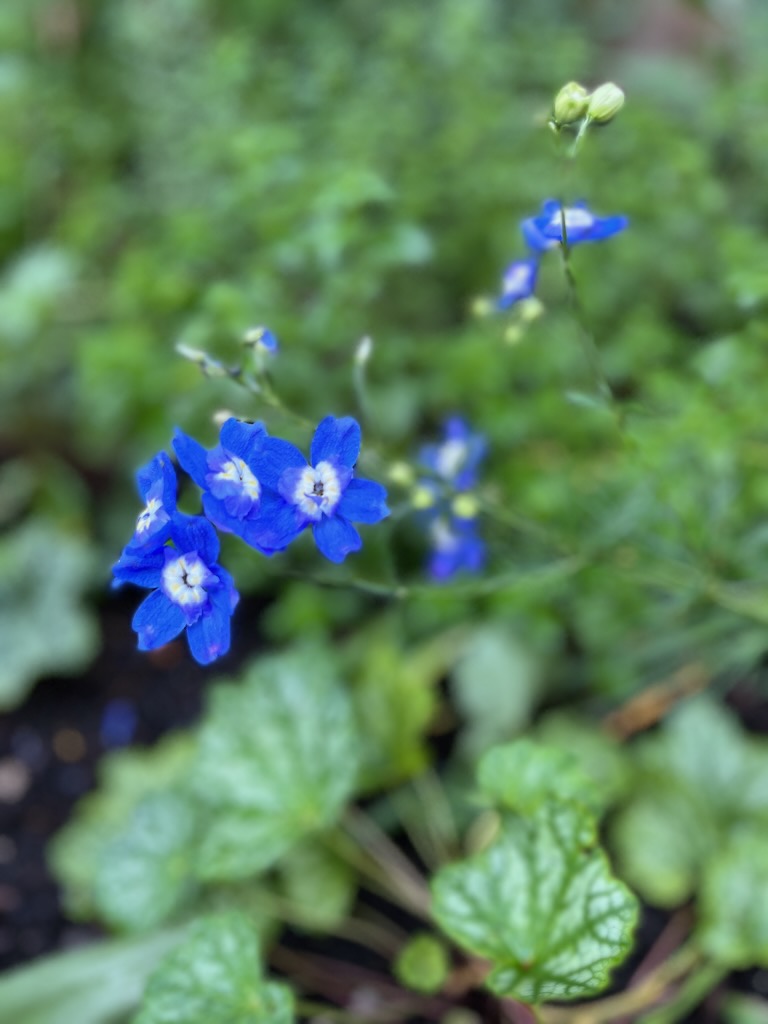
the garden, most of all, is living breathing companion. more than just a place to dig and poke, it almost speaks to me in whispers. delights me. returns the favour of my attention with its unfurled petals, its landing spot for bumblebee and butterfly and red-breasted robin. as one schooled in the storybook pages of tasha tudor, kate greenaway, and the norton anthology of children’s poetry, i honed early on my imagination’s muscles (thank you, mama). i spy a delphinium in bloom, a bloom as cobalt blue as neptune is thought to be, and i am certain an elfin soul will soon be stretching out a hammock from stem to stem down there where ladybugs and caterpillars roam. and so the garden to me is endless canvas of delight, whimsy, and unfolding tale, as if i’m something of the puppeteer to my plantings.

i relish sinking back into the rhythms of my chores: the way i stack the mugs, the wee bouquets i tuck around the house, the shopping list i know by heart.

all of it serves to cradle me. tells me i’m home where i belong.

the world and its adventures will be mine again, should i choose to wander. but for now, the summer––and the cicada––are upon us, and the tempo’s slowed, and my tank feels very much in need of filling.

i intend to surrender to summer, and let the whimsies steer me. i might not write each friday. i might write wednesdays instead. i might go a spell in silence. i might write in the middle of some night.

the point is, summer plays best in serendipitous tones. and i intend to listen. and to play along.

what will you do new this summer?

delphinium: the very definition of blue

that inextinguishable instinct

post-tonsillectomy children’s memorial, january 2000

dispatch from 20037. . .

two dozen years ago, a little guy I loved, a little guy of six, was wheeled down a long hallway to have his tonsils plucked. i walked the whole long way beside his gurney, straight into the OR, where they let me hold his hand till they were ready to send him off to dreamless land. and then, back I walked to wait, eyes awash with tears.

just now, that same kid was wheeled away again. and I, the nurse who flew in from chicago because I couldn’t imagine being even a mile away, was by his side. This time, though, I skipped the long walk, and no tears.

I seem to have been born hardwired to not stay far away, not when someone I love is being wheeled down long hallways, and the day begins at 4:45 a.m.

It’s an urge as irrepressible as anything I know. So much of mothering comes to me instinctively, without the synaptic pause that populates most thought. I leap before I think—leap into the fire, into the deep end, into wherever is the urgency. I don’t know how not to. And, yes, maybe sometimes I’m too much. And maybe I’m unnecessary. Or redundant. But where is there room for redundancy or un-necessity in the chambers of the heart?

Among the breaths of my life that I relish most, being by the side of the ones I birthed will always, always, be my most precious, most savored.

And so, in living my days with all I’ve got, this blessed day, being plopped in this hard chair, in this cacophonous waiting room in downtown DC, is one I will always hold so close to my heart. Truth is, I pray for as many of these sorts of days as time will give me. And as long as I can be there to plant one last kiss on the forehead I have loved since the hour of his birth, I am going to board all the planes, trains, and automobiles to get me here.

And now I’m signing off to keep my holy vigil.

xox

No need for any worries; all will be well here in the nation’s capital. Trust me on that.

PSS my uppers and lowers are a jumble today because I’m typing in my wee phone and can’t stop the gremlins from insisting on at least some proper capitalization.