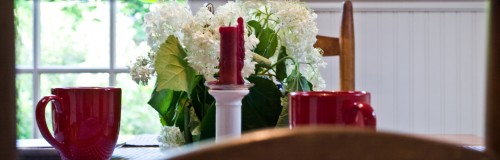
in the silence . . .

in the long tradition of seekers and sages, silence is a constant. a leitmotif maybe. a rhythm that ebbs and flows. it is into the silence that we surrender to enter the depths of our soul, the unencumbered spaces where whispers are heard, where the stirring comes.
in silence, the earthly noise is muffled. we tune our inner ear, the one that’s tied to the soul. the one that allows the sacred to find its way in.
and so, on this day, this good friday, a day long held in silence for me, i will make room for that long quenching that comes when i am alone in the depths, in the stillness.
this is the first holy week in a very long time where the braiding of the two traditions that animate this old house — jewish passover and christian easter — are not entwined. easter i only recently learned falls on the first sunday after the first full moon following the vernal equinox. passover, though, always begins on a full moon, the 15th day of the month of nisan on the hebrew calendar, and because the lunar and solar calendars are marching to their own separate tunes, every once in a while there is a good bit of moon between the two holidays.
so this year, i will be deep in good friday all day, as i was deep in holy thursday last night, the breathtakingly spare hour when, in a nod to jesus’ last supper, a seder in which he knew he would be betrayed by one of his closest twelve, and retreated to the garden of gethsemane to weep and to pray, the whole church was stripped of ornament and color. the altar was washed, the vestments of priest and deacon and choir were removed. every candle was snuffed. we left the church in thick silence.
my own blessed mother held this day, this good friday, in a reverence that seeped early on into the depths of me. silence was kept from noon till the hour of jesus’ death on the cross, which we somehow had determined was three in the afternoon. and so, all these years later, i keep that silence.
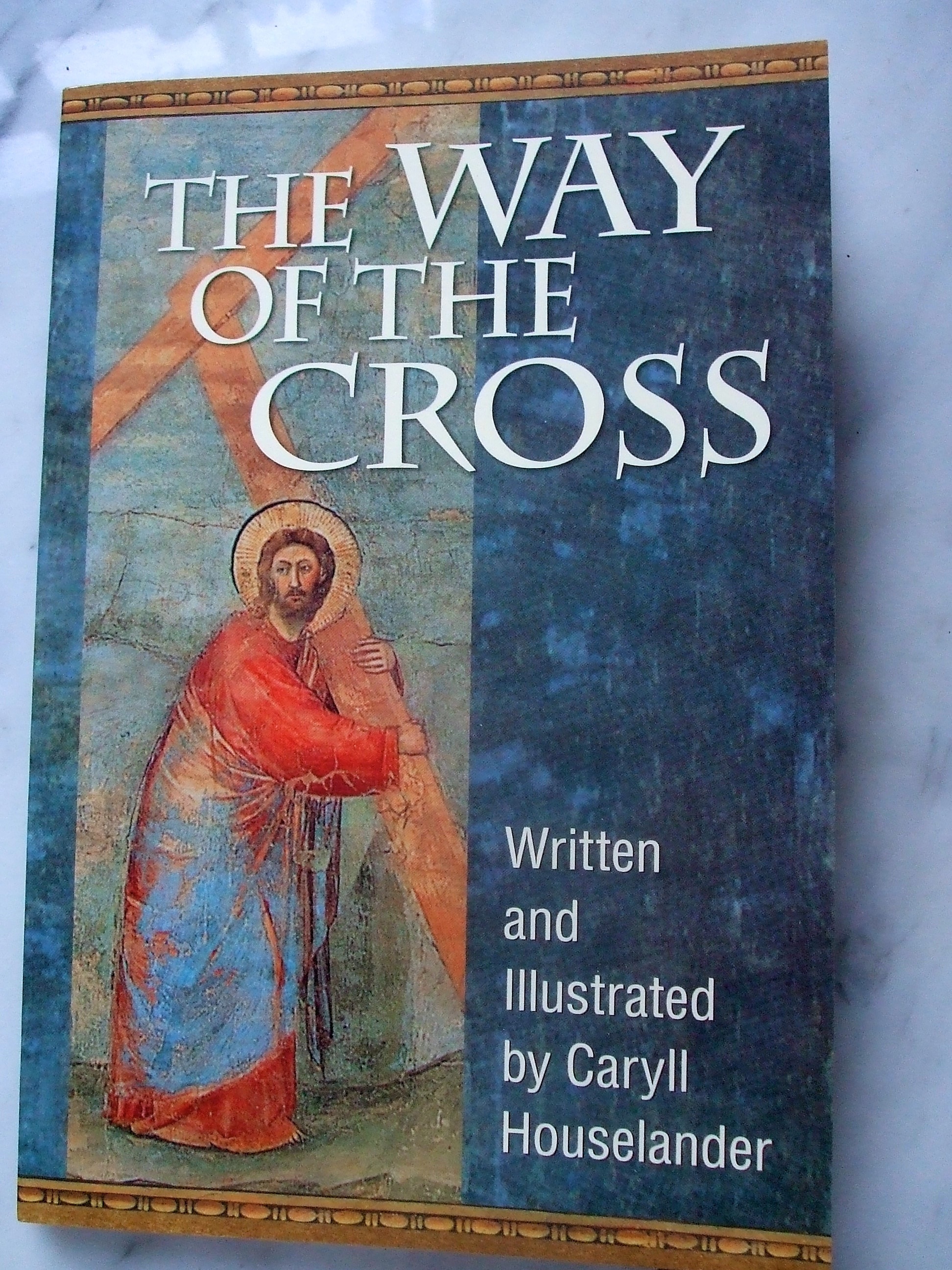
most often i take to my window seat, the perch looking out into the trees. i will pick up my caryll houselander, the 20th-century mystic whose words penetrate me like no other, her meditations on the stations of the cross, the dusty desolate path of jesus’ walk to the hill of golgotha, the hill where he would die.
there is much to pray on and for this year. the brokenness, the darkness, is plenty. and all we’ve got to begin to mend the brokenness, to kindle a flickering light in the darkness, is the small but inextinguishable capacity of whatever antidotes we can muster: the smallest kindness; the rare attention to someone else’s suffering; the unexpected delivery of joy.
we can, in our pointillist way, drop dot upon dot of goodness onto the canvas that is our moment in time on this planet. hope stirs as long as we can stand in the face of darkness, and muscle our few and feeble yet insuppressible defiances: we will not surrender to those forces we know to be counter to the sacred; we will not let all the light be extinguished. we are our own last best hopes for the world we imagine. and i will enter into the silence and the depths of the sorrow today to chart my way toward whatever light i can muster.
so help me God.
because it is increasingly my way to bring you the voices of souls far wiser and deeper than i might ever be, i have gathered up a few who stirred me this week.
first up, henri nouwen, restless seeker, priest and theologian, comes along, as antidote to so much suffering, reminding us–in one of his most indelible passages–to be surprised by joy:
Learn the discipline of being surprised not by suffering but by joy. As we grow old . . . there is suffering ahead of us, immense suffering, a suffering that will continue to tempt us to think that we have chosen the wrong road. . . . But don’t be surprised by pain. Be surprised by joy, be surprised by the little flower that shows its beauty in the midst of a barren desert, and be surprised by the immense healing power that keeps bursting forth like springs of fresh water from the depth of our pain.
henri nouwen
and praying this isn’t too dark, this epiphany from louise erdrich‘s the painted drum:
Life will break you. Nobody can protect you from that, and living alone won’t either, for solitude will also break you with its yearning. You have to love. You have to feel. It is the reason you are here on earth. You are here to risk your heart. You are here to be swallowed up. And when it happens that you are broken, or betrayed, or left, or hurt, or death brushes near, let yourself sit by an apple tree and listen to the apples falling all around you in heaps, wasting their sweetness. Tell yourself that you tasted as many as you could.
louise erdrich
and, bon mot for all who love poetry and find it endlessly a wonder, this from david hinton, chinese literature scholar:
Poetry is the cosmos awakened to itself. Narrative, reportage, explanation, idea: language is the medium of self-identity, and we normally live within that clutch of identity, identity that seems to look out at and think about the Cosmos as if from some outside space. But poetry pares language down to a bare minimum, thereby opening it to silence. And it is there in the margins of silence that poetry finds its deepest possibilities — for there it can render dimensions of consciousness that are much more expansive than that identity-center, primal dimensions of consciousness as the Cosmos awakened to itself. At least this is true for classical Chinese poetry, shaped as it is by Taoist and Ch’an (Zen) Buddhist thought into a form of spiritual practice. In its deepest possibilities, its inner wilds, poetry is the Cosmos awakened to itself — and the history of that awakening begins where the Cosmos begins.
where were you surprised by joy this week? and — only to ask yourself — what might you bring to this world today to turn back the darkness, to begin to mend the brokenness?

 pull up a chair